
睡眠时间短与心脑血管疾病发病的相关性:一项在中国上海开展的前瞻性队列研究。
Short sleep duration associated with the incidence of cardio-cerebral vascular disease: a prospective cohort study in Shanghai, China.
机构信息
Pudong New Area Center for Disease Control and Prevention, Pudong Institute of Preventive Medicine, Fudan University, 3039 Zhangyang Rd, Shanghai, 200136, P. R. China.
出版信息
BMC Cardiovasc Disord. 2023 Mar 31;23(1):177. doi: 10.1186/s12872-023-03205-y.
IMPORTANCE
Sleep duration plays an important role in predicting CCVD incidence, and have implications for reducing the burden of CCVD. However, the association between sleep duration and predicted cardio-cerebral vascular diseases (CCVD) risk remains to be fully understood.
OBJECTIVE
To investigate the effects of sleep duration on the development of CCVD among Chinese community residents.
DESIGN
A prospective cohort study. The baseline survey was conducted from January 2013 to July 2013. The cohort has been followed until December 31, 2016 using a combination of in-person interviews and record linkages with the vital registry of Pudong New Area, Shanghai, China.
SUBJECTS
A total of 8245 Chinese community residents were initially enrolled in the cohort. Of those, 6298 underwent the follow-up examination.
EXPOSURE
Self-reported sleep duration and sleep quality were obtained via the questionnaire. Sleep duration was divided into five categories: ≤5, 6, 7, 8, or ≥ 9 h per day.
MAIN OUTCOME(S) AND MEASURE(S): CCVD, Coronary heart disease (CHD) and Stroke occurrence, Hazard ratios (HRs) and 95% confidence intervals (95% CIs) were calculated using Fine-Gray proportional subdistribution hazards models.
RESULTS
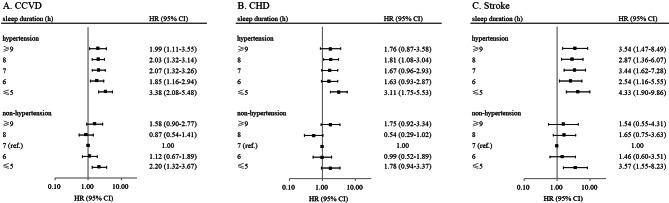
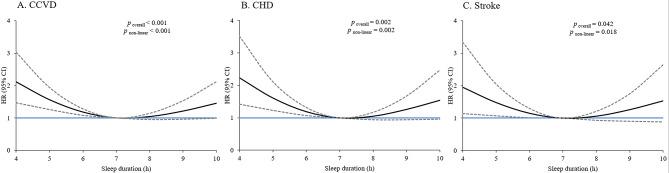
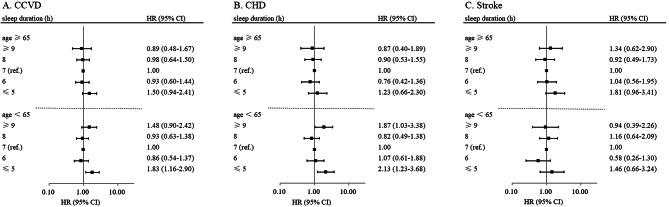
During a median follow-up of 3.00 years (IQR 2.92-3.08), we observed 370 participants have had incident CCVD events, of whom 230 had CHDs, 169 had strokes, and 29 had both. After adjustment for relevant confounders, short sleepers (≤ 5 h) had 83% higher risk of total CCVD incidence (HR: 1.83; 95% CI: 1.32-2.54), 82% higher risk of CHD incidence (HR: 1.82; 95% CI: 1.21-2.75), and 82% higher risk of stroke incidence (HR: 1.82; 95% CI: 1.12-2.98) in contrast to the reference group (7 h). Some of these U-shaped relationships varied by age, and were more pronounced in individuals aged < 65 years. Individuals who slept ≤ 5 h per day with baseline hypertension had the highest risk of CCVD incidence (HR: 3.38, 95% CI 2.08-5.48), CHD incidence (HR: 3.11, 95% CI 1.75-5.53), and stroke incidence (HR: 4.33, 95% CI 1.90-9.86), compared with those sleep 7 h and without baseline hypertension.
CONCLUSIONS
Short sleep duration is independently associated with greater incidence of CCVD, CHD and stroke.
重要性
睡眠时长在预测 CCVD 发病中起着重要作用,对降低 CCVD 负担具有重要意义。然而,睡眠时长与预测的心血管疾病(CCVD)风险之间的关系仍有待充分了解。
目的
调查睡眠时长对中国社区居民 CCVD 发病的影响。
设计
前瞻性队列研究。基线调查于 2013 年 1 月至 2013 年 7 月进行。该队列采用面对面访谈和与上海市浦东新区生命登记处的记录链接相结合的方式,随访至 2016 年 12 月 31 日。
受试者
共有 8245 名中国社区居民最初被纳入该队列。其中,6298 人接受了随访检查。
暴露
通过问卷获得自我报告的睡眠时长和睡眠质量。睡眠时长分为五组:≤5、6、7、8 或≥9 小时/天。
主要结果和测量
使用 Fine-Gray 比例亚分布风险模型计算 CCVD、冠心病(CHD)和中风发生的风险比(HRs)和 95%置信区间(95%CI)。
结果
在中位随访 3.00 年(IQR 2.92-3.08)期间,我们观察到 370 名参与者发生了 CCVD 事件,其中 230 名患有 CHD,169 名患有中风,29 名同时患有 CHD 和中风。在调整了相关混杂因素后,与参考组(7 小时)相比,短睡者(≤5 小时)发生总 CCVD 发病的风险增加 83%(HR:1.83;95%CI:1.32-2.54),发生 CHD 发病的风险增加 82%(HR:1.82;95%CI:1.21-2.75),发生中风发病的风险增加 82%(HR:1.82;95%CI:1.12-2.98)。这些 U 型关系中的一些因年龄而异,在年龄<65 岁的个体中更为明显。与睡眠 7 小时且无基线高血压的个体相比,基线时患有高血压且每天睡眠≤5 小时的个体发生 CCVD 发病(HR:3.38,95%CI 2.08-5.48)、CHD 发病(HR:3.11,95%CI 1.75-5.53)和中风发病(HR:4.33,95%CI 1.90-9.86)的风险最高。
结论
短睡眠时长与 CCVD、CHD 和中风发病风险增加独立相关。

 Zotero 插件