
基于磁共振成像的影像组学列线图预测非肌层浸润性膀胱癌的组织学分级
An MRI-based radiomics nomogram in predicting histologic grade of non-muscle-invasive bladder cancer.
作者信息
Li Longchao, Zhang Jing, Zhe Xia, Chang Hongzhi, Tang Min, Lei Xiaoyan, Zhang Li, Zhang Xiaoling
机构信息
Department of MRI, Shaanxi Provincial People's Hospital, Xi'an, Shaanxi, China.
出版信息
Front Oncol. 2023 Mar 16;13:1025972. doi: 10.3389/fonc.2023.1025972. eCollection 2023.
BACKGROUND
Non-muscle-invasive bladder cancer (NMIBC) is categorized into high and low grades with different clinical treatments and prognoses. Thus, accurate preoperative evaluation of the histologic NMIBC grade through imaging techniques is essential.
OBJECTIVES
To develop and validate an MRI-based radiomics nomogram for individualized prediction of NMIBC grading.
METHODS
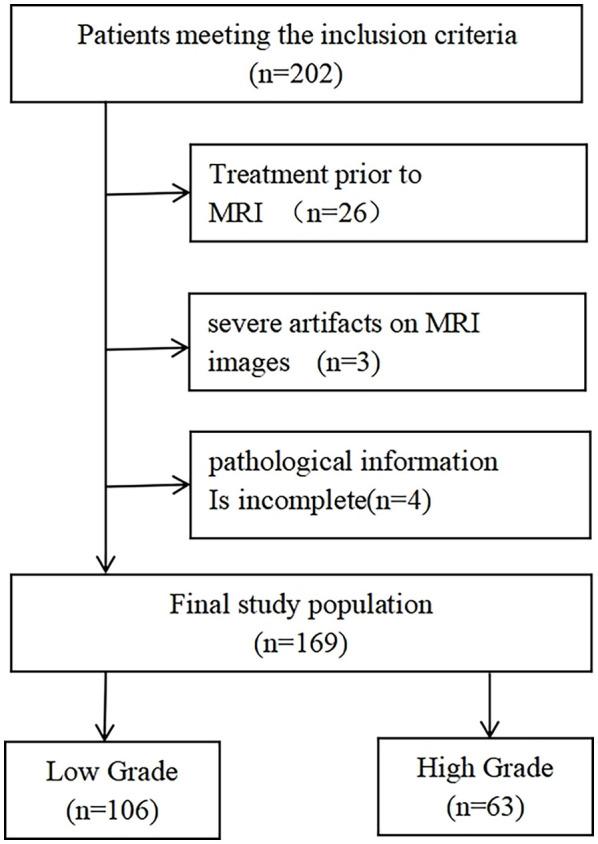
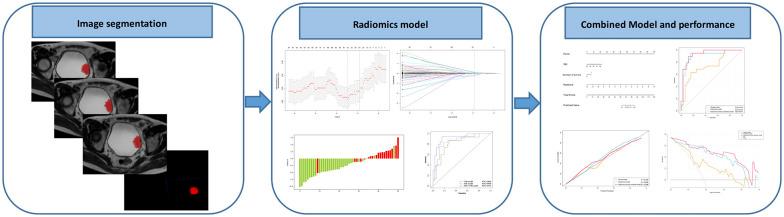
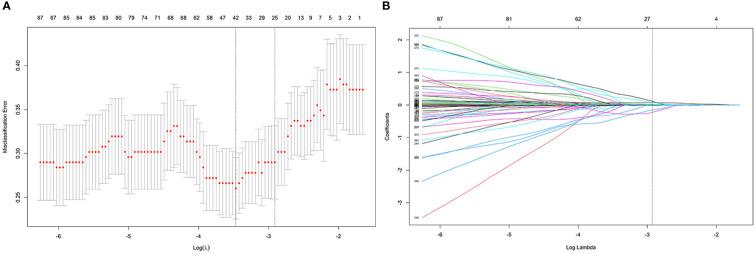
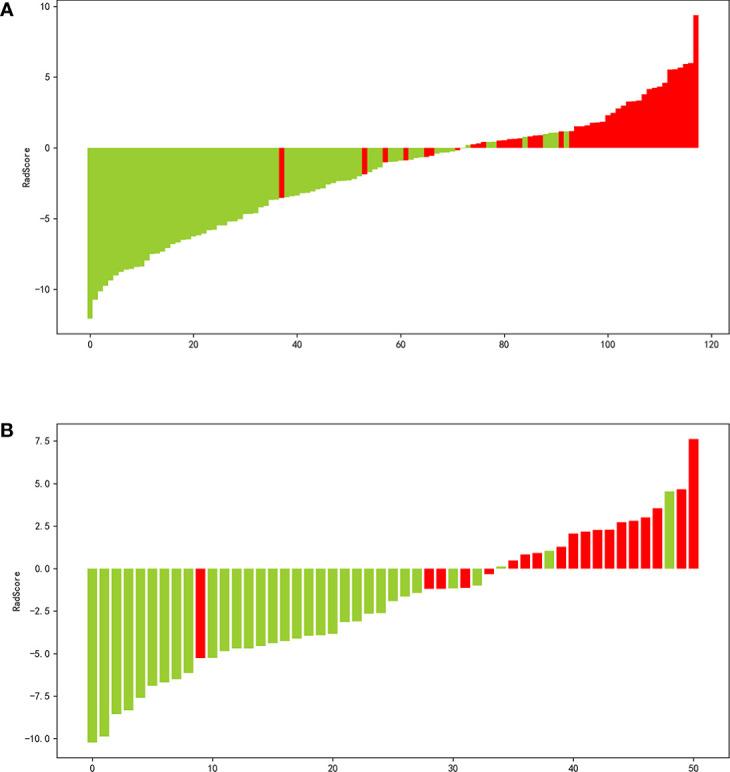
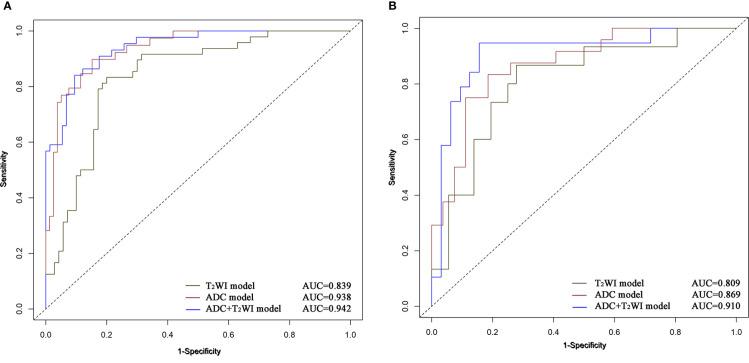
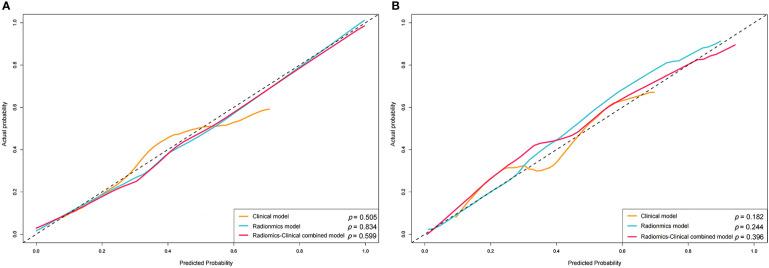
The study included 169 consecutive patients with NMIBC (training cohort: n = 118, validation cohort: n = 51). A total of 3148 radiomic features were extracted, and one-way analysis of variance and least absolute shrinkage and selection operator were used to select features for building the radiomics score(Rad-score). Three models to predict NMIBC grading were developed using logistic regression analysis: a clinical model, a radiomics model and a radiomics-clinical combined nomogram model. The discrimination and calibration power and clinical applicability of the models were evaluated. The diagnostic performance of each model was compared by determining the area under the curve (AUC) in receiver operating characteristic (ROC) curve analysis.
RESULTS
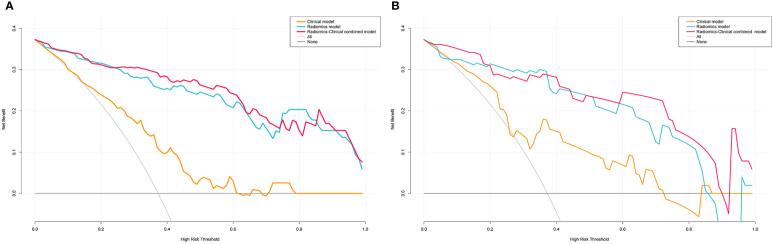
A total of 24 features were used to build the Rad-score. A clinical model, a radiomics model, and a radiomics-clinical nomogram model that incorporated the Rad-score, age, and number of tumors were constructed. The radiomics model and nomogram showed AUCs of 0.910 and 0.931 in the validation set, which outperformed the clinical model (0.745). The decision curve analysis also showed that the radiomics model and combined nomogram model yielded higher net benefits than the clinical model.
CONCLUSION
A radiomics-clinical combined nomogram model has the potential to be used as a non-invasive tool for the differentiating low-from high-grade NMIBCs.
背景
非肌层浸润性膀胱癌(NMIBC)分为高、低级别,具有不同的临床治疗方法和预后。因此,通过成像技术准确术前评估组织学NMIBC级别至关重要。
目的
开发并验证基于MRI的影像组学列线图,用于NMIBC分级的个体化预测。
方法
本研究纳入169例连续的NMIBC患者(训练队列:n = 118,验证队列:n = 51)。共提取3148个影像组学特征,并采用单因素方差分析和最小绝对收缩和选择算子来选择用于构建影像组学评分(Rad-score)的特征。使用逻辑回归分析开发了三种预测NMIBC分级的模型:临床模型、影像组学模型和影像组学-临床联合列线图模型。评估了模型的鉴别力、校准能力和临床适用性。通过在受试者操作特征(ROC)曲线分析中确定曲线下面积(AUC)来比较每个模型的诊断性能。
结果
共使用24个特征构建Rad-score。构建了临床模型、影像组学模型以及纳入Rad-score、年龄和肿瘤数量的影像组学-临床列线图模型。影像组学模型和列线图在验证集中的AUC分别为0.910和0.931,优于临床模型(0.745)。决策曲线分析还表明,影像组学模型和联合列线图模型比临床模型产生更高的净效益。
结论
影像组学-临床联合列线图模型有潜力作为一种非侵入性工具,用于区分低级别和高级别NMIBC。

 Zotero 插件