
使用基于计算机断层扫描的影像组学列线图预测膀胱癌术前肌肉浸润状态。
Predicting preoperative muscle invasion status for bladder cancer using computed tomography-based radiomics nomogram.
作者信息
Zhang Rui, Jia Shijun, Zhai Linhan, Wu Feng, Zhang Shuang, Li Feng
机构信息
Department of Radiology, Xiangyang Central Hospital, Affiliated Hospital of Hubei University of Arts and Science, Xiangyang, 441021, Hubei, China.
出版信息
BMC Med Imaging. 2024 Apr 27;24(1):98. doi: 10.1186/s12880-024-01276-7.
OBJECTIVES
The aim of the study is to assess the efficacy of the established computed tomography (CT)-based radiomics nomogram combined with radiomics and clinical features for predicting muscle invasion status in bladder cancer (BCa).
METHODS
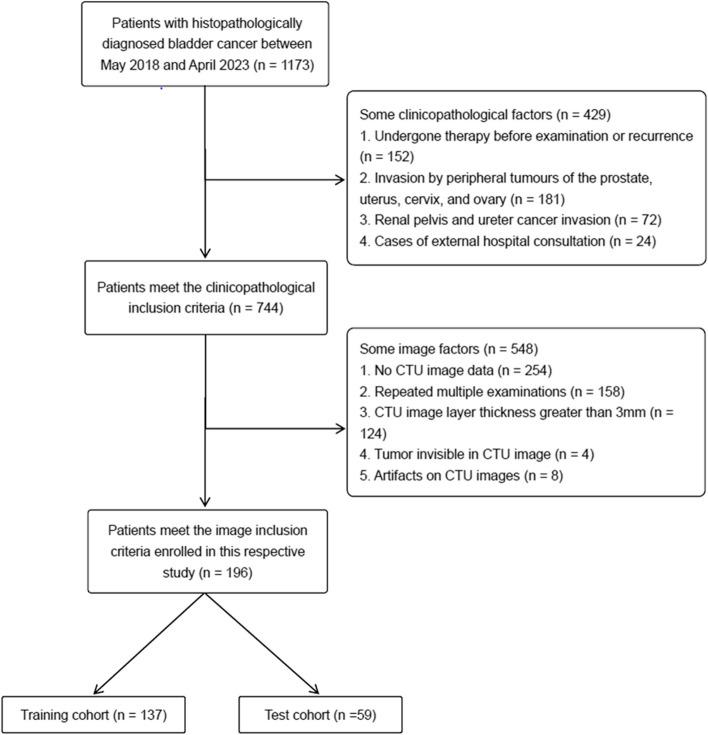
A retrospective analysis was conducted using data from patients who underwent CT urography at our institution between May 2018 and April 2023 with urothelial carcinoma of the bladder confirmed by postoperative histology. There were 196 patients enrolled in all, and each was randomized at random to either the training cohort (n = 137) or the test cohort (n = 59). Eight hundred fifty-one radiomics features in all were retrieved. For feature selection, the significance test and least absolute shrinkage and selection operator (LASSO) approaches were utilized. Subsequently, the radiomics score (Radscore) was obtained by applying linear weighting based on the selected features. The clinical and radiomics model, as well as radiomics-clinical nomogram were all established using logistic regression. Three models were evaluated using analysis of the receiver operating characteristic curve. An area under the curve (AUC) and 95% confidence intervals (CI) as well as specificity, sensitivity, accuracy, negative predictive value, and positive predictive value were included in the analysis. Radiomics-clinical nomogram's performance was assessed based on discrimination, calibration, and clinical utility.
RESULTS
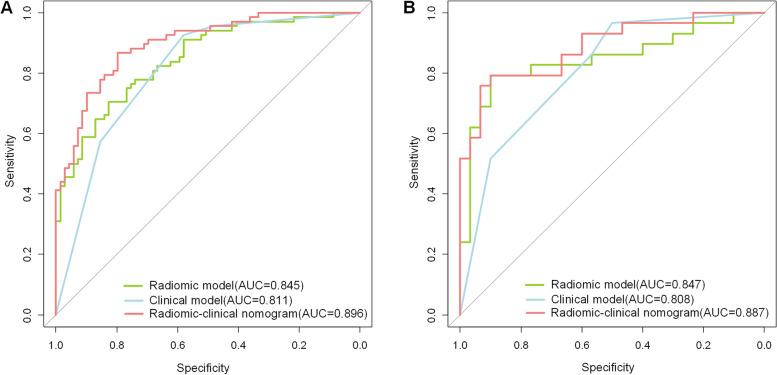
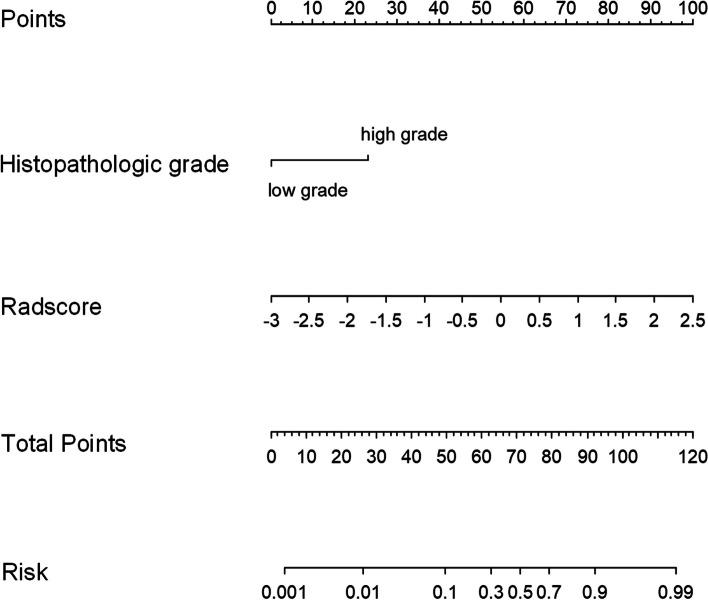
After obtaining 851 radiomics features, 12 features were ultimately selected. Histopathological grading and tortuous blood vessels were included in the clinical model. The Radscore and clinical histopathology grading were among the final predictors in the unique nomogram. The three models had an AUC of 0.811 (95% CI, 0.742-0.880), 0.845 (95% CI, 0.781-0.908), and 0.896 (95% CI, 0.846-0.947) in the training cohort and in the test cohort they were 0.808 (95% CI, 0.703-0.913), 0.847 (95% CI, 0.739-0.954), and 0.887 (95% CI, 0.803-0.971). According to the DeLong test, the radiomics-clinical nomogram's AUC in the training cohort substantially differed from that of the clinical model (AUC: 0.896 versus 0.845, p = 0.015) and the radiomics model (AUC: 0.896 versus 0.811, p = 0.002). The Delong test in the test cohort revealed no significant difference among the three models.
CONCLUSIONS
CT-based radiomics-clinical nomogram can be a useful tool for quantitatively predicting the status of muscle invasion in BCa.
目的
本研究旨在评估基于计算机断层扫描(CT)的放射组学列线图联合放射组学和临床特征预测膀胱癌(BCa)肌肉浸润状态的疗效。
方法
采用回顾性分析,数据来自2018年5月至2023年4月在本机构接受CT尿路造影检查且术后组织学确诊为膀胱尿路上皮癌的患者。共纳入196例患者,随机分为训练队列(n = 137)或测试队列(n = 59)。共提取851个放射组学特征。对于特征选择,采用显著性检验和最小绝对收缩和选择算子(LASSO)方法。随后,根据所选特征应用线性加权获得放射组学评分(Radscore)。临床和放射组学模型以及放射组学 - 临床列线图均采用逻辑回归建立。使用受试者操作特征曲线分析对三个模型进行评估。分析包括曲线下面积(AUC)、95%置信区间(CI)以及特异性、敏感性、准确性、阴性预测值和阳性预测值。基于鉴别力、校准和临床实用性评估放射组学 - 临床列线图的性能。
结果
在获得851个放射组学特征后,最终选择了12个特征。临床模型纳入了组织病理学分级和迂曲血管。Radscore和临床组织病理学分级是独特列线图中的最终预测因素。三个模型在训练队列中的AUC分别为0.811(95%CI,0.742 - 0.880)、0.845(95%CI,0.781 - 0.908)和0.896(95%CI,0.846 - 0.947),在测试队列中分别为0.808(95%CI,0.703 - 0.913)、0.847(95%CI,0.739 - 0.954)和0.887(95%CI,0.803 - 0.971)。根据DeLong检验,训练队列中放射组学 - 临床列线图的AUC与临床模型(AUC:0.896对0.845,p = 0.015)和放射组学模型(AUC:0.896对0.811,p = 0.002)有显著差异。测试队列中的DeLong检验显示三个模型之间无显著差异。
结论
基于CT的放射组学 - 临床列线图可作为定量预测BCa肌肉浸润状态的有用工具。


 Zotero 插件