
抗生素治疗期间的适应性抗菌耐药性。
adaptive antimicrobial resistance in during antibiotic therapy.
作者信息
Li Shuangshuang, Feng Xudong, Li Min, Shen Zhen
机构信息
Department of Laboratory Medicine, Ningbo Hospital, Ren Ji Hospital, Shanghai Jiao Tong University School of Medicine, Ningbo, China.
State Key Laboratory for the Diagnosis and Treatment of Infectious Diseases, The First Affiliated Hospital, Zhejiang University School of Medicine, Hangzhou, China.
出版信息
Front Microbiol. 2023 Mar 16;14:1159912. doi: 10.3389/fmicb.2023.1159912. eCollection 2023.
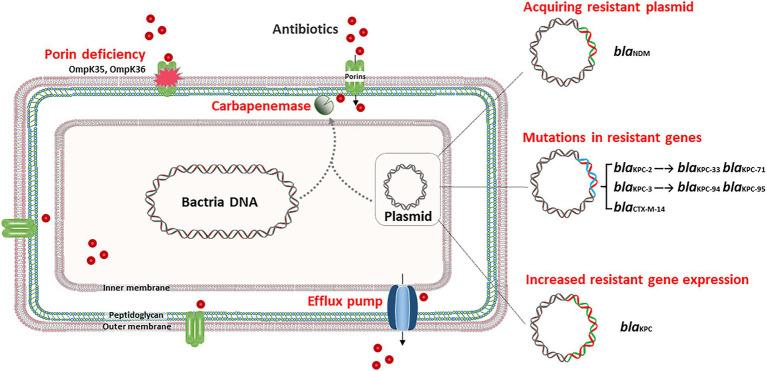
is one of the leading pathogens contributing to antimicrobial resistance. The emergence of carbapenem-resistant (CRKP) has put the use of clinical antimicrobial agents in a dilemma. In particular, CRKP exhibiting resistance to ceftazidime/avibactam, tigecycline and colistin have raised great clinical concern, as these are the last-resort antibiotics for the treatment of CRKP infections. Within-host evolution is a survival strategy closely related to the emergence of antimicrobial resistance, while little attention has been paid to the genetic process of conversion from antibiotic-susceptible to resistant . Here we have a literature review regarding the evolution of resistance to carbapenems, ceftazidime/avibactam, tigecycline, and colistin in during antibacterial therapy, and summarized the detailed resistance mechanisms. In general, acquiring and harboring-plasmid, specific mutations in , and porin genes, such as and , upregulation of , contribute to the development of carbapenem and ceftazidime/avibactam resistance . Overexpression of efflux pumps, acquiring plasmid-carrying variants, and ribosomal protein change can lead to the adaptive evolution of tigecycline resistance. Specific mutations in chromosomes result in the cationic substitution of the phosphate groups of lipid A, thus contributing to colistin resistance. The resistant plasmid might be acquired from the co-infecting or co-colonizing strains, and the internal environment and antibiotic selection pressure contribute to the emergence of resistant mutants. The internal environment within the human host could serve as an important source of resistant strains.
是导致抗菌药物耐药性的主要病原体之一。耐碳青霉烯类肺炎克雷伯菌(CRKP)的出现使临床抗菌药物的使用陷入困境。特别是,对头孢他啶/阿维巴坦、替加环素和黏菌素耐药的CRKP引起了极大的临床关注,因为这些是治疗CRKP感染的最后手段抗生素。宿主内进化是一种与抗菌药物耐药性出现密切相关的生存策略,而从抗生素敏感型转变为耐药型的遗传过程却很少受到关注。在此,我们对肺炎克雷伯菌在抗菌治疗期间对碳青霉烯类、头孢他啶/阿维巴坦、替加环素和黏菌素的耐药性进化进行了文献综述,并总结了详细的耐药机制。一般来说,获得和携带质粒、特定基因突变以及孔蛋白基因(如ompK35和ompK36)的变化、AmpC的上调,都有助于碳青霉烯类和头孢他啶/阿维巴坦耐药性的发展。外排泵的过度表达、获得携带质粒的tet(A)变体以及核糖体蛋白的变化可导致替加环素耐药性的适应性进化。染色体上的特定突变导致脂质A磷酸基团的阳离子取代,从而导致黏菌素耐药性。耐药质粒可能从共同感染或共同定植的菌株中获得,内部环境和抗生素选择压力有助于耐药突变体的出现。人类宿主内的内部环境可能是耐药菌株的重要来源。


 Zotero 插件