
苯甲酸、丁酸、辛酸和山梨酸等有机酸的组合为对抗急性弯曲杆菌病提供了一种新型的不依赖抗生素的治疗选择。
Combination of organic acids benzoate, butyrate, caprylate, and sorbate provides a novel antibiotics-independent treatment option in the combat of acute campylobacteriosis.
作者信息
Du Ke, Foote Minnja S, Mousavi Soraya, Buczkowski Agnes, Schmidt Sebastian, Peh Elisa, Kittler Sophie, Bereswill Stefan, Heimesaat Markus M
机构信息
Gastrointestinal Microbiology Research Group, Institute of Microbiology, Infectious Diseases and Immunology, Charité - University Medicine Berlin, Corporate Member of Freie Universität Berlin, Humboldt-Universität zu Berlin, Berlin Institute of Health, Berlin, Germany.
Hofmann & Sommer GmbH & Co. KG, Büro Berlin, Berlin, Germany.
出版信息
Front Microbiol. 2023 Mar 15;14:1128500. doi: 10.3389/fmicb.2023.1128500. eCollection 2023.
INTRODUCTION
The food-borne Gram-negative bacterial pathogen may cause the acute enterocolitis syndrome campylobacteriosis in infected humans. Given that human infections are rising globally which hold also true for resistance rates against antibiotic compounds such as macrolides and fluoroquinolones frequently prescribed for the treatment of severe infectious enteritis, novel antibiotics-independent therapeutic strategies are needed. Distinct organic acids are well known for their health-beneficial including anti-microbial and immunomodulatory properties. In our present study, we investigated potential pathogen-lowering and anti-inflammatory effects of benzoic acid, butyric acid, caprylic acid, and sorbic acid either alone or in combination during acute murine campylobacteriosis.
METHODS
Therefore, secondary abiotic IL-10 mice were perorally infected with strain 81-176 and subjected to a 4-day-course of respective organic acid treatment.
RESULTS AND DISCUSSION
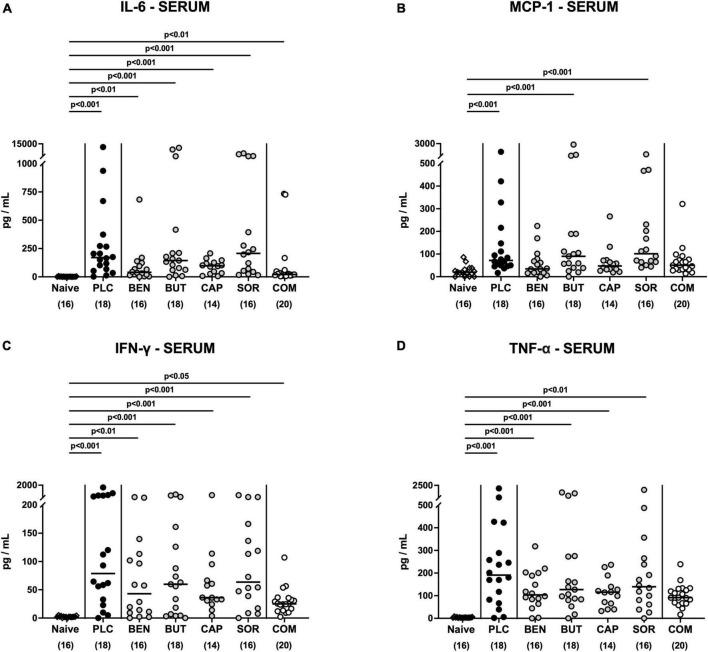
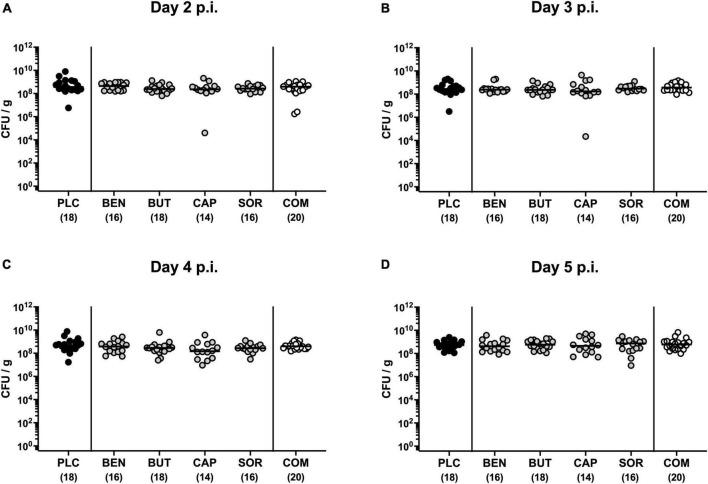
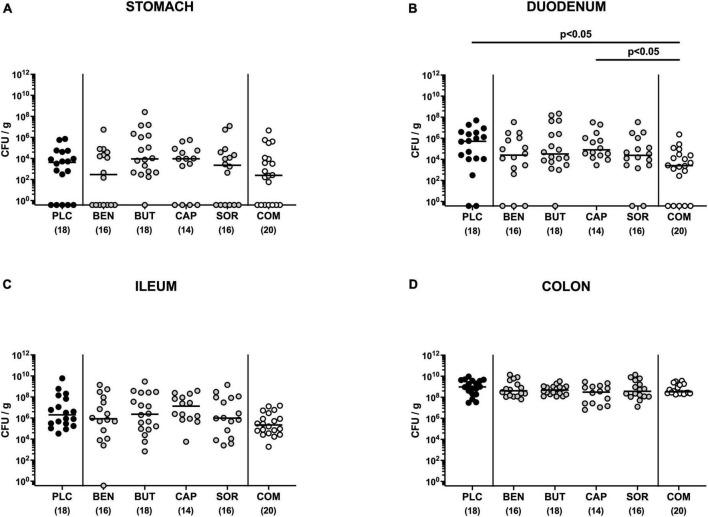
On day 6 post-infection, mice from the combination cohort displayed slightly lower pathogen loads in the duodenum, but neither in the stomach, ileum nor large intestine. Remarkably, the clinical outcome of induced acute enterocolitis was significantly improved after combined organic acid treatment when compared to the placebo control group. In support, the combinatory organic acid treatment dampened both, macroscopic and microscopic inflammatory sequelae of infection as indicated by less colonic shrinkage and less pronounced histopathological including apoptotic epithelial cell changes in the colon on day 6 post-infection. Furthermore, mice from the combination as compared to placebo cohort exhibited lower numbers of innate and adaptive immune cells such as neutrophilic granulocytes, macrophages, monocytes, and T lymphocytes in their colonic mucosa and lamina propria, respectively, which also held true for pro-inflammatory cytokine secretion in the large intestines and mesenteric lymph nodes. Notably, the anti-inflammatory effects were not restricted to the intestinal tract, but could also be observed systemically given pro-inflammatory mediator concentrations in infected mice from the combination organic acid treatment that were comparable to basal values. In conclusion, our study provides first evidence that an oral application of distinct organic acids in combination exhibits pronounced anti-inflammatory effects and hence, constitutes a promising novel antibiotics-independent therapeutic strategy in the combat of acute campylobacteriosis.
引言
食源革兰氏阴性细菌病原体可在受感染的人类中引起急性小肠结肠炎综合征弯曲杆菌病。鉴于全球范围内人类感染病例不断增加,对于常用于治疗严重感染性肠炎的抗生素化合物(如大环内酯类和氟喹诺酮类)的耐药率也在上升,因此需要新的非抗生素治疗策略。不同的有机酸因其有益健康的特性(包括抗菌和免疫调节特性)而闻名。在本研究中,我们调查了苯甲酸、丁酸、辛酸和山梨酸单独或联合使用对急性小鼠弯曲杆菌病期间潜在的降低病原体和抗炎作用。
方法
因此,对二级无特定病原体的IL-10小鼠经口感染81-176菌株,并进行为期4天的相应有机酸治疗。
结果与讨论
感染后第6天,联合治疗组小鼠十二指肠中的病原体载量略低,但胃、回肠和大肠中的病原体载量均未降低。值得注意的是,与安慰剂对照组相比,联合有机酸治疗后诱导的急性小肠结肠炎的临床结果得到了显著改善。此外,联合有机酸治疗减轻了感染的宏观和微观炎症后遗症,感染后第6天结肠收缩减少以及结肠组织病理学变化(包括凋亡上皮细胞变化)不明显表明了这一点。此外,与安慰剂组相比,联合治疗组小鼠结肠黏膜和固有层中先天性和适应性免疫细胞(如中性粒细胞、巨噬细胞、单核细胞和T淋巴细胞)的数量分别较低,大肠和肠系膜淋巴结中促炎细胞因子的分泌情况也是如此。值得注意的是,抗炎作用不仅限于肠道,在联合有机酸治疗的感染小鼠中,促炎介质浓度与基础值相当,这表明全身也可观察到抗炎作用。总之,我们的研究首次证明,联合口服不同的有机酸具有显著的抗炎作用,因此,在对抗急性弯曲杆菌病方面构成了一种有前景的新型非抗生素治疗策略。


 Zotero 插件