
亚洲国家常见神经疾病负担,1990-2019 年:2019 年全球疾病负担研究分析。
Burden of Common Neurologic Diseases in Asian Countries, 1990-2019: An Analysis for the Global Burden of Disease Study 2019.
机构信息
From the Department of Neurology (Yue Wang, J.L., Y.F., L.Z., Y.Z., Yajuan Wang, L.H., Z.L., Z.X.), Renmin Hospital of Wuhan University; Department of Neurology (D.Y., Yilong Wang), Beijing Tiantan Hospital, Capital Medical University; Chinese Institute for Brain Research (Yilong Wang); China National Clinical Research Center for Neurological Diseases (Yilong Wang); Advanced Innovation Center for Human Brain Protection (Yilong Wang), Capital Medical University, Beijing; and Beijing Key Laboratory of Translational Medicine for Cerebrovascular Disease (Yilong Wang), China.
出版信息
Neurology. 2023 May 23;100(21):e2141-e2154. doi: 10.1212/WNL.0000000000207218. Epub 2023 Apr 4.
BACKGROUND AND OBJECTIVES
Based on the Global Burden of Diseases, Injuries, and Risk Factors (GBD) study, neurologic disorders are a major cause of morbidity and mortality worldwide. However, there has been no comprehensive assessment of neurologic disorders in Asia. Data from the GBD 1990-2019 study were investigated to provide new details for neurologic disorders in Asia.
METHODS
The burden of common neurologic disorders in Asia was calculated for 1990 and 2019 as incidence, prevalence, deaths, and disability-adjusted life-years (DALYs). Thirteen common neurologic disorders were analyzed. Data are presented as totals and by sex, age, year, location, risk factors, and sociodemographic index (SDI) and shown as counts and rates.
RESULTS
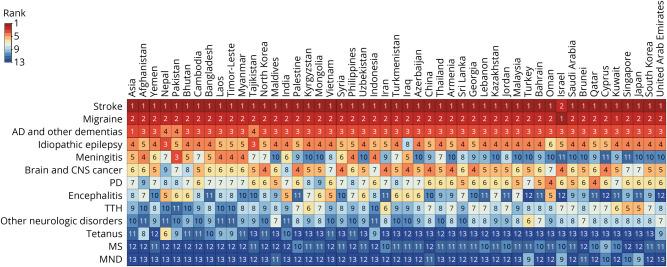
In 2019, the most burdensome neurologic disorders in Asia for the absolute number of DALYs were stroke (98.8 million, 95% uncertainty interval [UI] 91.0-107.0), migraine (24.6 million, 95% UI 3.4-56.4), and Alzheimer disease (AD) and other dementias (13.5 million, 95% UI 5.9-29.8). From 1990 to 2019, the absolute number of DALYs and deaths caused by combined neurologic disorders (deaths by 60.7% and DALYs by 17.6%) increased, but the age-standardized rates (deaths by 34.1% and DALYs by 36.3%) decreased. The burden of neurologic disorders peaked among individuals aged 65-74 years and was higher among male than among female individuals; moreover, this burden varied considerably across Asian subregions and countries. Risk-attributable DALYs accounted for 86.9%, 28.5%, and 11.1% of DALYs for stroke, AD and other dementias, and multiple sclerosis, respectively. SDI was associated with both stroke and communicable neurological disorders. In terms of crude rate, the higher the SDI value, the higher the prevalence of stroke, and the lower all metrics of communicable neurological disorders.
DISCUSSION
Neurologic disorders were the leading cause of DALYs and the second leading cause of deaths in Asia in 2019, and the burden may likely increase with the growth and aging of the Asian population. Urgent measures are needed for prevention, treatment, rehabilitation, and support services for common neurologic disorders regionally and nationally.
背景与目的
基于全球疾病、伤害和危险因素负担研究(GBD),神经系统疾病是全世界发病率和死亡率的主要原因。然而,亚洲神经系统疾病的综合评估尚未开展。本研究旨在通过分析 1990 年至 2019 年 GBD 数据,为亚洲神经系统疾病提供新的细节信息。
方法
计算了 1990 年和 2019 年亚洲常见神经系统疾病的发病率、患病率、死亡率和伤残调整生命年(DALYs)。分析了 13 种常见神经系统疾病。数据以总数和性别、年龄、年份、地点、危险因素以及社会人口指数(SDI)呈现,以数量和比率表示。
结果
2019 年,亚洲造成 DALYs 数量最多的神经系统疾病分别为卒中(9880 万,95%置信区间 [9100-10700])、偏头痛(2460 万,95%置信区间 [3400-5640])和阿尔茨海默病(AD)和其他痴呆(1350 万,95%置信区间 [5900-29800])。1990 年至 2019 年,神经系统疾病所致的 DALYs 绝对数量和死亡人数(死亡人数增加 60.7%,DALYs 增加 17.6%)增加,但年龄标准化率(死亡人数下降 34.1%,DALYs 下降 36.3%)下降。神经系统疾病的负担在 65-74 岁人群中达到峰值,且男性高于女性;此外,亚洲各次区域和国家之间的负担差异很大。归因于风险的 DALYs 分别占卒中、AD 和其他痴呆以及多发性硬化症 DALYs 的 86.9%、28.5%和 11.1%。SDI 与卒中和传染性神经系统疾病均相关。从粗率来看,SDI 值越高,卒中的患病率越高,传染性神经系统疾病的所有指标越低。
讨论
2019 年,神经系统疾病是亚洲 DALYs 的主要原因,也是死亡的第二大原因,随着亚洲人口的增长和老龄化,疾病负担可能会进一步增加。需要在区域和国家层面采取紧急措施,预防、治疗、康复和支持常见神经系统疾病。


 Zotero 插件