
含蒽环类和紫杉类化疗药物治疗早期可手术乳腺癌的患者水平荟萃分析:来自 86 项随机试验的 10 万名女性的研究。
Anthracycline-containing and taxane-containing chemotherapy for early-stage operable breast cancer: a patient-level meta-analysis of 100 000 women from 86 randomised trials.
出版信息
Lancet. 2023 Apr 15;401(10384):1277-1292. doi: 10.1016/S0140-6736(23)00285-4.
BACKGROUND
Anthracycline-taxane chemotherapy for early-stage breast cancer substantially improves survival compared with no chemotherapy. However, concerns about short-term and long-term side-effects of anthracyclines have led to increased use of taxane chemotherapy without anthracycline, which could compromise efficacy. We aimed to better characterise the benefits and risks of including anthracycline, and the comparative benefits of different anthracycline-taxane regimens.
METHODS
We did an individual patient-level meta-analysis of randomised trials comparing taxane regimens with versus without anthracycline, and updated our previous meta-analysis of anthracycline regimens with versus without taxane, as well as analysing 44 trials in six related comparisons. We searched databases, including MEDLINE, Embase, the Cochrane Library, and meeting abstracts to identify trials assessing anthracycline and taxane chemotherapy. Adjuvant or neoadjuvant trials were eligible if they began before Jan 1, 2012. Primary outcomes were breast cancer recurrence and cause-specific mortality. Log-rank analyses yielded first-event rate ratios (RRs) and CIs.
FINDINGS
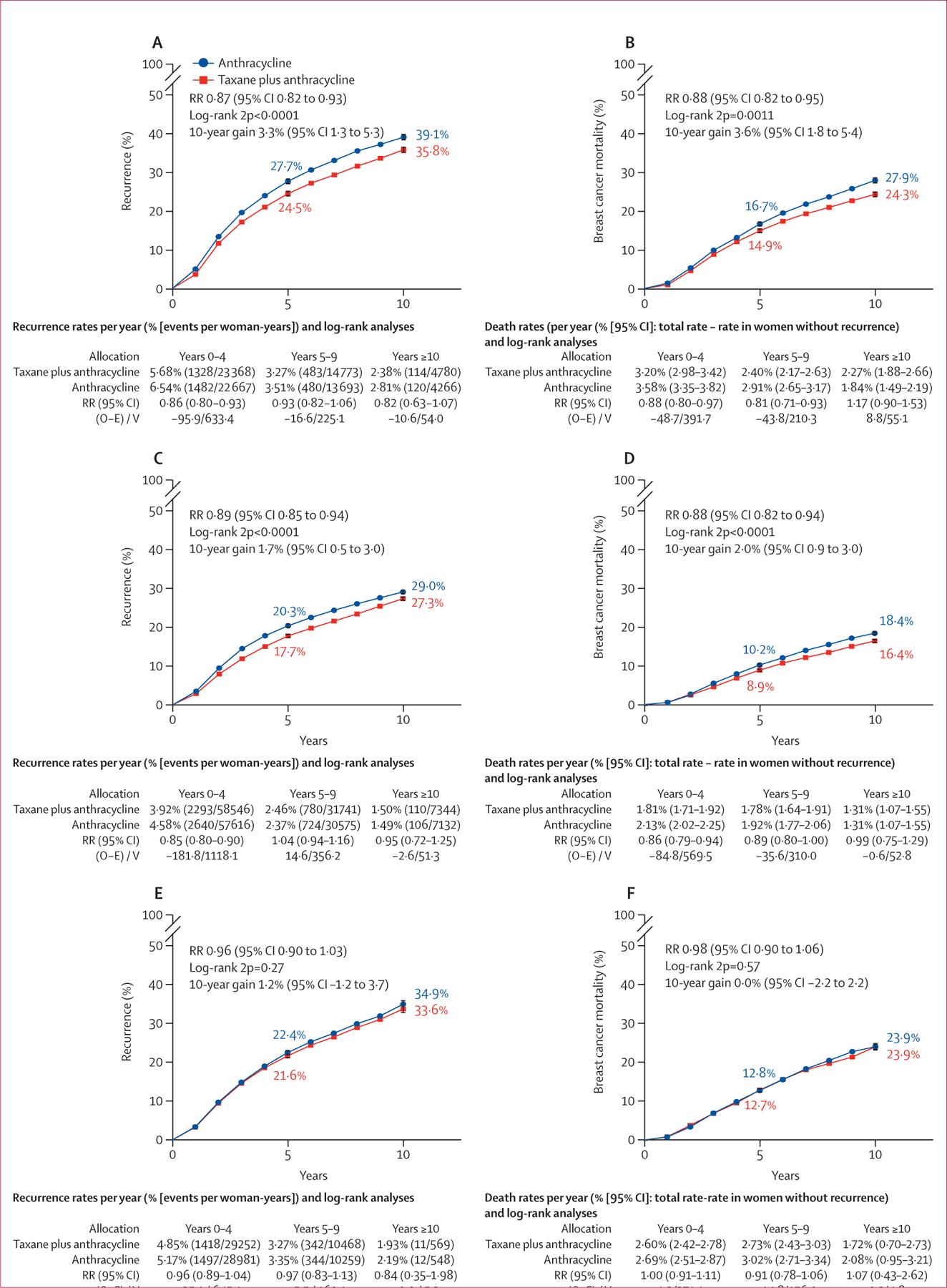
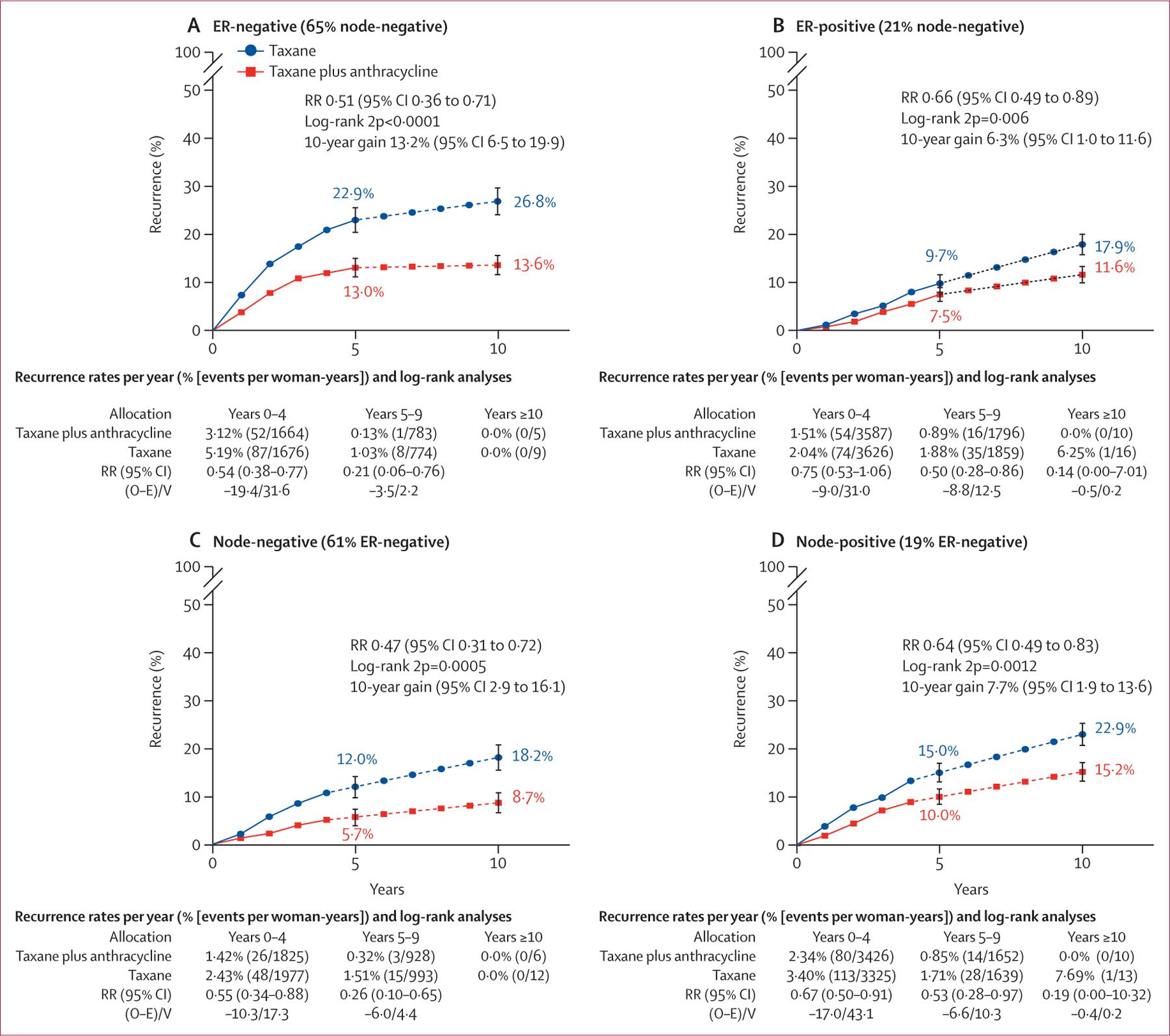
28 trials of taxane regimens with or without anthracycline were identified, of which 23 were deemed eligible, and 15 provided data on 18 103 women. Across all 15 trials that provided individual data, recurrence rates were 14% lower on average (RR 0·86, 95% CI 0·79-0·93; p=0·0004) with taxane regimens including anthracycline than those without. Non-breast cancer deaths were not increased but there was one additional acute myeloid leukaemia case per 700 women treated. The clearest reductions in recurrence were found when anthracycline was added concurrently to docetaxel plus cyclophosphamide versus the same dose of docetaxel plus cyclophosphamide (10-year recurrence risk 12·3% vs 21·0%; risk difference 8·7%, 95% CI 4·5-12·9; RR 0·58, 0·47-0·73; p<0·0001). 10-year breast cancer mortality in this group was reduced by 4·2% (0·4-8·1; p=0·0034). No significant reduction in recurrence risk was found for sequential schedules of taxane plus anthracycline when compared with docetaxel plus cyclophosphamide (RR 0·94, 0·83-1·06; p=0·30). For the analysis of anthracycline regimens with versus without taxane, 35 trials (n=52 976) provided individual patient data. Larger recurrence reductions were seen from adding taxane to anthracycline regimens when the cumulative dose of anthracycline was the same in each group (RR 0·87, 0·82-0·93; p<0·0001; n=11 167) than in trials with two-fold higher cumulative doses of non-taxane (mostly anthracycline) in the control group than in the taxane group (RR 0·96, 0·90-1·03; p=0·27; n=14 620). Direct comparisons between anthracycline and taxane regimens showed that a higher cumulative dose and more dose-intense schedules were more efficacious. The proportional reductions in recurrence for taxane plus anthracycline were similar in oestrogen receptor-positive and oestrogen receptor-negative disease, and did not differ by age, nodal status, or tumour size or grade.
INTERPRETATION
Anthracycline plus taxane regimens are most efficacious at reducing breast cancer recurrence and death. Regimens with higher cumulative doses of anthracycline plus taxane provide the greatest benefits, challenging the current trend in clinical practice and guidelines towards non-anthracycline chemotherapy, particularly shorter regimens, such as four cycles of docetaxel-cyclophosphamide. By bringing together data from almost all relevant trials, this meta-analysis provides a reliable evidence base to inform individual treatment decisions, clinical guidelines, and the design of future clinical trials.
FUNDING
Cancer Research UK, UK Medical Research Council.
背景
与无化疗相比,早期乳腺癌的蒽环类药物-紫杉烷化疗可显著提高生存率。然而,人们对蒽环类药物的短期和长期副作用的担忧导致紫杉烷化疗的应用增加,而不使用蒽环类药物,这可能会影响疗效。我们旨在更好地描述包括蒽环类药物的益处和风险,以及不同蒽环类药物-紫杉烷方案的比较益处。
方法
我们对比较紫杉烷方案与有无蒽环类药物的随机试验进行了个体患者水平的荟萃分析,并更新了我们之前关于有无紫杉烷的蒽环类药物方案的荟萃分析,以及对六项相关比较中的 44 项试验进行了分析。我们检索了包括 MEDLINE、Embase、Cochrane 图书馆和会议摘要在内的数据库,以确定评估蒽环类药物和紫杉烷化疗的试验。辅助或新辅助试验如果在 2012 年 1 月 1 日之前开始,便符合入选条件。主要结局是乳腺癌复发和特定原因死亡率。对数秩分析得出了首次事件率比(RR)和 95%置信区间(CI)。
结果
共确定了 28 项紫杉烷方案与有无蒽环类药物的试验,其中 23 项被认为符合入选条件,15 项提供了 18103 名女性的数据。在所有提供个体数据的 15 项试验中,蒽环类药物联合紫杉烷方案的复发率平均降低了 14%(RR 0.86,95%CI 0.79-0.93;p=0.0004)。非乳腺癌死亡没有增加,但每 700 名接受治疗的女性中就会增加一例急性髓系白血病。当蒽环类药物与多西紫杉醇联合环磷酰胺同时给药时,与相同剂量的多西紫杉醇联合环磷酰胺相比,复发率的降低最为明显(10 年复发风险 12.3%比 21.0%;风险差异 8.7%,95%CI 4.5-12.9;RR 0.58,0.47-0.73;p<0.0001)。该组的 10 年乳腺癌死亡率降低了 4.2%(0.4-8.1;p=0.0034)。与多西紫杉醇联合环磷酰胺相比,当紫杉烷联合蒽环类药物的序贯方案与多西紫杉醇联合环磷酰胺相比,复发风险无显著降低(RR 0.94,0.83-1.06;p=0.30)。对于蒽环类药物方案与有无紫杉烷的分析,35 项试验(n=52976)提供了个体患者数据。当每组蒽环类药物累积剂量相同时,从蒽环类药物中添加紫杉烷可观察到更大的复发率降低(RR 0.87,0.82-0.93;p<0.0001;n=11167),而在对照组中紫杉烷累积剂量是实验组的两倍(主要是蒽环类药物)的试验中,复发率降低(RR 0.96,0.90-1.03;p=0.27;n=14620)。蒽环类药物和紫杉烷方案之间的直接比较表明,更高的累积剂量和更剂量密集的方案更有效。紫杉烷联合蒽环类药物的复发比例降低相似,在雌激素受体阳性和雌激素受体阴性疾病中,且与年龄、淋巴结状态、肿瘤大小或分级无关。
解释
蒽环类药物联合紫杉烷方案最能有效降低乳腺癌复发和死亡风险。蒽环类药物联合紫杉烷方案的累积剂量越高,获益越大,这对目前临床实践和指南中向非蒽环类药物化疗的趋势提出了挑战,尤其是较短的方案,如四周期多西紫杉醇-环磷酰胺。通过汇集几乎所有相关试验的数据,本荟萃分析为个体治疗决策、临床指南和未来临床试验的设计提供了可靠的证据基础。
资金
英国癌症研究中心,英国医学研究理事会。


 Zotero 插件