
灵长类动物保守的碳酸酐酶 IV 和鼠类特异性 LY6C1 使工程化病毒载体能够穿越血脑屏障。
Primate-conserved carbonic anhydrase IV and murine-restricted LY6C1 enable blood-brain barrier crossing by engineered viral vectors.
机构信息
Division of Biology and Biological Engineering, California Institute of Technology, Pasadena, CA, USA.
California State Polytechnic University, Pomona, Pomona, CA, USA.
出版信息
Sci Adv. 2023 Apr 21;9(16):eadg6618. doi: 10.1126/sciadv.adg6618. Epub 2023 Apr 19.
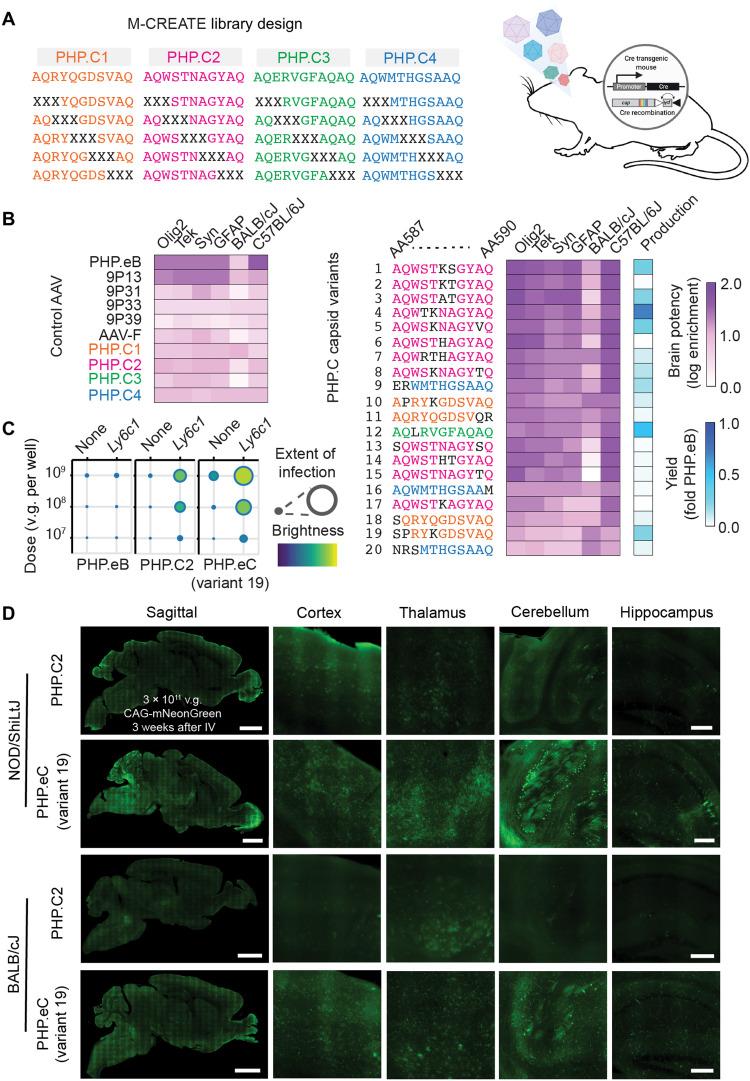
The blood-brain barrier (BBB) presents a major challenge for delivering large molecules to study and treat the central nervous system. This is due in part to the scarcity of targets known to mediate BBB crossing. To identify novel targets, we leverage a panel of adeno-associated viruses (AAVs) previously identified through mechanism-agnostic directed evolution for improved BBB transcytosis. Screening potential cognate receptors for enhanced BBB crossing, we identify two targets: murine-restricted LY6C1 and widely conserved carbonic anhydrase IV (CA-IV). We apply AlphaFold-based in silico methods to generate capsid-receptor binding models to predict the affinity of AAVs for these identified receptors. Demonstrating how these tools can unlock target-focused engineering strategies, we create an enhanced LY6C1-binding vector, AAV-PHP.eC, that, unlike our prior PHP.eB, also works in -deficient mouse strains such as BALB/cJ. Combined with structural insights from computational modeling, the identification of primate-conserved CA-IV enables the design of more specific and potent human brain-penetrant chemicals and biologicals, including gene delivery vectors.
血脑屏障 (BBB) 对向中枢神经系统输送大分子物质以进行研究和治疗构成了重大挑战。这在一定程度上是由于介导 BBB 穿越的已知靶点稀缺。为了识别新的靶点,我们利用先前通过无机制定向进化鉴定的腺相关病毒 (AAV) 进行筛选,以提高 BBB 转胞吞作用。为了筛选增强 BBB 穿越的潜在同源受体,我们确定了两个靶点:鼠特异性 LY6C1 和广泛保守的碳酸酐酶 IV (CA-IV)。我们应用基于 AlphaFold 的计算方法生成衣壳-受体结合模型,以预测鉴定出的受体对 AAV 的亲和力。通过展示这些工具如何解锁以目标为重点的工程策略,我们创建了一个增强的 LY6C1 结合载体 AAV-PHP.eC,与我们之前的 PHP.eB 不同,它还可以在缺乏 - 的小鼠品系(如 BALB/cJ)中发挥作用。与计算建模的结构见解相结合,灵长类动物保守 CA-IV 的鉴定使得设计更具特异性和效力的穿透人脑的化学物质和生物制剂,包括基因传递载体成为可能。




 Zotero 插件