
神经系统相关受体碳酸酐酶 IV 识别腺相关病毒的结构基础。
Structural basis of the recognition of adeno-associated virus by the neurological system-related receptor carbonic anhydrase IV.
机构信息
Jinshan Hospital, Institute for Translational Brain Research, Fudan University, Shanghai, China.
MOE Key Laboratory of Protein Science, School of Medicine, Tsinghua University, Beijing, China.
出版信息
PLoS Pathog. 2024 Feb 5;20(2):e1011953. doi: 10.1371/journal.ppat.1011953. eCollection 2024 Feb.
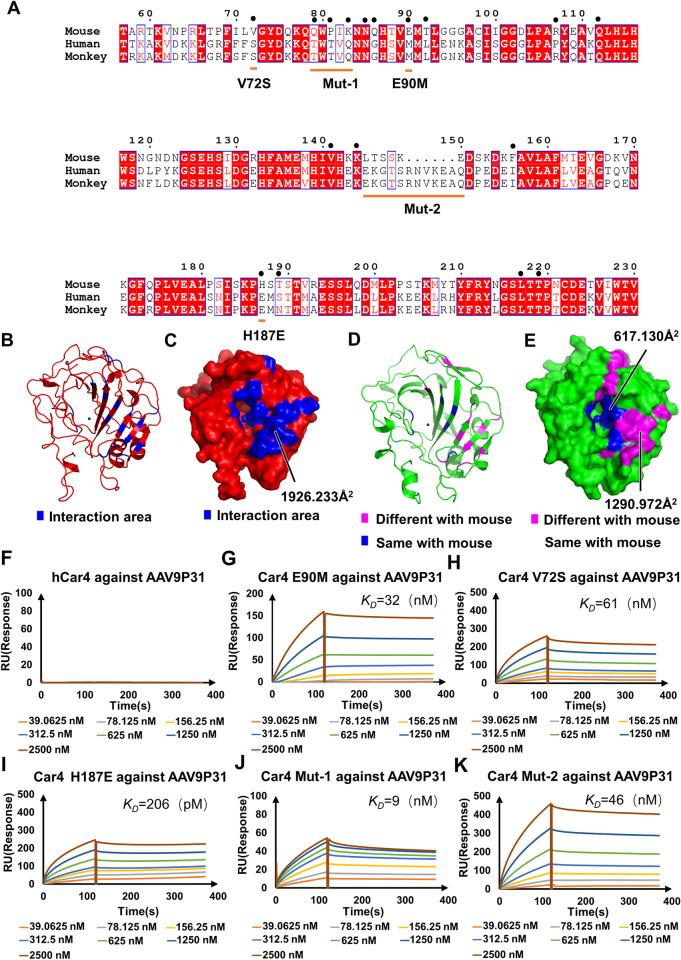
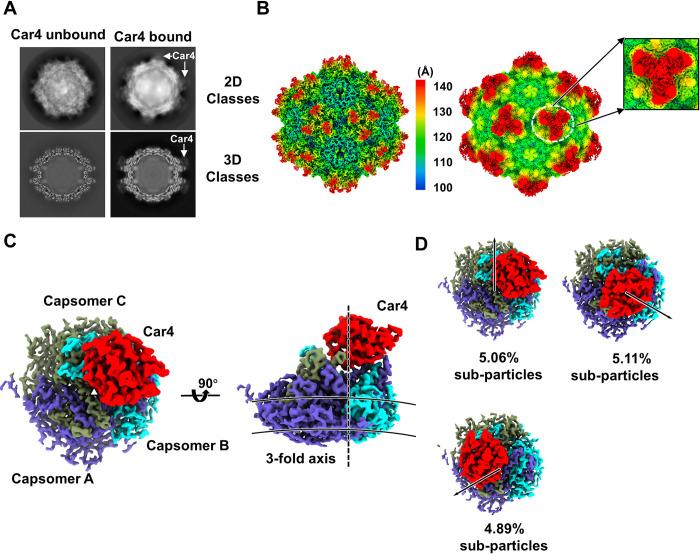
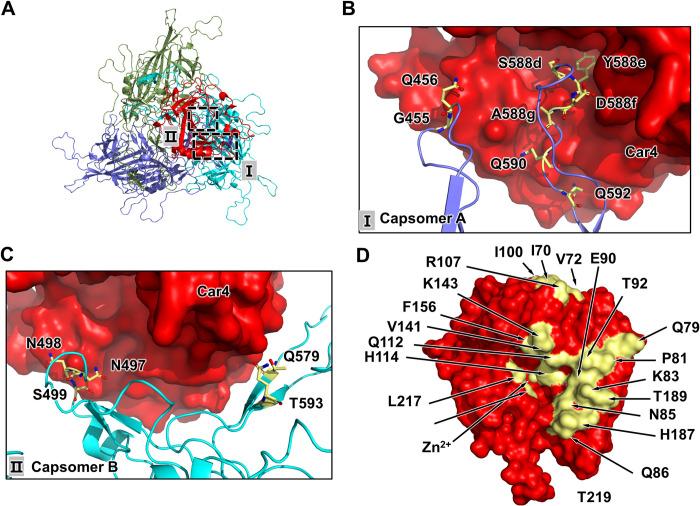
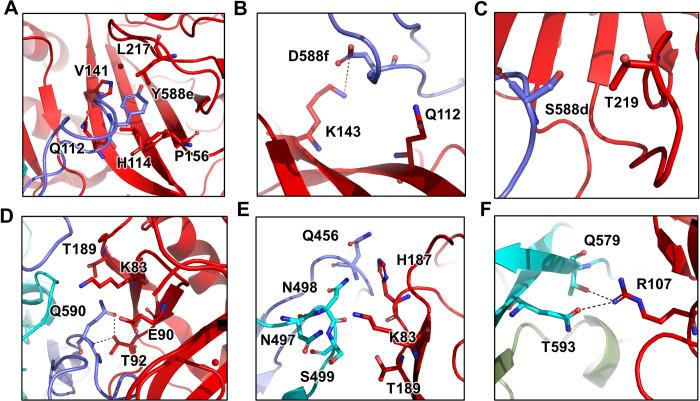
Carbonic anhydrase IV (Car4) is a newly identified receptor that allows adeno-associated virus (AAV) 9P31 to cross the blood-brain barrier and achieve efficient infection in the central nervous system (CNS) in mouse models. However, the molecular mechanism by which engineered AAV capsids with 7-mer insertion in the variable region (VR) VIII recognize these novel cellular receptors is unknown. Here we report the cryo-EM structures of AAV9P31 and its complex with Mus musculus Car4 at atomic resolution by utilizing the block-based reconstruction (BBR) method. The structures demonstrated that Car4 binds to the protrusions at 3-fold axes of the capsid. The inserted 7-mer extends into a hydrophobic region near the catalytic center of Car4 to form stable interactions. Mutagenesis studies also identified the key residues in Car4 responsible for the AAV9P31 interaction. These findings provide new insights into the novel receptor recognition mechanism of AAV generated by directed evolution and highlight the application of the BBR method to studying the virus-receptor molecular mechanism.
碳酸酐酶 IV(Car4)是一种新鉴定的受体,它允许腺相关病毒(AAV)9P31 穿过血脑屏障并在小鼠模型中实现中枢神经系统(CNS)的有效感染。然而,具有 7 个氨基酸插入变异区(VR)VIII 的工程化 AAV 衣壳识别这些新型细胞受体的分子机制尚不清楚。在这里,我们通过利用基于块的重建(BBR)方法,报道了 AAV9P31 及其与 Mus musculus Car4 复合物的冷冻电镜结构,达到原子分辨率。这些结构表明,Car4 结合在衣壳的 3 倍轴的突起上。插入的 7 个氨基酸延伸到 Car4 的催化中心附近的疏水区,形成稳定的相互作用。突变研究还确定了 Car4 中负责 AAV9P31 相互作用的关键残基。这些发现为通过定向进化产生的新型 AAV 受体识别机制提供了新的见解,并强调了 BBR 方法在研究病毒-受体分子机制中的应用。


 Zotero 插件