
神经复杂性 EEG 生物标志物在老年难治性抑郁症快速和快速后氯胺酮效应中的研究:一项随机对照试验。
Neural complexity EEG biomarkers of rapid and post-rapid ketamine effects in late-life treatment-resistant depression: a randomized control trial.
机构信息
Baylor College of Medicine, Menninger Department of Psychiatry and Behavioral Sciences, Houston, TX, USA.
The Menninger Clinic, Houston, TX, USA.
出版信息
Neuropsychopharmacology. 2023 Oct;48(11):1586-1593. doi: 10.1038/s41386-023-01586-4. Epub 2023 Apr 19.
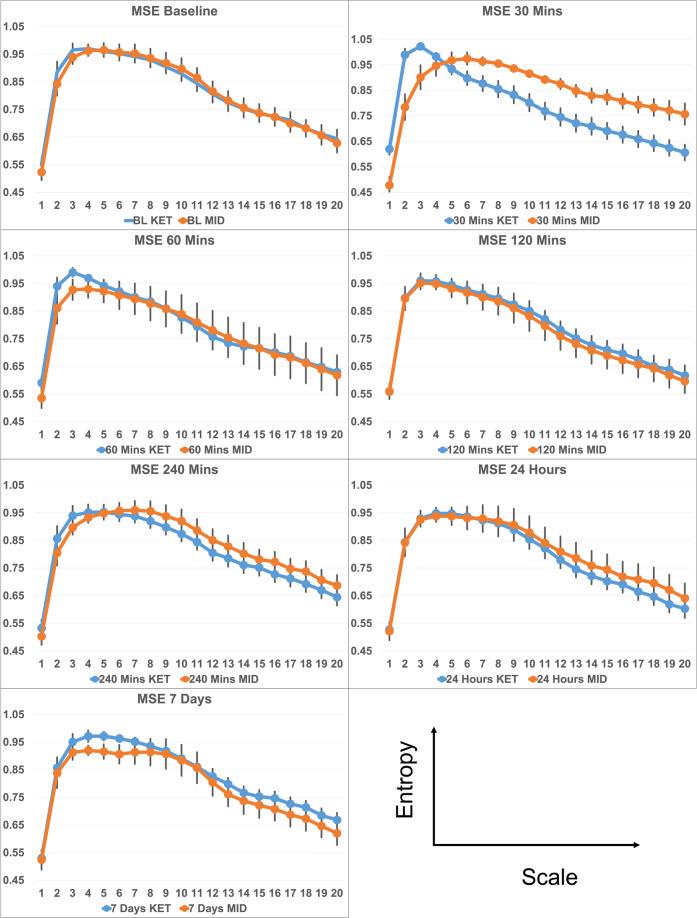
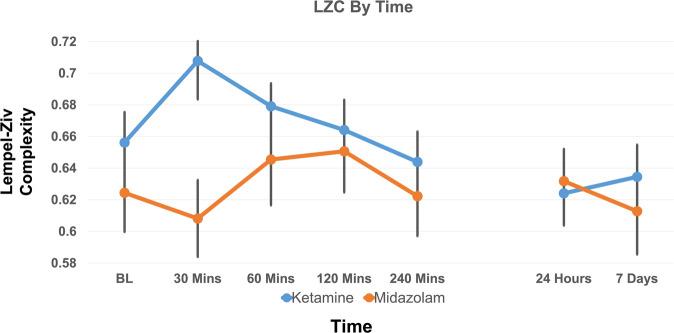
Ketamine is an effective intervention for treatment-resistant depression (TRD), including late-in-life (LL-TRD). The proposed mechanism of antidepressant effects of ketamine is a glutamatergic surge, which can be measured by electroencephalogram (EEG) gamma oscillations. Yet, non-linear EEG biomarkers of ketamine effects such as neural complexity are needed to capture broader systemic effects, represent the level of organization of synaptic communication, and elucidate mechanisms of action for treatment responders. In a secondary analysis of a randomized control trial, we investigated two EEG neural complexity markers (Lempel-Ziv complexity [LZC] and multiscale entropy [MSE]) of rapid (baseline to 240 min) and post-rapid ketamine (24 h and 7 days) effects after one 40-min infusion of IV ketamine or midazolam (active control) in 33 military veterans with LL-TRD. We also studied the relationship between complexity and Montgomery-Åsberg Depression Rating Scale score change at 7 days post-infusion. We found that LZC and MSE both increased 30 min post-infusion, with effects not localized to a single timescale for MSE. Post-rapid effects of reduced complexity with ketamine were observed for MSE. No relationship was observed between complexity and reduction in depressive symptoms. Our findings support the hypothesis that a single sub-anesthetic ketamine infusion has time-varying effects on system-wide contributions to the evoked glutamatergic surge in LL-TRD. Further, changes to complexity were observable outside the time-window previously shown for effects on gamma oscillations. These preliminary results have clinical implications in providing a functional marker of ketamine that is non-linear, amplitude-independent, and represents larger dynamic properties, providing strong advantages over linear measures in highlighting ketamine's effects.
氯胺酮是一种有效的治疗抵抗性抑郁症(TRD)的干预手段,包括老年(LL-TRD)。氯胺酮抗抑郁作用的提出机制是谷氨酸能激增,这可以通过脑电图(EEG)伽马振荡来测量。然而,需要非线性 EEG 生物标志物来捕捉更广泛的系统效应,代表突触通讯的组织水平,并阐明治疗反应者的作用机制。在一项随机对照试验的二次分析中,我们研究了 33 名患有 LL-TRD 的退伍军人在接受一次 40 分钟 IV 氯胺酮或咪达唑仑(活性对照)输注后快速(基线至 240 分钟)和快速后(24 小时和 7 天)的两个 EEG 神经复杂性标志物(Lempel-Ziv 复杂性 [LZC] 和多尺度熵 [MSE])的变化。我们还研究了复杂性与 7 天输注后蒙哥马利-阿斯伯格抑郁评定量表评分变化之间的关系。我们发现,LZC 和 MSE 都在输注后 30 分钟增加,而 MSE 的效应并不局限于单一时间尺度。在接受氯胺酮治疗的患者中,MSE 观察到快速后复杂性降低的效应。复杂性与抑郁症状的减轻之间没有观察到关系。我们的研究结果支持以下假设:单次亚麻醉氯胺酮输注对老年 TRD 中诱发谷氨酸能激增的全系统贡献具有时变效应。此外,在先前显示对伽马振荡效应的时间窗口之外,也可以观察到复杂性的变化。这些初步结果在提供非线性、与振幅无关且代表更大动态特性的氯胺酮功能标志物方面具有临床意义,与线性测量相比,它在突出氯胺酮的作用方面具有明显优势。
 Zotero 插件