
抗阻体育锻炼对阿尔茨海默病APP/PS1小鼠模型的神经保护作用。
Neuroprotective effects of resistance physical exercise on the APP/PS1 mouse model of Alzheimer's disease.
作者信息
Campos Henrique Correia, Ribeiro Deidiane Elisa, Hashiguchi Debora, Glaser Talita, Milanis Milena da Silva, Gimenes Christiane, Suchecki Deborah, Arida Ricardo Mario, Ulrich Henning, Monteiro Longo Beatriz
机构信息
Laboratory of Neurophysiology, Department of Physiology, Universidade Federal de São Paulo, São Paulo, Brazil.
Department of Biochemistry, Institute of Chemistry, University of São Paulo, São Paulo, Brazil.
出版信息
Front Neurosci. 2023 Apr 6;17:1132825. doi: 10.3389/fnins.2023.1132825. eCollection 2023.
INTRODUCTION
Physical exercise has beneficial effects by providing neuroprotective and anti-inflammatory responses to AD. Most studies, however, have been conducted with aerobic exercises, and few have investigated the effects of other modalities that also show positive effects on AD, such as resistance exercise (RE). In addition to its benefits in developing muscle strength, balance and muscular endurance favoring improvements in the quality of life of the elderly, RE reduces amyloid load and local inflammation, promotes memory and cognitive improvements, and protects the cortex and hippocampus from the degeneration that occurs in AD. Similar to AD patients, double-transgenic APPswe/PS1dE9 (APP/PS1) mice exhibit Αβ plaques in the cortex and hippocampus, hyperlocomotion, memory deficits, and exacerbated inflammatory response. Therefore, the aim of this study was to investigate the effects of 4 weeks of RE intermittent training on the prevention and recovery from these AD-related neuropathological conditions in APP/PS1 mice.
METHODS
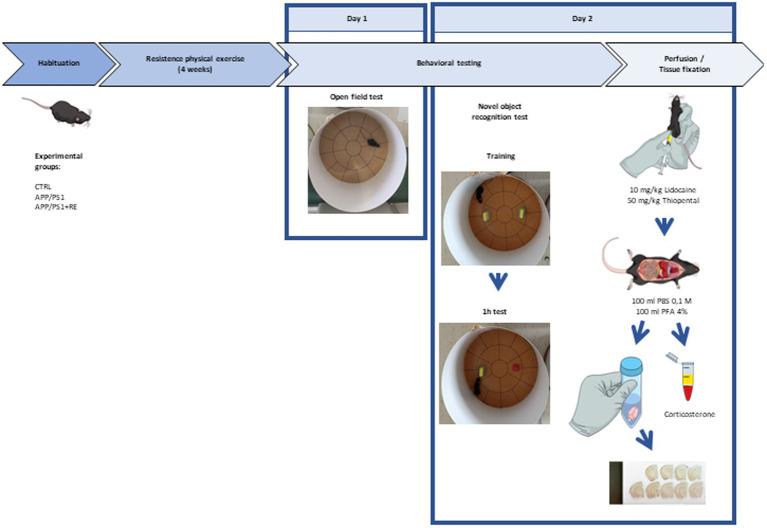
For this purpose, 6-7-month-old male APP/PS1 transgenic mice and their littermates, negative for the mutations (CTRL), were distributed into three groups: CTRL, APP/PS1, APP/PS1+RE. RE training lasted four weeks and, at the end of the program, the animals were tested in the open field test for locomotor activity and in the object recognition test for recognition memory evaluation. The brains were collected for immunohistochemical analysis of Aβ plaques and microglia, and blood was collected for plasma corticosterone by ELISA assay.
RESULTS
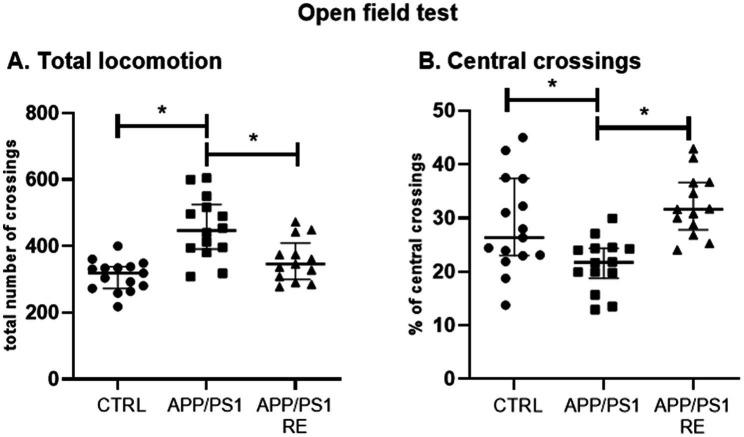
APP/PS1 transgenic sedentary mice showed increased hippocampal Aβ plaques and higher plasma corticosterone levels, as well as hyperlocomotion and reduced central crossings in the open field test, compared to APP/PS1 exercised and control animals. The intermittent program of RE was able to recover the behavioral, corticosterone and Aβ alterations to the CTRL levels. In addition, the RE protocol increased the number of microglial cells in the hippocampus of APP/PS1 mice. Despite these alterations, no memory impairment was observed in APP/PS1 mice in the novel object recognition test.
DISCUSSION
Altogether, the present results suggest that RE plays a role in alleviating AD symptoms, and highlight the beneficial effects of RE training as a complementary treatment for AD.
引言
体育锻炼通过对阿尔茨海默病(AD)产生神经保护和抗炎反应而具有有益作用。然而,大多数研究是针对有氧运动进行的,很少有研究调查其他对AD也有积极作用的运动方式的效果,如抗阻运动(RE)。RE除了有助于增强肌肉力量、平衡能力和肌肉耐力,从而改善老年人的生活质量外,还能减少淀粉样蛋白负荷和局部炎症,促进记忆力和认知能力的改善,并保护皮质和海马体免受AD中发生的退化。与AD患者相似,双转基因APPswe/PS1dE9(APP/PS1)小鼠在皮质和海马体中出现Aβ斑块、运动亢进、记忆缺陷以及炎症反应加剧。因此,本研究的目的是调查4周的RE间歇训练对APP/PS1小鼠预防和恢复这些与AD相关的神经病理状况的影响。
方法
为此,将6至7个月大的雄性APP/PS1转基因小鼠及其未携带突变的同窝小鼠(对照组)分为三组:对照组、APP/PS1组、APP/PS1+RE组。RE训练持续四周,在训练结束时,对动物进行旷场试验以评估运动活动,进行物体识别试验以评估识别记忆。收集大脑用于Aβ斑块和小胶质细胞的免疫组织化学分析,并收集血液通过酶联免疫吸附测定法检测血浆皮质酮水平。
结果
与进行运动的APP/PS1组和对照组动物相比,久坐不动的APP/PS1转基因小鼠海马体中的Aβ斑块增多,血浆皮质酮水平升高,在旷场试验中表现出运动亢进且穿越中央区域的次数减少。RE间歇训练方案能够使行为、皮质酮和Aβ的改变恢复到对照组水平。此外,RE方案增加了APP/PS1小鼠海马体中小胶质细胞的数量。尽管有这些改变,但在新物体识别试验中未观察到APP/PS1小鼠存在记忆障碍。
讨论
总的来说,目前的结果表明RE在减轻AD症状方面发挥作用,并突出了RE训练作为AD辅助治疗的有益效果。



 Zotero 插件