
载脂蛋白包覆的介孔硅纳米颗粒通过递送 CRISPR-Cas9 核糖核蛋白用于抗病毒应用。
Lipid-coated mesoporous silica nanoparticles for anti-viral applications via delivery of CRISPR-Cas9 ribonucleoproteins.
机构信息
Department of Biotechnology and Bioengineering, Sandia National Laboratories, Livermore, USA.
Department of Systems Biology, Sandia National Laboratories, Livermore, USA.
出版信息
Sci Rep. 2023 Apr 27;13(1):6873. doi: 10.1038/s41598-023-33092-4.
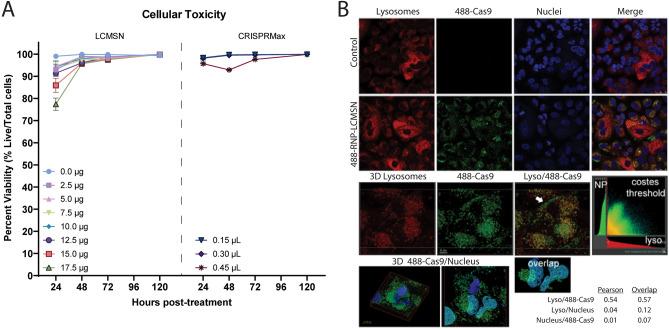
Emerging and re-emerging viral pathogens present a unique challenge for anti-viral therapeutic development. Anti-viral approaches with high flexibility and rapid production times are essential for combating these high-pandemic risk viruses. CRISPR-Cas technologies have been extensively repurposed to treat a variety of diseases, with recent work expanding into potential applications against viral infections. However, delivery still presents a major challenge for these technologies. Lipid-coated mesoporous silica nanoparticles (LCMSNs) offer an attractive delivery vehicle for a variety of cargos due to their high biocompatibility, tractable synthesis, and amenability to chemical functionalization. Here, we report the use of LCMSNs to deliver CRISPR-Cas9 ribonucleoproteins (RNPs) that target the Niemann-Pick disease type C1 gene, an essential host factor required for entry of the high-pandemic risk pathogen Ebola virus, demonstrating an efficient reduction in viral infection. We further highlight successful in vivo delivery of the RNP-LCMSN platform to the mouse liver via systemic administration.
新兴和重现的病毒病原体对抗病毒治疗药物的开发提出了独特的挑战。具有高灵活性和快速生产时间的抗病毒方法对于对抗这些高流行风险病毒至关重要。CRISPR-Cas 技术已被广泛重新用于治疗各种疾病,最近的工作扩展到了针对病毒感染的潜在应用。然而,这些技术的递送仍然是一个主要挑战。由于其高生物相容性、可处理的合成以及对化学官能化的适应性,脂质包覆的介孔硅纳米颗粒(LCMSNs)为各种载药提供了一种有吸引力的递送载体。在这里,我们报告了使用 LCMSNs 递送至尼曼-匹克病 C1 型基因的 CRISPR-Cas9 核糖核蛋白(RNP),尼曼-匹克病 C1 型基因是高流行风险病原体埃博拉病毒进入所必需的关键宿主因子,证明了对病毒感染的有效降低。我们进一步强调了通过系统给药将 RNP-LCMSN 平台成功递送至小鼠肝脏的体内。



 Zotero 插件