
奥西罗度他在库欣病中的临床应用:现有文献综述。
Clinical Utility of Osilodrostat in Cushing's Disease: Review of Currently Available Literature.
机构信息
Neuroendocrine Unit, Massachusetts General Hospital, Boston, MA, USA.
Department of Medicine, South Shore Hospital, South Weymouth, MA, USA.
出版信息
Drug Des Devel Ther. 2023 Apr 27;17:1303-1312. doi: 10.2147/DDDT.S315359. eCollection 2023.
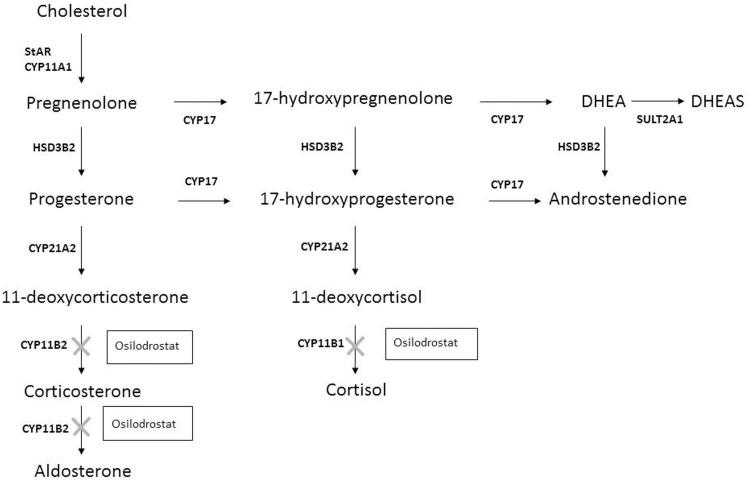
Cushing's disease (CD) is caused by endogenous hypercortisolism as a result of adrenocorticotropin (ACTH) secretion from a pituitary tumor. The condition is associated with multiple comorbidities and increased mortality. First-line therapy for CD is pituitary surgery, performed by an experienced pituitary neurosurgeon. Hypercortisolism may often persist or recur after initial surgery. Patients with persistent or recurrent CD will generally benefit from medical therapy, often administered to patients who underwent radiation therapy to the sella and are awaiting its salutary effects. There are three groups of medications directed against CD, including pituitary-targeted medications that inhibit ACTH secretion from tumorous corticotroph cells, adrenally-directed medications that inhibit adrenal steroidogenesis and a glucocorticoid receptor (GR) antagonist. The focus of this review is osilodrostat, a steroidogenesis inhibitor. Osilodrostat (LCI699) was initially developed to lower serum aldosterone levels and control hypertension. However, it was soon realized that osilodrostat also inhibits 11-beta hydroxylase (CYP11B1), leading to a reduction in serum cortisol levels. The focus of drug development then shifted from treatment of hypertension to treatment of hypercortisolism in CD. In a series of studies (LINC 1 through 4), osilodrostat was shown to be effective in normalizing 24-h urinary free cortisol (UFC) in the majority of treated patients and was approved for patients with CD who have failed surgery or are not surgical candidates. Further study is needed to examine the role of combination therapy as well as long-term outcomes of treated patients. Osilodrostat was shown to have an overall good safety profile. Most common adverse effects include nausea, headache, fatigue, arthralgias, dizziness, prolonged QT interval, hypokalemia. In females, the drug can cause hirsutism and acne. Osilodrostat is administered twice daily, making it a good choice for patients with difficulty adhering to more complex regimens. Osilodrostat has an important, albeit adjunctive, role in the management of patients with CD.
库欣病(CD)是由垂体肿瘤分泌促肾上腺皮质激素(ACTH)引起的内源性皮质醇增多症。这种情况与多种合并症和死亡率增加有关。CD 的一线治疗方法是由经验丰富的垂体神经外科医生进行的垂体手术。皮质醇增多症在初次手术后往往仍然存在或复发。患有持续性或复发性 CD 的患者通常会从药物治疗中受益,这些药物通常用于接受鞍区放疗并等待其治疗效果的患者。有三组针对 CD 的药物,包括靶向垂体的药物,可抑制肿瘤性促肾上腺皮质激素细胞分泌 ACTH;作用于肾上腺的药物,可抑制肾上腺类固醇生成;以及糖皮质激素受体(GR)拮抗剂。本综述的重点是抑制类固醇生成的药物奥昔罗司他。奥昔罗司他(LCI699)最初是为了降低血清醛固酮水平和控制高血压而开发的。然而,人们很快意识到奥昔罗司他还抑制 11-β羟化酶(CYP11B1),导致血清皮质醇水平降低。药物开发的重点随后从治疗高血压转移到治疗 CD 中的皮质醇增多症。在一系列研究(LINC 1 至 4)中,奥昔罗司他被证明在大多数接受治疗的患者中有效使 24 小时尿游离皮质醇(UFC)正常化,并被批准用于手术失败或不适合手术的 CD 患者。需要进一步研究来检查联合治疗的作用以及治疗患者的长期结果。奥昔罗司他总体安全性良好。最常见的不良反应包括恶心、头痛、疲劳、关节痛、头晕、QT 间期延长、低钾血症。在女性中,该药会导致多毛症和痤疮。奥昔罗司他每天给药两次,这对难以坚持更复杂治疗方案的患者是一个很好的选择。奥昔罗司他在 CD 患者的管理中具有重要作用,尽管是辅助作用。
 Zotero 插件