
手性药物功能化金手性纳米粒子的合成与表征
Synthesis and Characterization of Gold Chiral Nanoparticles Functionalized by a Chiral Drug.
作者信息
Bettini Simona, Ottolini Michela, Valli Donato, Pagano Rosanna, Ingrosso Chiara, Roeffaers Maarten, Hofkens Johan, Valli Ludovico, Giancane Gabriele
机构信息
Department of Biological and Environmental Sciences and Technologies, University of Salento, Via per Monteroni, 73100 Lecce, Italy.
Department of Engineering for Innovation, University of Salento, Via per Monteroni, 73100 Lecce, Italy.
出版信息
Nanomaterials (Basel). 2023 Apr 30;13(9):1526. doi: 10.3390/nano13091526.
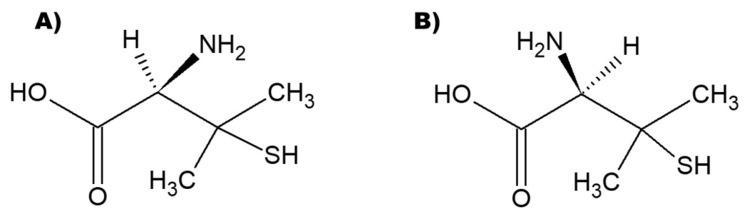
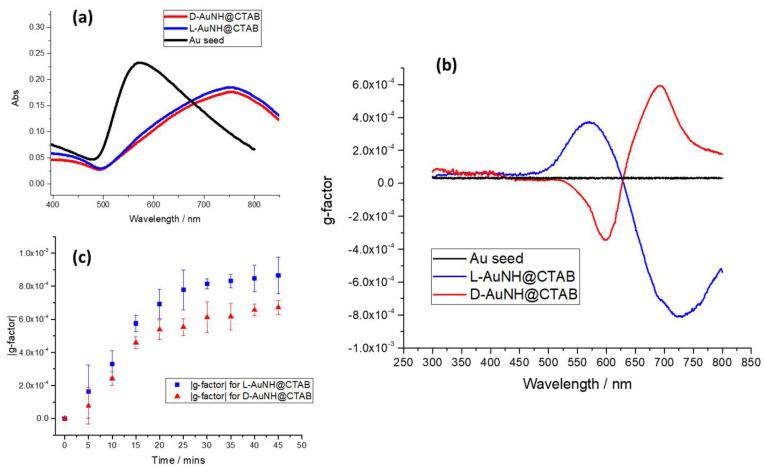
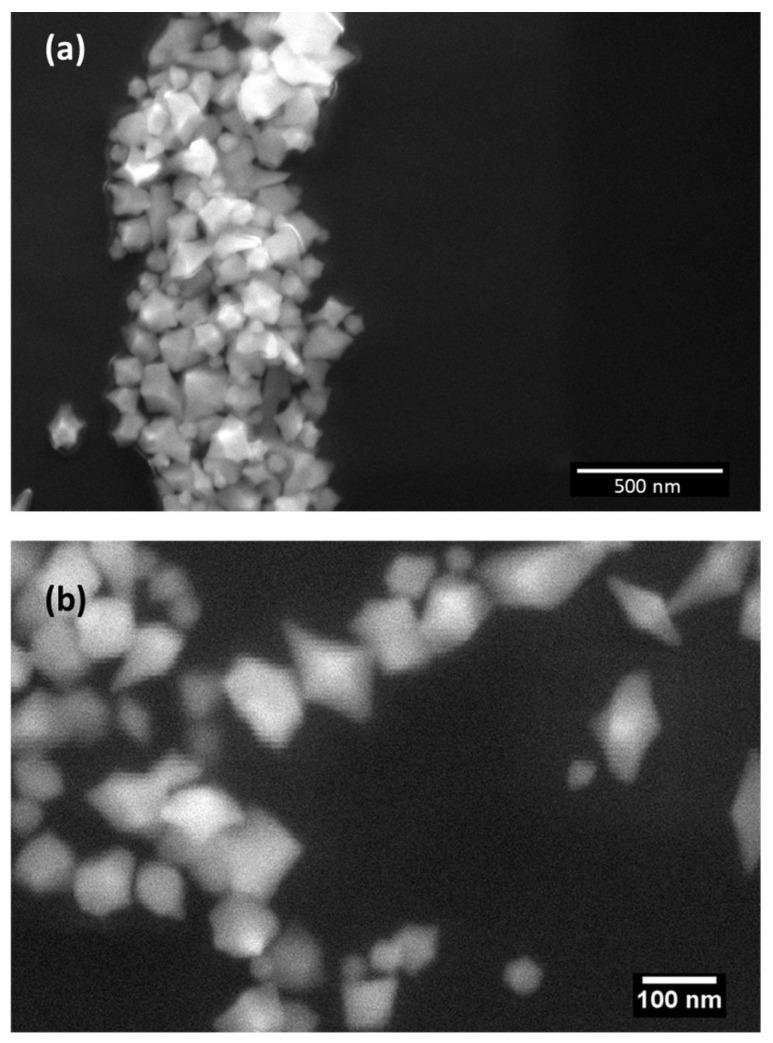
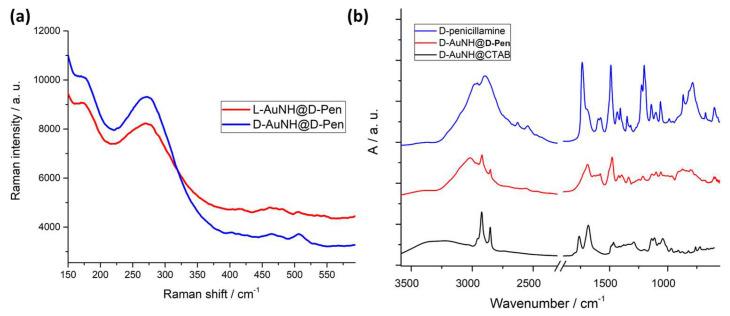
Inorganic chiral nanoparticles are attracting more and more attention due to their peculiar optical properties and potential biological applications, such as bioimaging, therapeutics, and diagnostics. Among inorganic chiral nanoparticles, gold chiral nanostructures were demonstrated to be very interesting in this context, with good physical chemical stability and also the possibility to decorate the surface, improving biomedical application as the interaction with the bio-systems. Gold (Au) nanostructures were synthesized according to a seed-mediated procedure which envisages the use of cetyltrimethylammonium bromide (CTAB) as the capping agent and L- and D-cysteine to promote chirality. Au nanostructures have been demonstrated to have opposite circular dichroism signals depending on the amino acid enantiomer used during the synthesis. Then, a procedure to decorate the Au surface with penicillamine, a drug used for the treatment of Wilson's disease, was developed. The composite material of gold nanoparticles/penicillamine was characterized using electron microscopy, and the penicillamine functionalization was monitored by means of UV-Visible, Raman, and infrared spectroscopy, highlighting the formation of the Au-S bond. Furthermore, electron circular dichroism was used to monitor the chirality of the synthesized nanostructures and it was demonstrated that both penicillamine enantiomers can be successfully bonded with both the enantiomers of the gold nanostructures without affecting gold nanoparticles' chirality. The effective modification of nanostructures' surfaces via penicillamine introduction allowed us to address the important issue of controlling chirality and surface properties in the chiral nano-system.
无机手性纳米粒子因其独特的光学性质和潜在的生物应用,如生物成像、治疗和诊断等,正吸引着越来越多的关注。在无机手性纳米粒子中,金手性纳米结构在这方面表现出极大的吸引力,具有良好的物理化学稳定性,并且能够修饰表面,改善与生物系统的相互作用,从而提升生物医学应用性能。金(Au)纳米结构是根据种子介导法合成的,该方法设想使用十六烷基三甲基溴化铵(CTAB)作为封端剂,并使用L-半胱氨酸和D-半胱氨酸来促进手性的产生。已证明,根据合成过程中所使用的氨基酸对映体不同,金纳米结构具有相反的圆二色性信号。随后,开发了一种用用于治疗威尔逊病的药物青霉胺修饰金表面的方法。使用电子显微镜对金纳米粒子/青霉胺复合材料进行了表征,并通过紫外可见光谱、拉曼光谱和红外光谱监测青霉胺的功能化过程,突出显示了Au-S键的形成。此外,利用电子圆二色性监测合成纳米结构的手性,结果表明,两种青霉胺对映体均可成功地与金纳米结构的两种对映体结合,而不影响金纳米粒子的手性。通过引入青霉胺对纳米结构表面进行有效修饰,使我们能够解决手性纳米系统中控制手性和表面性质这一重要问题。



 Zotero 插件