
临床流行病学与德国抗菌药物耐药相关病死率:一项系统评价和荟萃分析,2010 年 1 月 1 日至 2021 年 12 月 31 日。
Clinical epidemiology and case fatality due to antimicrobial resistance in Germany: a systematic review and meta-analysis, 1 January 2010 to 31 December 2021.
机构信息
Institute of General Practice and Family Medicine, Jena University Hospital, Friedrich Schiller University Jena, Jena, Germany.
Unit for Healthcare Associated Infections, Surveillance of Antimicrobial Resistance and Consumption, Department of Infectious Disease Epidemiology, Robert Koch Institute, Berlin, Germany.
出版信息
Euro Surveill. 2023 May;28(20). doi: 10.2807/1560-7917.ES.2023.28.20.2200672.
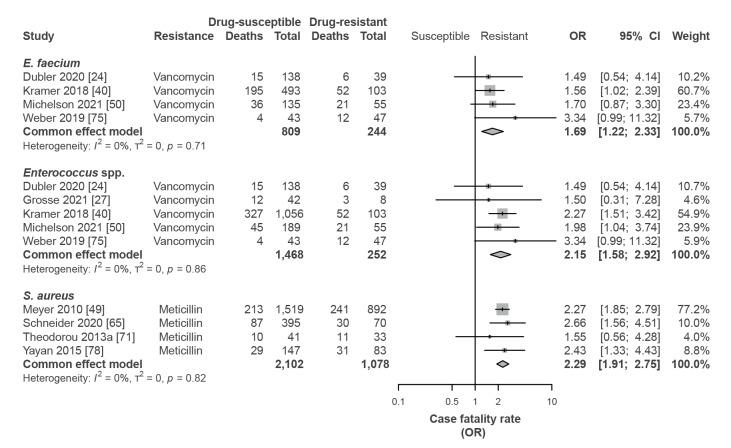
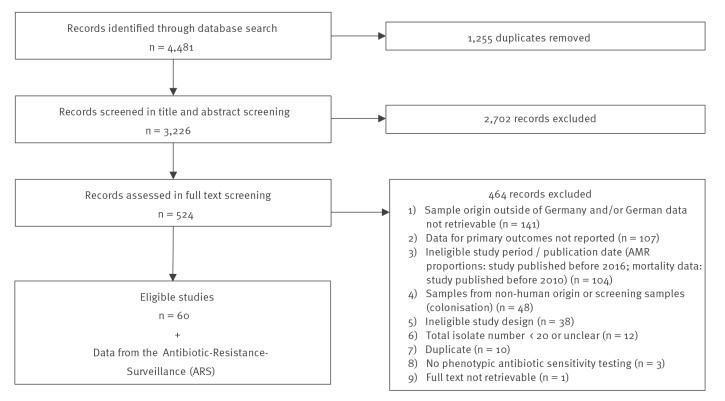
BackgroundAntimicrobial resistance (AMR) is of public health concern worldwide.AimWe aimed to summarise the German AMR situation for clinicians and microbiologists.MethodsWe conducted a systematic review and meta-analysis of 60 published studies and data from the German (ARS). Primary outcomes were AMR proportions in bacterial isolates from infected patients in Germany (2016-2021) and the case fatality rates (2010-2021). Random and fixed (common) effect models were used to calculate pooled proportions and pooled case fatality odds ratios, respectively.ResultsThe pooled proportion of meticillin resistance in infections (MRSA) was 7.9% with a declining trend between 2014 and 2020 (odds ratio (OR) = 0.89; 95% CI: 0.886-0.891; p < 0.0001), while vancomycin resistance in (VRE) bloodstream infections increased (OR = 1.18; (95% CI: 1.16-1.21); p < 0.0001) with a pooled proportion of 34.9%. Case fatality rates for MRSA and VRE were higher than for their susceptible strains (OR = 2.29; 95% CI: 1.91-2.75 and 1.69; 95% CI: 1.22-2.33, respectively). Carbapenem resistance in Gram-negative pathogens (, , spp. and ) was low to moderate (< 9%), but resistance against third-generation cephalosporins and fluoroquinolones was moderate to high (5-25%). exhibited high resistance against carbapenems (17.0%; 95% CI: 11.9-22.8), third-generation cephalosporins (10.1%; 95% CI: 6.6-14.2) and fluoroquinolones (24.9%; 95% CI: 19.3-30.9). Statistical heterogeneity was high (I2 > 70%) across studies reporting resistance proportions.ConclusionContinuous efforts in AMR surveillance and infection prevention and control as well as antibiotic stewardship are needed to limit the spread of AMR in Germany.
背景
抗菌药物耐药性(AMR)是全球公共卫生关注的问题。
目的
本研究旨在为临床医生和微生物学家总结德国 AMR 现状。
方法
我们对 60 篇已发表的研究和德国 (ARS)数据进行了系统评价和荟萃分析。主要结局指标为德国感染患者分离细菌的 AMR 比例(2016-2021 年)和病死率(2010-2021 年)。采用随机效应和固定效应模型分别计算汇总比例和汇总病死率比值比。
结果
感染的甲氧西林耐药 (MRSA)比例为 7.9%,2014 年至 2020 年呈下降趋势(比值比(OR)=0.89;95%CI:0.886-0.891;p<0.0001),而 血流感染的万古霉素耐药 (VRE)则呈上升趋势(OR=1.18;95%CI:1.16-1.21;p<0.0001),其汇总比例为 34.9%。MRSA 和 VRE 的病死率高于其敏感株(OR=2.29;95%CI:1.91-2.75 和 1.69;95%CI:1.22-2.33)。革兰氏阴性病原体( 、 、 spp. 和 )的碳青霉烯类耐药程度为低至中度(<9%),但对第三代头孢菌素类和氟喹诺酮类的耐药程度为中至高度(5-25%)。 对碳青霉烯类(17.0%;95%CI:11.9-22.8)、第三代头孢菌素类(10.1%;95%CI:6.6-14.2)和氟喹诺酮类(24.9%;95%CI:19.3-30.9)的耐药率较高。报告耐药率的研究之间存在高度统计学异质性(I2>70%)。
结论
需要持续努力进行 AMR 监测、感染预防和控制以及抗生素管理,以限制德国 AMR 的传播。
 Zotero 插件