
生物膜中的抗生素耐药机制。
Mechanisms of antibiotic resistance in biofilms.
作者信息
Fernández-Billón María, Llambías-Cabot Aina E, Jordana-Lluch Elena, Oliver Antonio, Macià María D
机构信息
Department of Microbiology, Hospital Universitario Son Espases, Health Research Institute of the Balearic Islands (IdISBa), 07120, Palma de Mallorca, Spain.
Centro de Investigación Biomédica en Red en Enfermedades Infecciosas, Instituto de Salud Carlos III (CIBERINFEC), 28029, Madrid, Spain.
出版信息
Biofilm. 2023 May 2;5:100129. doi: 10.1016/j.bioflm.2023.100129. eCollection 2023 Dec.
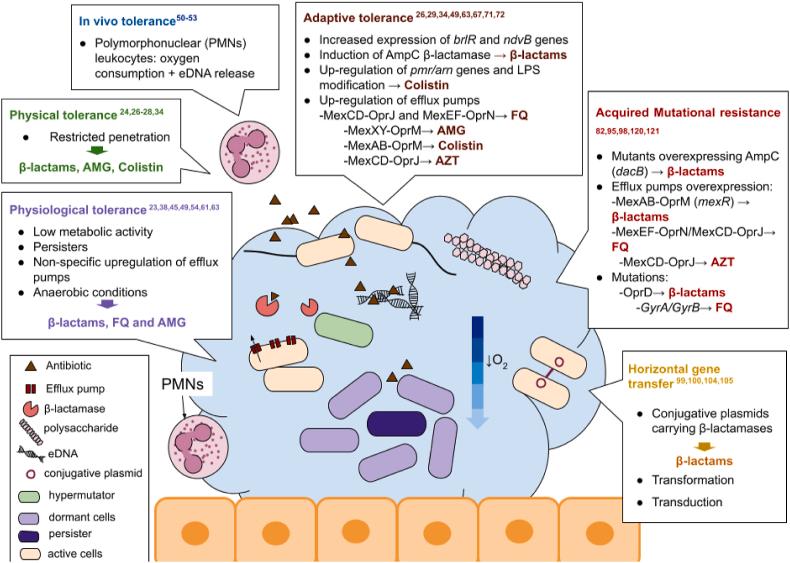
is a major cause of life-threatening acute infections and life-long lasting chronic infections. The characteristic biofilm mode of life in chronic infections severely limits the efficacy of antimicrobial therapies, as it leads to intrinsic tolerance, involving physical and physiological factors in addition to biofilm-specific genes that can confer a transient protection against antibiotics promoting the development of resistance. Indeed, a striking feature of this pathogen is the extraordinary capacity to develop resistance to nearly all available antibiotics through the selection of chromosomal mutations, evidenced by its outstanding and versatile mutational resistome. This threat is dramatically amplified in chronic infections, driven by the frequent emergence of mutator variants with enhanced spontaneous mutation rates. Thus, this mini review is focused on describing the complex interplay of antibiotic resistance mechanisms in biofilms, to provide potentially useful information for the design of effective therapeutic strategies.
是危及生命的急性感染和长期慢性感染的主要原因。慢性感染中典型的生物膜生活方式严重限制了抗菌治疗的效果,因为它导致内在耐受性,除了生物膜特异性基因外,还涉及物理和生理因素,这些基因可提供对促进耐药性发展的抗生素的短暂保护。事实上,这种病原体的一个显著特征是通过选择染色体突变对几乎所有可用抗生素产生耐药性的非凡能力,其出色且多样的突变抗性组证明了这一点。在慢性感染中,由于具有增强自发突变率的突变变体频繁出现,这种威胁被极大地放大。因此,本综述聚焦于描述生物膜中抗生素耐药机制的复杂相互作用,为设计有效的治疗策略提供潜在有用的信息。
 Zotero 插件