Thang Morrent, Mellows Clara, Mercer-Smith Alison, Nguyen Phuong, Hingtgen Shawn
Neuroscience Center, University of North Carolina-Chapel Hill School of Medicine, Chapel Hill, North Carolina, USA.
Division of Pharmacoengineering and Molecular Pharmaceutics, University of North Carolina-Chapel Hill School of Pharmacy, Chapel Hill, North Carolina, USA.
Neurooncol Adv. 2023 Apr 21;5(1):vdad047. doi: 10.1093/noajnl/vdad047. eCollection 2023 Jan-Dec.
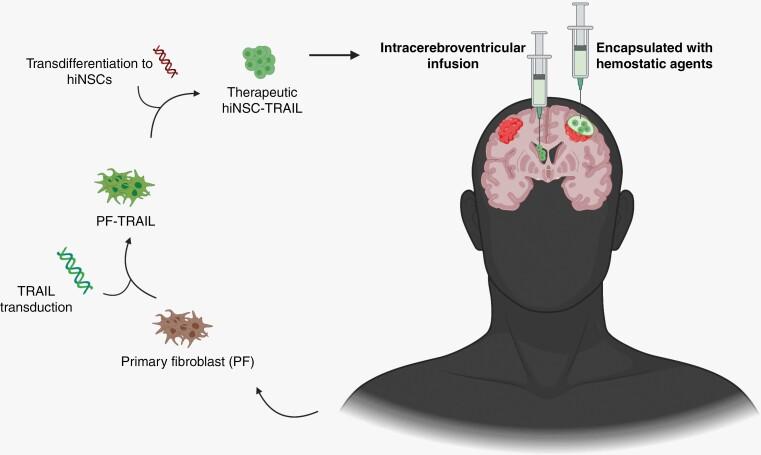
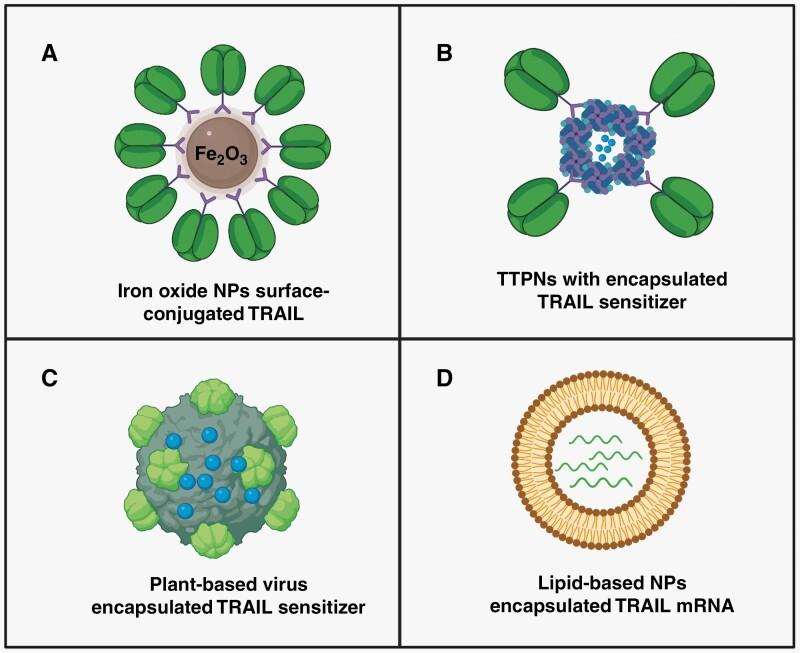
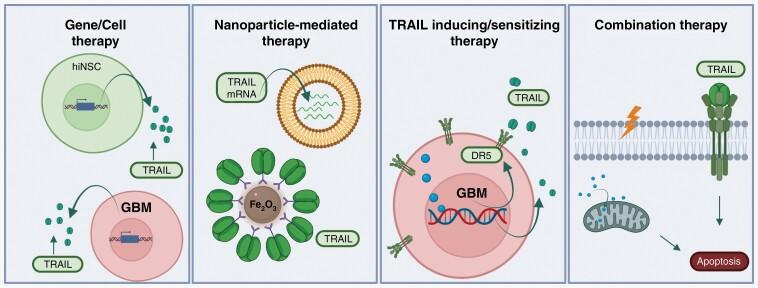
Glioblastoma (GBM) is the most prevalent, aggressive, primary brain cancer in adults and continues to pose major medical challenges due in part to its high rate of recurrence. Extensive research is underway to discover new therapies that target GBM cells and prevent the inevitable recurrence in patients. The pro-apoptotic protein tumor necrosis factor-related apoptosis-inducing ligand (TRAIL) has attracted attention as an ideal anticancer agent due to its ability to selectively kill cancer cells with minimal toxicity in normal cells. Although initial clinical evaluations of TRAIL therapies in several cancers were promising, later stages of clinical trial results indicated that TRAIL and TRAIL-based therapies failed to demonstrate robust efficacies due to poor pharmacokinetics, resulting in insufficient concentrations of TRAIL at the therapeutic site. However, recent studies have developed novel ways to prolong TRAIL bioavailability at the tumor site and efficiently deliver TRAIL and TRAIL-based therapies using cellular and nanoparticle vehicles as drug loading cargos. Additionally, novel techniques have been developed to address monotherapy resistance, including modulating biomarkers associated with TRAIL resistance in GBM cells. This review highlights the promising work to overcome the challenges of TRAIL-based therapies with the aim to facilitate improved TRAIL efficacy against GBM.
胶质母细胞瘤(GBM)是成人中最常见、侵袭性最强的原发性脑癌,部分由于其高复发率,仍然构成重大医学挑战。目前正在进行广泛研究,以发现针对GBM细胞并防止患者不可避免复发的新疗法。促凋亡蛋白肿瘤坏死因子相关凋亡诱导配体(TRAIL)因其能够以对正常细胞毒性最小的方式选择性杀死癌细胞,而作为一种理想的抗癌剂受到关注。尽管TRAIL疗法在几种癌症中的初步临床评估前景乐观,但临床试验后期结果表明,由于药代动力学不佳,TRAIL和基于TRAIL的疗法未能显示出强大疗效,导致治疗部位的TRAIL浓度不足。然而,最近的研究已经开发出延长TRAIL在肿瘤部位生物利用度的新方法,并使用细胞和纳米颗粒载体作为药物装载物有效递送TRAIL和基于TRAIL的疗法。此外,还开发了新技术来解决单一疗法耐药性问题,包括调节与GBM细胞中TRAIL耐药性相关的生物标志物。本综述重点介绍了为克服基于TRAIL的疗法的挑战而开展的有前景的工作,旨在提高TRAIL对GBM的疗效。

 Zotero 插件