
全球、区域和国家对母体肺炎克雷伯菌疫苗影响的估计:贝叶斯建模分析。
Global, regional, and national estimates of the impact of a maternal Klebsiella pneumoniae vaccine: A Bayesian modeling analysis.
机构信息
Princeton University, Princeton, New Jersey, United States of America.
Ineos Oxford Institute for Antimicrobial Resistance, Department of Zoology, Oxford, United Kingdom.
出版信息
PLoS Med. 2023 May 22;20(5):e1004239. doi: 10.1371/journal.pmed.1004239. eCollection 2023 May.
BACKGROUND
Despite significant global progress in reducing neonatal mortality, bacterial sepsis remains a major cause of neonatal deaths. Klebsiella pneumoniae (K. pneumoniae) is the leading pathogen globally underlying cases of neonatal sepsis and is frequently resistant to antibiotic treatment regimens recommended by the World Health Organization (WHO), including first-line therapy with ampicillin and gentamicin, second-line therapy with amikacin and ceftazidime, and meropenem. Maternal vaccination to prevent neonatal infection could reduce the burden of K. pneumoniae neonatal sepsis in low- and middle-income countries (LMICs), but the potential impact of vaccination remains poorly quantified. We estimated the potential impact of such vaccination on cases and deaths of K. pneumoniae neonatal sepsis and project the global effects of routine immunization of pregnant women with the K. pneumoniae vaccine as antimicrobial resistance (AMR) increases.
METHODS AND FINDINGS
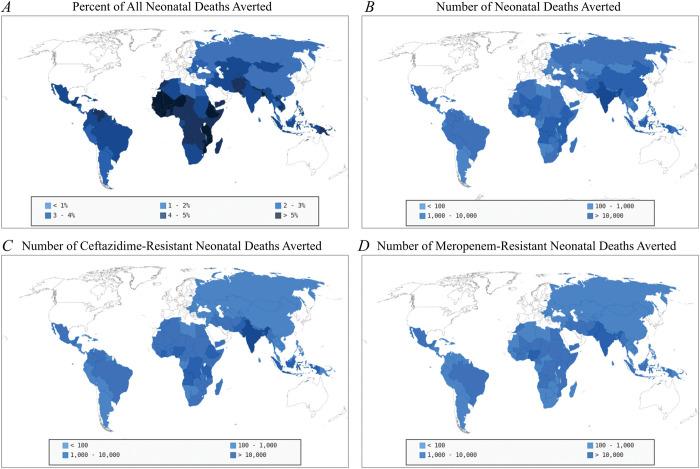
We developed a Bayesian mixture-modeling framework to estimate the effects of a hypothetical K. pneumoniae maternal vaccine with 70% efficacy administered with coverage equivalent to that of the maternal tetanus vaccine on neonatal sepsis infections and mortality. To parameterize our model, we used data from 3 global studies of neonatal sepsis and/or mortality-with 2,330 neonates who died with sepsis surveilled from 2016 to 2020 undertaken in 18 mainly LMICs across all WHO regions (Ethiopia, Kenya, Mali, Mozambique, Nigeria, Rwanda, Sierra Leone, South Africa, Uganda, Brazil, Italy, Greece, Pakistan, Bangladesh, India, Thailand, China, and Vietnam). Within these studies, 26.95% of fatal neonatal sepsis cases were culture-positive for K. pneumoniae. We analyzed 9,070 K. pneumoniae genomes from human isolates gathered globally from 2001 to 2020 to quantify the temporal rate of acquisition of AMR genes in K. pneumoniae isolates to predict the future number of drug-resistant cases and deaths that could be averted by vaccination. Resistance rates to carbapenems are increasing most rapidly and 22.43% [95th percentile Bayesian credible interval (CrI): 5.24 to 41.42] of neonatal sepsis deaths are caused by meropenem-resistant K. pneumoniae. Globally, we estimate that maternal vaccination could avert 80,258 [CrI: 18,084 to 189,040] neonatal deaths and 399,015 [CrI: 334,523 to 485,442] neonatal sepsis cases yearly worldwide, accounting for more than 3.40% [CrI: 0.75 to 8.01] of all neonatal deaths. The largest relative benefits are in Africa (Sierra Leone, Mali, Niger) and South-East Asia (Bangladesh) where vaccination could avert over 6% of all neonatal deaths. Nevertheless, our modeling only considers country-level trends in K. pneumoniae neonatal sepsis deaths and is unable to consider within-country variability in bacterial prevalence that may impact the projected burden of sepsis.
CONCLUSIONS
A K. pneumoniae maternal vaccine could have widespread, sustained global benefits as AMR in K. pneumoniae continues to increase.
背景
尽管全球在降低新生儿死亡率方面取得了重大进展,但细菌性败血症仍然是新生儿死亡的主要原因。肺炎克雷伯菌(K. pneumoniae)是全球导致新生儿败血症的主要病原体,并且经常对世界卫生组织(WHO)推荐的抗生素治疗方案产生抗药性,包括氨苄西林和庆大霉素的一线治疗、阿米卡星和头孢他啶的二线治疗以及美罗培南。针对母体的疫苗接种可以预防新生儿感染,从而降低中低收入国家(LMICs)中肺炎克雷伯菌引起的新生儿败血症负担,但疫苗接种的潜在影响仍未得到充分量化。我们估计了这种疫苗接种对肺炎克雷伯菌新生儿败血症病例和死亡的潜在影响,并预测了随着抗生素耐药性(AMR)的增加,对孕妇进行常规肺炎克雷伯菌疫苗接种的全球影响。
方法和发现
我们开发了一个贝叶斯混合模型框架,以估计一种假设的肺炎克雷伯菌母体疫苗的效果,该疫苗的有效性为 70%,接种范围与破伤风母体疫苗相当,可用于预防新生儿败血症感染和死亡。为了参数化我们的模型,我们使用了来自全球 3 项新生儿败血症和/或死亡率研究的数据,这些研究在所有 WHO 区域(埃塞俄比亚、肯尼亚、马里、莫桑比克、尼日利亚、卢旺达、塞拉利昂、南非、乌干达、巴西、意大利、希腊、巴基斯坦、孟加拉国、印度、泰国、中国和越南)中进行,共有 18 个主要的 LMICs。在这些研究中,26.95%的致命性新生儿败血症病例的培养物呈肺炎克雷伯菌阳性。我们分析了全球范围内 2001 年至 2020 年间从人类分离株中收集的 9070 个肺炎克雷伯菌基因组,以量化肺炎克雷伯菌分离株中获得抗生素耐药性基因的时间速率,从而预测可以通过疫苗接种预防的耐药病例和死亡数量。碳青霉烯类药物的耐药率增长最快,22.43%(95%贝叶斯可信区间(CrI):5.24 至 41.42)的新生儿败血症死亡是由美罗培南耐药肺炎克雷伯菌引起的。全球范围内,我们估计母体疫苗接种每年可以避免 80258 例(CrI:18084 至 189040 例)新生儿死亡和 399015 例(CrI:334523 至 485442 例)新生儿败血症病例,占所有新生儿死亡人数的 3.40%以上(CrI:0.75 至 8.01)。最大的相对益处是在非洲(塞拉利昂、马里、尼日尔)和东南亚(孟加拉国),疫苗接种可以避免超过 6%的所有新生儿死亡。然而,我们的模型仅考虑了肺炎克雷伯菌新生儿败血症死亡的国家层面趋势,无法考虑可能影响败血症负担的国家内细菌流行率的变化。
结论
随着肺炎克雷伯菌的抗生素耐药性继续增加,肺炎克雷伯菌母体疫苗可能会在全球范围内产生广泛而持续的益处。


 Zotero 插件