
凝血因子对子宫内膜异位症风险的影响:一项孟德尔随机化研究。
The effects of coagulation factors on the risk of endometriosis: a Mendelian randomization study.
机构信息
Department of Family Planning, The Second Hospital of Tianjin Medical University, The Province and Ministry Co-Sponsored Collaborative Innovation Center for Medical Epigenetics, Tianjin Key Laboratory of Inflammation Biology, School of Basic Medical Sciences, Tianjin Medical University, Tianjin, 300070, China.
State Key Laboratory of Experimental Hematology, National Clinical Research Center for Blood Diseases, Haihe Laboratory of Cell Ecosystems, Institute of Hematology and Blood Diseases Hospital, Chinese Academy of Medical Sciences and Peking Union Medical College, Tianjin, 300020, China.
出版信息
BMC Med. 2023 May 25;21(1):195. doi: 10.1186/s12916-023-02881-z.
BACKGROUND
Endometriosis is recognized as a complex gynecological disorder that can cause severe pain and infertility, affecting 6-10% of all reproductive-aged women. Endometriosis is a condition in which endometrial tissue, which normally lines the inside of the uterus, deposits in other tissues. The etiology and pathogenesis of endometriosis remain ambiguous. Despite debates, it is generally agreed that endometriosis is a chronic inflammatory disease, and patients with endometriosis appear to be in a hypercoagulable state. The coagulation system plays important roles in hemostasis and inflammatory responses. Therefore, the purpose of this study is to use publicly available GWAS summary statistics to examine the causal relationship between coagulation factors and the risk of endometriosis.
METHODS
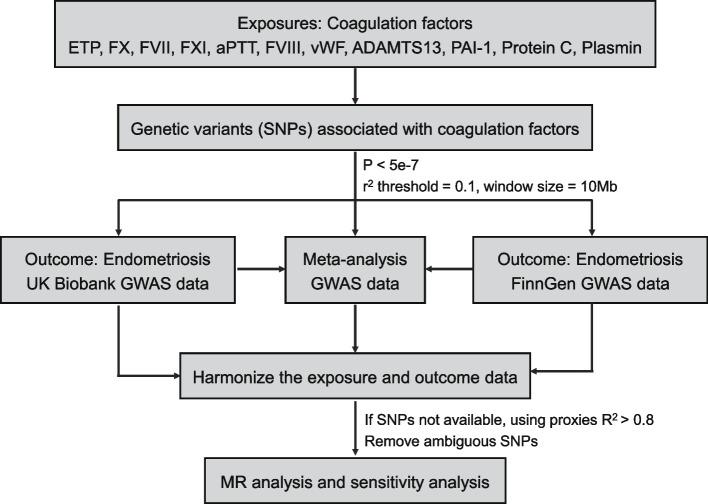
To investigate the causal relationship between coagulation factors and the risk of endometriosis, a two-sample Mendelian randomization (MR) analytic framework was used. A series of quality control procedures were followed in order to select eligible instrumental variables that were strongly associated with the exposures (vWF, ADAMTS13, aPTT, FVIII, FXI, FVII, FX, ETP, PAI-1, protein C, and plasmin). Two independent cohorts of European ancestry with endometriosis GWAS summary statistics were used: UK Biobank (4354 cases and 217,500 controls) and FinnGen (8288 cases and 68,969 controls). We conducted MR analyses separately in the UK Biobank and FinnGen, followed by a meta-analysis. The Cochran's Q test, MR-Egger intercept test, and leave-one-out sensitivity analyses were used to assess the heterogeneities, horizontal pleiotropy, and stabilities of SNPs in endometriosis.
RESULTS
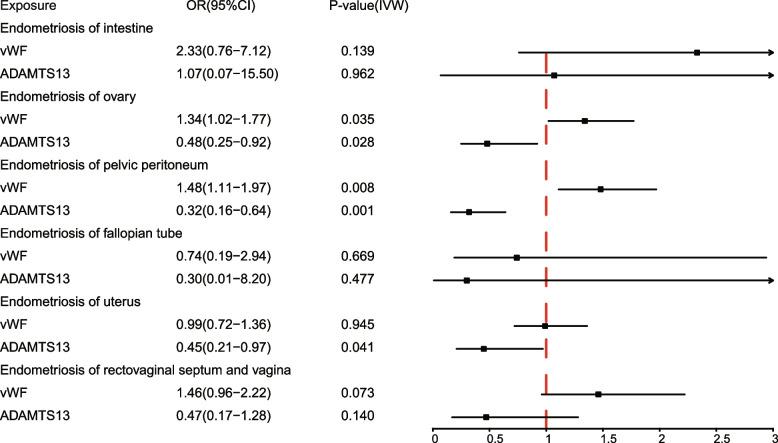
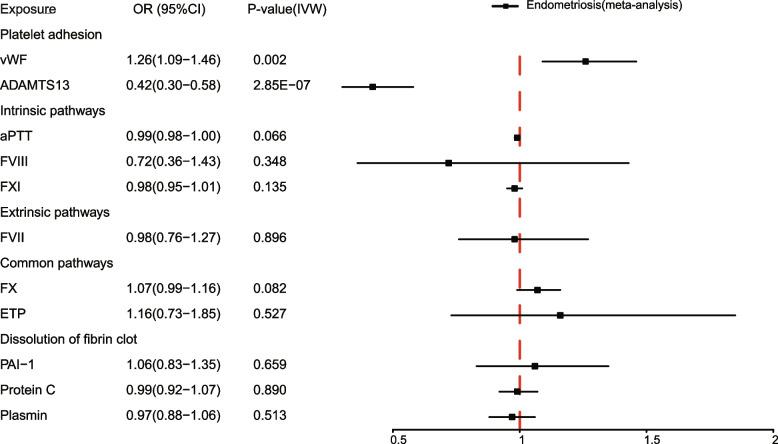
Our two-sample MR analysis of 11 coagulation factors in the UK Biobank suggested a reliable causal effect of genetically predicted plasma ADAMTS13 level on decreased endometriosis risk. A negative causal effect of ADAMTS13 and a positive causal effect of vWF on endometriosis were observed in the FinnGen. In the meta-analysis, the causal associations remained significant with a strong effect size. The MR analyses also identified potential causal effects of ADAMTS13 and vWF on different sub-phenotypes of endometrioses.
CONCLUSIONS
Our MR analysis based on GWAS data from large-scale population studies demonstrated the causal associations between ADAMTS13/vWF and the risk of endometriosis. These findings suggest that these coagulation factors are involved in the development of endometriosis and may represent potential therapeutic targets for the management of this complex disease.
背景
子宫内膜异位症是一种复杂的妇科疾病,可导致严重疼痛和不孕,影响所有育龄妇女的 6-10%。子宫内膜异位症是一种子宫内膜组织在子宫内生长的疾病。子宫内膜组织通常位于子宫内,但其在其他组织中沉积。子宫内膜异位症的病因和发病机制仍不清楚。尽管存在争议,但普遍认为子宫内膜异位症是一种慢性炎症性疾病,子宫内膜异位症患者似乎处于高凝状态。凝血系统在止血和炎症反应中起着重要作用。因此,本研究旨在使用公开可用的 GWAS 汇总统计数据来研究凝血因子与子宫内膜异位症风险之间的因果关系。
方法
为了研究凝血因子与子宫内膜异位症风险之间的因果关系,使用了两样本 Mendelian 随机化 (MR) 分析框架。为了选择与暴露(vWF、ADAMTS13、aPTT、FVIII、FXI、FVII、FX、ETP、PAI-1、蛋白 C 和纤溶酶)强相关的合格工具变量,遵循了一系列质量控制程序。使用来自欧洲血统的两个独立子宫内膜异位症 GWAS 汇总统计数据的队列:英国生物库 (4354 例病例和 217500 例对照) 和 FinnGen (8288 例病例和 68969 例对照)。我们分别在英国生物库和 FinnGen 中进行了 MR 分析,然后进行了荟萃分析。使用 Cochran's Q 检验、MR-Egger 截距检验和单样本敏感性分析来评估 SNPs 在子宫内膜异位症中的异质性、水平多效性和稳定性。
结果
我们对英国生物库中的 11 种凝血因子进行的两样本 MR 分析表明,遗传预测的血浆 ADAMTS13 水平与降低子宫内膜异位症风险之间存在可靠的因果关系。在 FinnGen 中观察到 ADAMTS13 的负因果关系和 vWF 的正因果关系对子宫内膜异位症的影响。荟萃分析中,因果关联仍然具有显著的效应量。MR 分析还确定了 ADAMTS13 和 vWF 对子宫内膜异位症不同亚表型的潜在因果作用。
结论
我们基于来自大型人群研究的 GWAS 数据的 MR 分析表明,ADAMTS13/vWF 与子宫内膜异位症风险之间存在因果关系。这些发现表明,这些凝血因子参与了子宫内膜异位症的发展,可能代表了这种复杂疾病管理的潜在治疗靶点。

 Zotero 插件