
用于跨学科多模式慢性肌肉骨骼疼痛治疗的机器学习临床决策支持
Machine learning clinical decision support for interdisciplinary multimodal chronic musculoskeletal pain treatment.
作者信息
Zmudzki Fredrick, Smeets Rob J E M
机构信息
Époque Consulting, Sydney, NSW, Australia.
Social Policy Research Centre, University of New South Wales, Sydney, NSW, Australia.
出版信息
Front Pain Res (Lausanne). 2023 May 9;4:1177070. doi: 10.3389/fpain.2023.1177070. eCollection 2023.
INTRODUCTION
Chronic musculoskeletal pain is a prevalent condition impacting around 20% of people globally; resulting in patients living with pain, fatigue, restricted social and employment capacity, and reduced quality of life. Interdisciplinary multimodal pain treatment programs have been shown to provide positive outcomes by supporting patients modify their behavior and improve pain management through focusing attention on specific patient valued goals rather than fighting pain.
METHODS
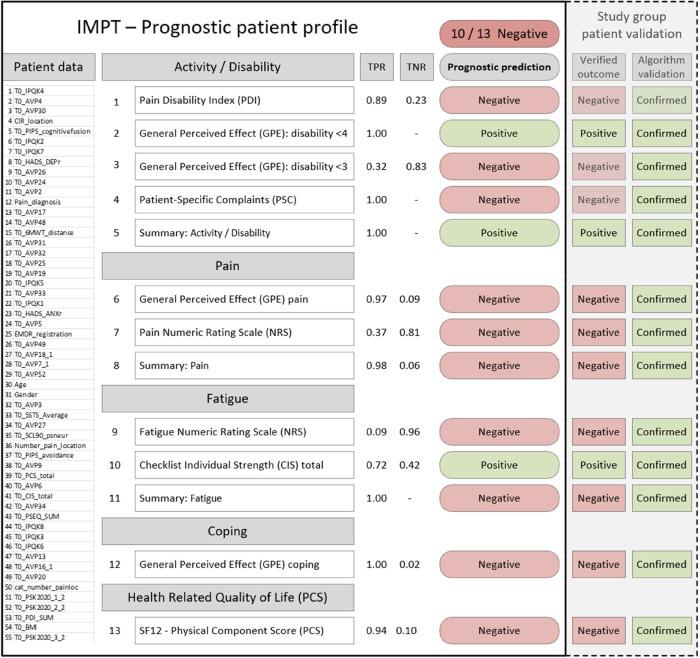
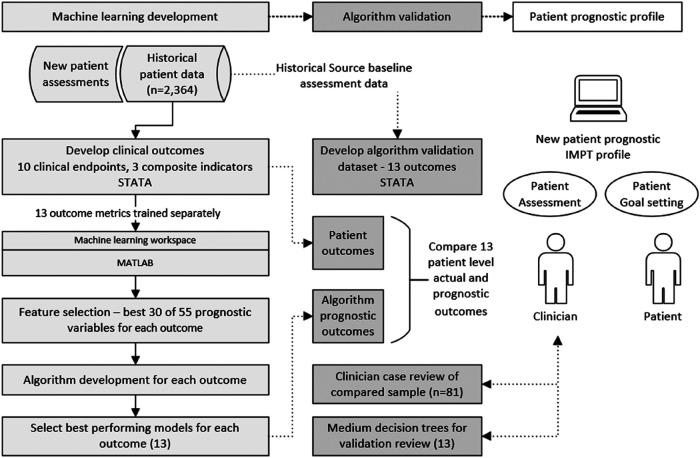
Given the complex nature of chronic pain there is no single clinical measure to assess outcomes from multimodal pain programs. Using Centre for Integral Rehabilitation data from 2019-2021 ( = 2,364), we developed a multidimensional machine learning framework of 13 outcome measures across 5 clinically relevant domains including activity/disability, pain, fatigue, coping and quality of life. Machine learning models for each endpoint were separately trained using the most important 30 of 55 demographic and baseline variables based on minimum redundancy maximum relevance feature selection. Five-fold cross validation identified best performing algorithms which were rerun on deidentified source data to verify prognostic accuracy.
RESULTS
Individual algorithm performance ranged from 0.49 to 0.65 AUC reflecting characteristic outcome variation across patients, and unbalanced training data with high positive proportions of up to 86% for some measures. As expected, no single outcome provided a reliable indicator, however the complete set of algorithms established a stratified prognostic patient profile. Patient level validation achieved consistent prognostic assessment of outcomes for 75.3% of the study group ( = 1,953). Clinician review of a sample of predicted negative patients ( = 81) independently confirmed algorithm accuracy and suggests the prognostic profile is potentially valuable for patient selection and goal setting.
DISCUSSION
These results indicate that although no single algorithm was individually conclusive, the complete stratified profile consistently identified patient outcomes. Our predictive profile provides promising positive contribution for clinicians and patients to assist with personalized assessment and goal setting, program engagement and improved patient outcomes.
引言
慢性肌肉骨骼疼痛是一种普遍存在的病症,全球约20%的人受其影响;导致患者遭受疼痛、疲劳、社交和就业能力受限以及生活质量下降之苦。跨学科多模式疼痛治疗项目已被证明可通过支持患者改变行为并通过关注特定的患者重视目标而非对抗疼痛来改善疼痛管理,从而产生积极效果。
方法
鉴于慢性疼痛的复杂性,没有单一的临床指标可评估多模式疼痛项目的结果。利用2019 - 2021年综合康复中心的数据(n = 2364),我们开发了一个多维机器学习框架,涵盖5个临床相关领域的13项结果指标,包括活动/残疾、疼痛、疲劳、应对方式和生活质量。基于最小冗余最大相关性特征选择,使用55个人口统计学和基线变量中最重要的30个,分别对每个终点的机器学习模型进行训练。五折交叉验证确定了表现最佳的算法,这些算法在去识别源数据上重新运行以验证预测准确性。
结果
个体算法性能的曲线下面积(AUC)范围为0.49至0.65,反映了患者之间特征性的结果差异,以及训练数据不均衡,某些指标的阳性比例高达86%。不出所料,没有单一结果能提供可靠指标,然而完整的算法集建立了一个分层的预后患者概况。患者层面的验证对75.3%的研究组(n = 1953)实现了一致的预后结果评估。临床医生对预测为阴性的患者样本(n = 81)进行审查,独立证实了算法的准确性,并表明预后概况对患者选择和目标设定可能具有重要价值。
讨论
这些结果表明,虽然没有单一算法能单独得出结论,但完整的分层概况始终能识别患者结果。我们的预测概况为临床医生和患者提供了有前景的积极贡献,有助于个性化评估和目标设定、项目参与以及改善患者结果。
 Zotero 插件