
iTCep:一种利用融合特征识别T细胞表位的深度学习框架。
iTCep: a deep learning framework for identification of T cell epitopes by harnessing fusion features.
作者信息
Zhang Yu, Jian Xingxing, Xu Linfeng, Zhao Jingjing, Lu Manman, Lin Yong, Xie Lu
机构信息
School of Health Science and Engineering, University of Shanghai for Science and Technology, Shanghai, China.
Shanghai-MOST Key Laboratory of Health and Disease Genomics, Institute of Genome and Bioinformatics, Shanghai Institute for Biomedical and Pharmaceutical Technologies, Shanghai, China.
出版信息
Front Genet. 2023 May 9;14:1141535. doi: 10.3389/fgene.2023.1141535. eCollection 2023.
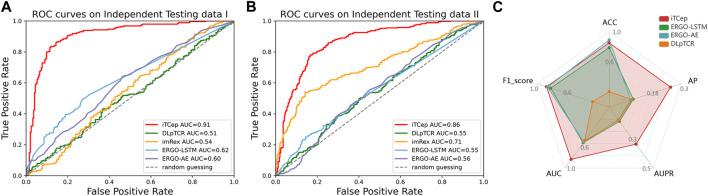
Neoantigens recognized by cytotoxic T cells are effective targets for tumor-specific immune responses for personalized cancer immunotherapy. Quite a few neoantigen identification pipelines and computational strategies have been developed to improve the accuracy of the peptide selection process. However, these methods mainly consider the neoantigen end and ignore the interaction between peptide-TCR and the preference of each residue in TCRs, resulting in the filtered peptides often fail to truly elicit an immune response. Here, we propose a novel encoding approach for peptide-TCR representation. Subsequently, a deep learning framework, namely iTCep, was developed to predict the interactions between peptides and TCRs using fusion features derived from a feature-level fusion strategy. The iTCep achieved high predictive performance with AUC up to 0.96 on the testing dataset and above 0.86 on independent datasets, presenting better prediction performance compared with other predictors. Our results provided strong evidence that model iTCep can be a reliable and robust method for predicting TCR binding specificities of given antigen peptides. One can access the iTCep through a user-friendly web server at http://biostatistics.online/iTCep/, which supports prediction modes of peptide-TCR pairs and peptide-only. A stand-alone software program for T cell epitope prediction is also available for convenient installing at https://github.com/kbvstmd/iTCep/.
细胞毒性T细胞识别的新抗原是个性化癌症免疫治疗中肿瘤特异性免疫反应的有效靶点。已经开发了不少新抗原识别流程和计算策略来提高肽段选择过程的准确性。然而,这些方法主要考虑新抗原末端,而忽略了肽-TCR之间的相互作用以及TCR中每个残基的偏好性,导致筛选出的肽段往往无法真正引发免疫反应。在此,我们提出了一种用于肽-TCR表征的新型编码方法。随后,开发了一个深度学习框架,即iTCep,以使用源自特征级融合策略的融合特征来预测肽段与TCR之间的相互作用。iTCep在测试数据集上的AUC高达0.96,在独立数据集上高于0.86,实现了较高的预测性能,与其他预测器相比,呈现出更好的预测性能。我们的结果提供了有力证据,表明模型iTCep可以成为预测给定抗原肽段TCR结合特异性的可靠且稳健的方法。用户可以通过一个用户友好的网络服务器http://biostatistics.online/iTCep/访问iTCep,该服务器支持肽-TCR对和仅肽段的预测模式。还有一个用于T细胞表位预测的独立软件程序,可在https://github.com/kbvstmd/iTCep/方便地安装。


 Zotero 插件