
一种基于流式细胞术的用于鉴定HCN4环核苷酸结合结构域配体的新型检测方法。
A Novel Flow Cytometry-Based Assay for the Identification of HCN4 CNBD Ligands.
作者信息
Wojciechowski Magdalena N, Schreiber Sebastian, Jose Joachim
机构信息
University of Münster, Institute of Pharmaceutical and Medicinal Chemistry, Pharmacampus, 48149 Münster, Germany.
出版信息
Pharmaceuticals (Basel). 2023 May 7;16(5):710. doi: 10.3390/ph16050710.
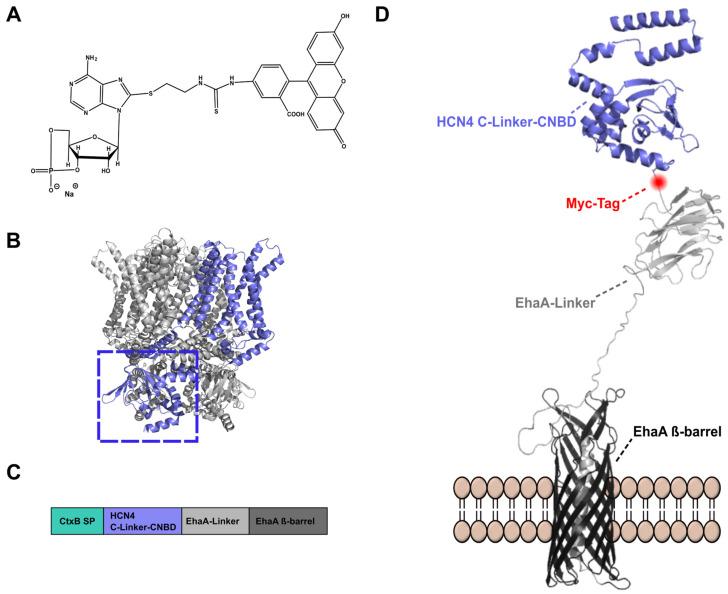
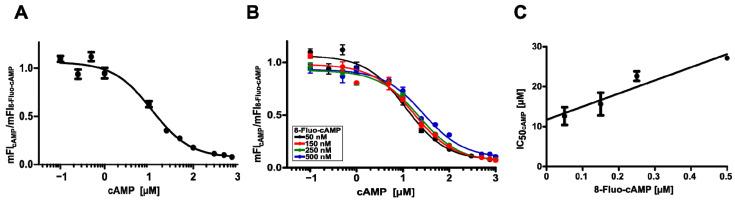
Hyperpolarization-activated and cyclic nucleotide-gated (HCN) channels are promising therapeutic targets because of their association with the genesis of several diseases. The identification of selective compounds that alter cAMP-induced ion channel modulation by binding to the cyclic nucleotide-binding domain (CNBD) will facilitate HCN channel-specific drug development. In this study, a fast and protein purification-free ligand-binding approach with a surface-displayed HCN4 C-Linker-CNBD on is presented. 8-Fluo-cAMP ligand binding was monitored by single-cell analysis via flow cytometry, and a K-value of 173 ± 46 nM was determined. The K value was confirmed by ligand depletion analysis and equilibrium state measurements. Applying increasing concentrations of cAMP led to a concentration-dependent decrease in fluorescence intensity, indicating a displacement of 8-Fluo-cAMP. A K-value of 8.5 ± 2 µM was determined. The linear relationship of IC values obtained for cAMP as a function of ligand concentration confirmed the competitive binding mode: IC: 13 ± 2 µM/16 ± 3 µM/23 ± 1 µM/27 ± 1 µM for 50 nM/150 nM/250 nM/500 nM 8-Fluo-cAMP. A similar competitive mode of binding was confirmed for 7-CH-cAMP, and an IC value of 230 ± 41 nM and a K of 159 ± 29 nM were determined. Two established drugs were tested in the assay. Ivabradine, an approved HCN channel pore blocker and gabapentin, is known to bind to HCN4 channels in preference to other isoforms with an unknown mode of action. As expected, ivabradine had no impact on ligand binding. In addition, gabapentin had no influence on 8-Fluo-cAMP's binding to HCN4-CNBD. This is the first indication that gabapentin is not interacting with this part of the HCN4 channel. The ligand-binding assay as described can be used to determine binding constants for ligands such as cAMP and derivatives. It could also be applied for the identification of new ligands binding to the HCN4-CNBD.
超极化激活的环核苷酸门控(HCN)通道因其与多种疾病的发生有关而成为有前景的治疗靶点。通过结合环核苷酸结合结构域(CNBD)来鉴定能够改变cAMP诱导的离子通道调节的选择性化合物,将有助于HCN通道特异性药物的开发。在本研究中,提出了一种快速且无需蛋白质纯化的配体结合方法,该方法利用在[具体对象]上表面展示的HCN4 C-连接子-CNBD。通过流式细胞术的单细胞分析监测8-氟-cAMP配体的结合,并确定K值为173±46 nM。该K值通过配体消耗分析和平衡态测量得到证实。应用浓度不断增加的cAMP导致荧光强度呈浓度依赖性下降,表明8-氟-cAMP被取代。确定K值为8.5±2 µM。作为配体浓度函数得到的cAMP的IC值的线性关系证实了竞争结合模式:对于50 nM/150 nM/250 nM/500 nM 8-氟-cAMP,IC值分别为13±2 µM/16±3 µM/23±1 µM/27±1 µM。对于7-氯-cAMP也证实了类似的竞争结合模式,并确定IC值为230±41 nM,K值为159±29 nM。在该测定中测试了两种已上市的药物。伊伐布雷定是一种已获批的HCN通道孔道阻滞剂,加巴喷丁已知优先于其他亚型与HCN4通道结合,但其作用方式未知。正如预期的那样,伊伐布雷定对配体结合没有影响。此外,加巴喷丁对8-氟-cAMP与HCN4-CNBD的结合没有影响。这是加巴喷丁不与HCN4通道的这一部分相互作用的首个迹象。所描述的配体结合测定可用于确定cAMP及其衍生物等配体的结合常数。它也可用于鉴定与HCN4-CNBD结合的新配体。


 Zotero 插件