
SthK羧基末端区域的结构揭示了环核苷酸调节离子通道的门控机制。
Structure of the SthK carboxy-terminal region reveals a gating mechanism for cyclic nucleotide-modulated ion channels.
作者信息
Kesters Divya, Brams Marijke, Nys Mieke, Wijckmans Eveline, Spurny Radovan, Voets Thomas, Tytgat Jan, Kusch Jana, Ulens Chris
机构信息
Laboratory of Structural Neurobiology, KU Leuven, Herestraat 49, PB601, Leuven, B-3000, Belgium.
Laboratory of Ion Channel Research, KU Leuven, Herestraat 49, PB802, Leuven, B-3000, Belgium.
出版信息
PLoS One. 2015 Jan 27;10(1):e0116369. doi: 10.1371/journal.pone.0116369. eCollection 2015.
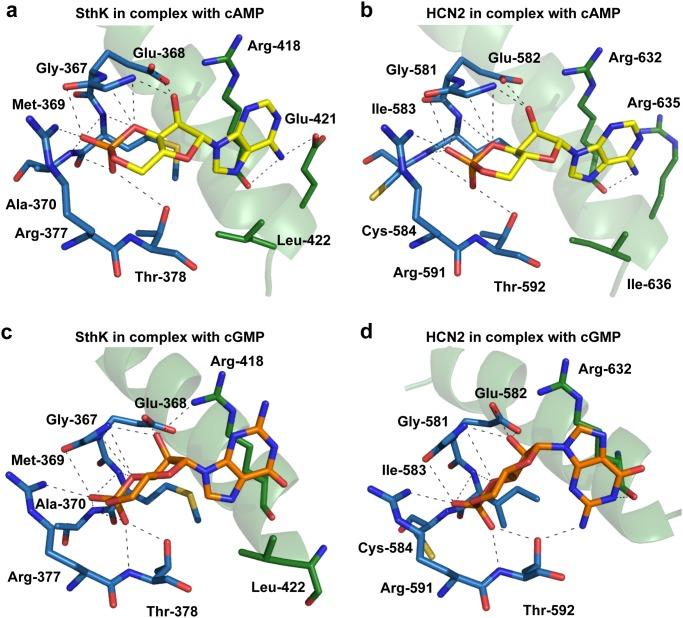
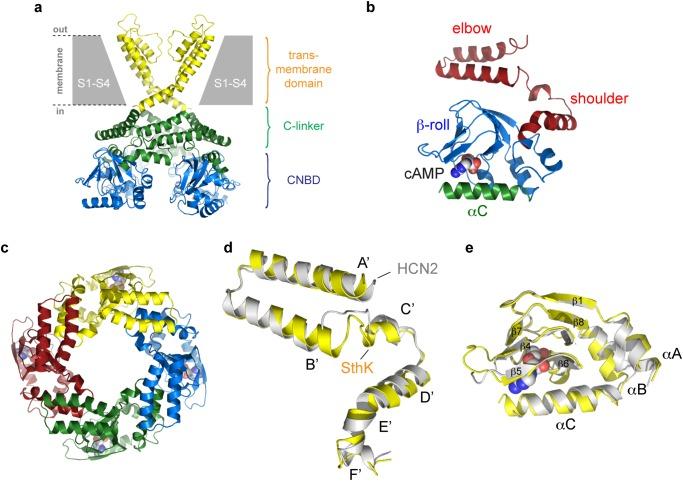
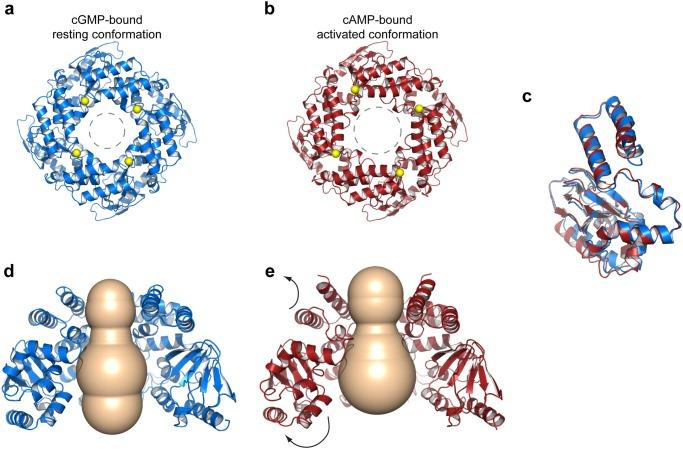
Cyclic nucleotide-sensitive ion channels are molecular pores that open in response to cAMP or cGMP, which are universal second messengers. Binding of a cyclic nucleotide to the carboxyterminal cyclic nucleotide binding domain (CNBD) of these channels is thought to cause a conformational change that promotes channel opening. The C-linker domain, which connects the channel pore to this CNBD, plays an important role in coupling ligand binding to channel opening. Current structural insight into this mechanism mainly derives from X-ray crystal structures of the C-linker/CNBD from hyperpolarization-activated cyclic nucleotide-modulated (HCN) channels. However, these structures reveal little to no conformational changes upon comparison of the ligand-bound and unbound form. In this study, we take advantage of a recently identified prokaryote ion channel, SthK, which has functional properties that strongly resemble cyclic nucleotide-gated (CNG) channels and is activated by cAMP, but not by cGMP. We determined X-ray crystal structures of the C-linker/CNBD of SthK in the presence of cAMP or cGMP. We observe that the structure in complex with cGMP, which is an antagonist, is similar to previously determined HCN channel structures. In contrast, the structure in complex with cAMP, which is an agonist, is in a more open conformation. We observe that the CNBD makes an outward swinging movement, which is accompanied by an opening of the C-linker. This conformation mirrors the open gate structures of the Kv1.2 channel or MthK channel, which suggests that the cAMP-bound C-linker/CNBD from SthK represents an activated conformation. These results provide a structural framework for better understanding cyclic nucleotide modulation of ion channels, including HCN and CNG channels.
环核苷酸敏感离子通道是一类分子孔道,它们会响应环磷酸腺苷(cAMP)或环磷酸鸟苷(cGMP)而开启,这两种物质是通用的第二信使。环核苷酸与这些通道的羧基末端环核苷酸结合结构域(CNBD)结合,被认为会引起构象变化,从而促进通道开放。连接通道孔与该CNBD的C连接结构域在将配体结合与通道开放相偶联的过程中起着重要作用。目前对这一机制的结构认识主要来自超极化激活的环核苷酸调节(HCN)通道的C连接结构域/CNBD的X射线晶体结构。然而,这些结构在比较配体结合形式和未结合形式时几乎没有显示出构象变化。在本研究中,我们利用了最近鉴定出的一种原核生物离子通道SthK,它具有与环核苷酸门控(CNG)通道非常相似的功能特性,可被cAMP激活,但不能被cGMP激活。我们测定了在存在cAMP或cGMP的情况下SthK的C连接结构域/CNBD的X射线晶体结构。我们观察到,与作为拮抗剂的cGMP形成复合物的结构与先前测定的HCN通道结构相似。相比之下,与作为激动剂的cAMP形成复合物的结构处于更开放的构象。我们观察到CNBD发生向外摆动运动,同时伴有C连接结构域的开放。这种构象反映了Kv1.2通道或MthK通道的开放门结构,这表明来自SthK的与cAMP结合的C连接结构域/CNBD代表一种激活构象。这些结果为更好地理解离子通道(包括HCN和CNG通道)的环核苷酸调节提供了一个结构框架。
 Zotero 插件