
细胞属性感知社区检测可提高单细胞 RNA-Seq 数据的差异丰度检测。
Cell-attribute aware community detection improves differential abundance testing from single-cell RNA-Seq data.
机构信息
CAS Key Laboratory of Computational Biology, Shanghai Institute of Nutrition and Health, University of Chinese Academy of Sciences, Chinese Academy of Sciences, 320 Yue Yang Road, Shanghai, 200031, China.
UCL Cancer Institute, Paul O'Gorman Building, University College London, 72 Huntley Street, London, WC1E 6BT, United Kingdom.
出版信息
Nat Commun. 2023 Jun 5;14(1):3244. doi: 10.1038/s41467-023-39017-z.
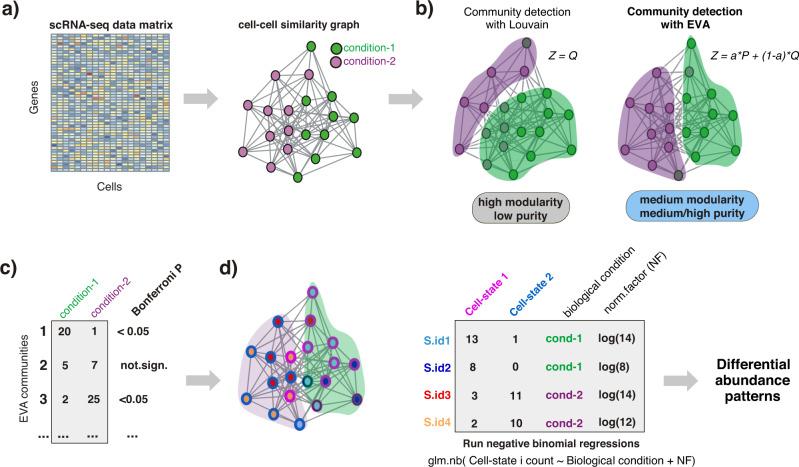
Variations of cell-type proportions within tissues could be informative of biological aging and disease risk. Single-cell RNA-sequencing offers the opportunity to detect such differential abundance patterns, yet this task can be statistically challenging due to the noise in single-cell data, inter-sample variability and because such patterns are often of small effect size. Here we present a differential abundance testing paradigm called ELVAR that uses cell attribute aware clustering when inferring differentially enriched communities within the single-cell manifold. Using simulated and real single-cell and single-nucleus RNA-Seq datasets, we benchmark ELVAR against an analogous algorithm that uses Louvain for clustering, as well as local neighborhood-based methods, demonstrating that ELVAR improves the sensitivity to detect cell-type composition shifts in relation to aging, precancerous states and Covid-19 phenotypes. In effect, leveraging cell attribute information when inferring cell communities can denoise single-cell data, avoid the need for batch correction and help retrieve more robust cell states for subsequent differential abundance testing. ELVAR is available as an open-source R-package.
组织内细胞类型比例的变化可能与生物衰老和疾病风险有关。单细胞 RNA 测序为检测这种差异丰度模式提供了机会,但由于单细胞数据的噪声、样本间的可变性以及这些模式通常效应量较小,因此这项任务在统计学上具有挑战性。在这里,我们提出了一种称为 ELVAR 的差异丰度测试范例,该范例在推断单细胞流形内差异富集的群落时使用细胞属性感知聚类。使用模拟和真实的单细胞和单核 RNA-Seq 数据集,我们将 ELVAR 与使用 Louvain 进行聚类的类似算法以及基于局部邻域的方法进行基准测试,证明 ELVAR 提高了检测与衰老、癌前状态和 Covid-19 表型相关的细胞类型组成变化的敏感性。实际上,在推断细胞群落时利用细胞属性信息可以对单细胞数据进行去噪,避免批次校正的需要,并有助于为后续的差异丰度测试检索更稳健的细胞状态。ELVAR 作为一个开源 R 包提供。



 Zotero 插件