
GhPYL9-5D 和 GhPYR1-3 正向调控拟南芥和棉花对 ABA、干旱、高盐和渗透胁迫的响应。
GhPYL9-5D and GhPYR1-3 A positively regulate Arabidopsis and cotton responses to ABA, drought, high salinity and osmotic stress.
机构信息
National Key Laboratory of Cotton Bio-breeding and Integrated Utilization, School of Life Sciences, College of Agriculture, Henan University, Kaifeng, 475004, China.
出版信息
BMC Plant Biol. 2023 Jun 10;23(1):310. doi: 10.1186/s12870-023-04330-8.
BACKGROUND
Abscisic acid (ABA) receptor pyrabactin resistance 1/PYR1-like/regulatory components of ABA receptor proteins (PYR/PYL/RCARs) have been demonstrated to play pivotal roles in ABA signaling and in response to diverse environmental stimuli including drought, salinity and osmotic stress in Arabidopsis. However, whether and how GhPYL9-5D and GhPYR1-3A, the homologues of Arabidopsis PYL9 and PYR1 in cotton, function in responding to ABA and abiotic stresses are still unclear.
RESULTS
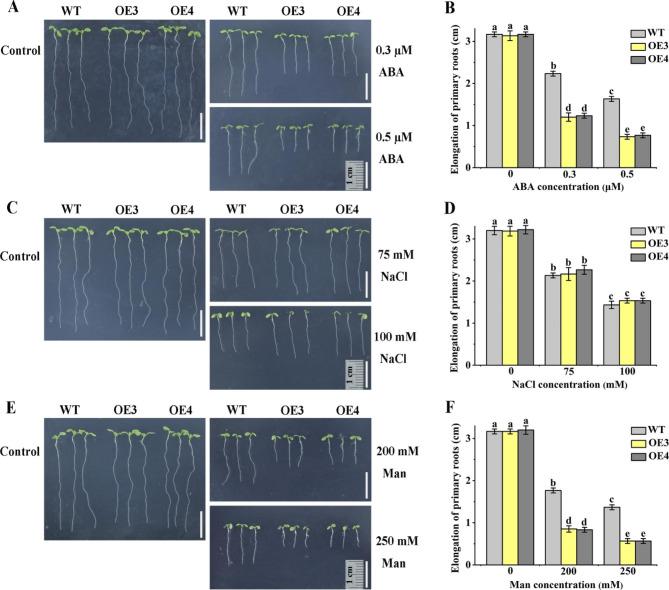
GhPYL9-5D and GhPYR1-3A were targeted to the cytoplasm and nucleus. Overexpression of GhPYL9-5D and GhPYR1-3A in Arabidopsis wild type and sextuple mutant pyr1pyl1pyl2pyl4pyl5pyl8 plants resulted in ABA hypersensitivity in terms of seed germination, root growth and stomatal closure, as well as seedling tolerance to water deficit, salt and osmotic stress. Moreover, the VIGS (Virus-induced gene silencing) cotton plants, in which GhPYL9-5D or GhPYR1-3A were knocked down, showed clearly reduced tolerance to polyethylene glycol 6000 (PEG)-induced drought, salinity and osmotic stresses compared with the controls. Additionally, transcriptomic data revealed that GhPYL9-5D was highly expressed in the root, and GhPYR1-3A was strongly expressed in the fiber and stem. GhPYL9-5D, GhPYR1-3A and their homologs in cotton were highly expressed after treatment with PEG or NaCl, and the two genes were co-expressed with redox signaling components, transcription factors and auxin signal components. These results suggest that GhPYL9-5D and GhPYR1-3A may serve important roles through interplaying with hormone and other signaling components in cotton adaptation to salt or osmotic stress.
CONCLUSIONS
GhPYL9-5D and GhPYR1-3A positively regulate ABA-mediated seed germination, primary root growth and stomatal closure, as well as tolerance to drought, salt and osmotic stresses likely through affecting the expression of multiple downstream stress-associated genes in Arabidopsis and cotton.
背景
脱落酸(ABA)受体 pyrabactin 抗性 1/PYR1 样/ABA 受体蛋白的调节成分(PYR/PYL/RCARs)已被证明在 ABA 信号转导以及对各种环境刺激(包括干旱、盐度和渗透胁迫)的响应中发挥关键作用在拟南芥中。然而,棉花中拟南芥 PYL9 和 PYR1 的同源物 GhPYL9-5D 和 GhPYR1-3A 是否以及如何在响应 ABA 和非生物胁迫中发挥作用仍不清楚。
结果
GhPYL9-5D 和 GhPYR1-3A 靶向细胞质和细胞核。在拟南芥野生型和六重突变体 pyr1pyl1pyl2pyl4pyl5pyl8 植物中过表达 GhPYL9-5D 和 GhPYR1-3A 导致种子萌发、根生长和气孔关闭方面的 ABA 敏感性,以及幼苗对水分亏缺、盐和渗透胁迫的耐受性。此外,VIGS(病毒诱导基因沉默)棉花植物中,GhPYL9-5D 或 GhPYR1-3A 被敲低,与对照相比,对聚乙二醇 6000(PEG)诱导的干旱、盐度和渗透胁迫的耐受性明显降低。此外,转录组数据显示,GhPYL9-5D 在根中高度表达,GhPYR1-3A 在纤维和茎中强烈表达。在 PEG 或 NaCl 处理后,棉花中的 GhPYL9-5D、GhPYR1-3A 及其同源物高度表达,这两个基因与氧化还原信号成分、转录因子和生长素信号成分共表达。这些结果表明,GhPYL9-5D 和 GhPYR1-3A 可能通过与激素和其他信号成分相互作用在棉花适应盐度或渗透胁迫中发挥重要作用。
结论
GhPYL9-5D 和 GhPYR1-3A 正向调节 ABA 介导的种子萌发、主根生长和气孔关闭以及对干旱、盐度和渗透胁迫的耐受性,可能通过影响拟南芥和棉花中多个下游与应激相关基因的表达。




 Zotero 插件