
来自亚洲棉的受体样激酶基因(GbRLK)增强了拟南芥的耐盐和耐旱性。
A receptor-like kinase gene (GbRLK) from Gossypium barbadense enhances salinity and drought-stress tolerance in Arabidopsis.
机构信息
National Key Laboratory of Crop Genetics & Germplasm Enhancement, MOE Hybrid Cotton R&D Engineering Research Center, Nanjing Agricultural University, Nanjing 210095, Jiangsu Province, China.
出版信息
BMC Plant Biol. 2013 Aug 6;13:110. doi: 10.1186/1471-2229-13-110.
BACKGROUND
Cotton (Gossypium spp.) is widely cultivated due to the important economic value of its fiber. However, extreme environmental degradation impedes cotton growth and production. Receptor-like kinase (RLK) proteins play important roles in signal transduction and participate in a diverse range of processes in response to plant hormones and environmental cues. Here, we introduced an RLK gene (GbRLK) from cotton into Arabidopsis and investigated its role in imparting abiotic stress tolerance.
RESULTS
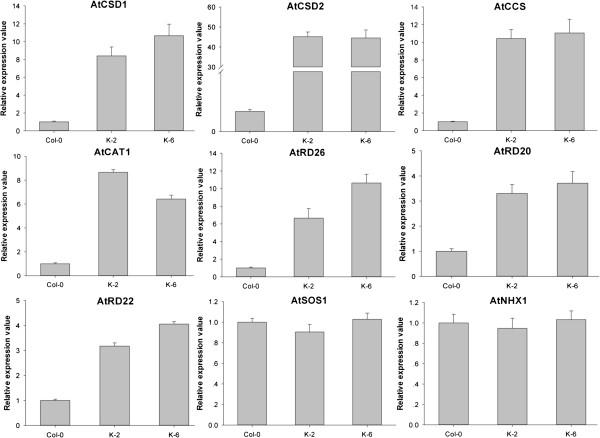
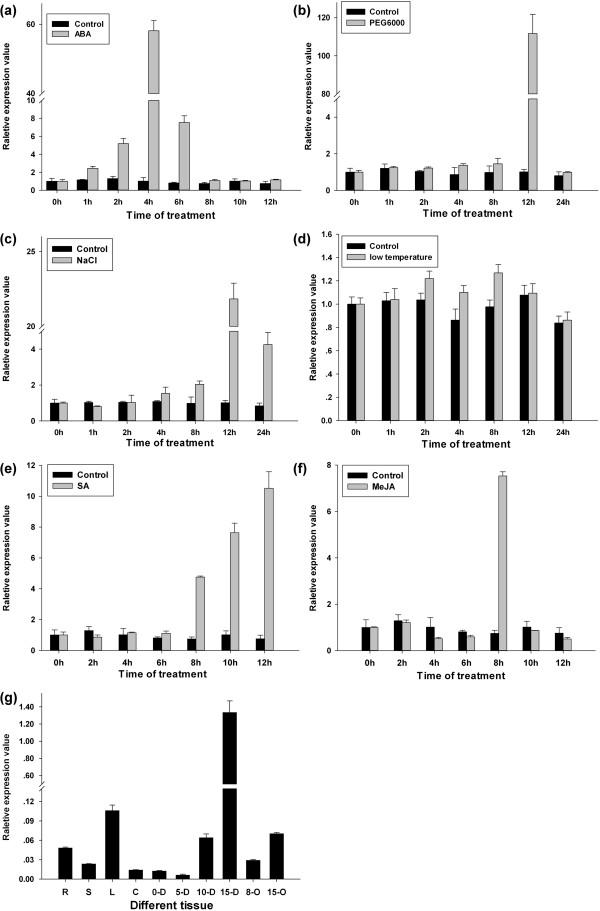
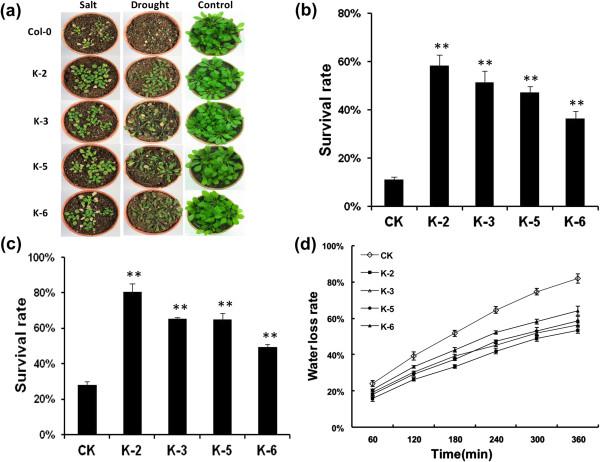
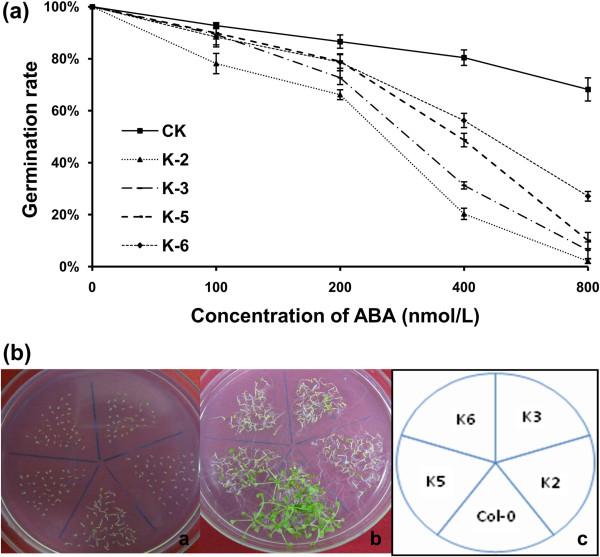
GbRLK transcription was induced by exogenously supplied abscisic acid (ABA), salicylic acid, methyl jasmonate, mock drought conditions and high salinity. We cloned the promoter sequence of this gene via self-formed adaptor PCR. Sequence analysis revealed that the promoter region contains many cis-acting stress-responsive elements such as ABRE, W-Box, MYB-core, W-Box core, TCA-element and others. We constructed a vector containing a 1,890-bp sequence in the 5' region upstream of the initiation codon of this promoter and transformed it into Arabidopsis thaliana. GUS histochemical staining analysis showed that GbRLK was expressed mainly in leaf veins, petioles and roots of transgenic Arabidopsis, but not in the cotyledons or root hairs. GbRLK promoter activity was induced by ABA, PEG, NaCl and Verticillium dahliae. Transgenic Arabidopsis with constitutive overexpression of GbRLK exhibited a reduced rate of water loss in leaves in vitro, along with improved salinity and drought tolerance and increased sensitivity to ABA compared with non-transgenic Col-0 Arabidopsis. Expression analysis of stress-responsive genes in GbRLK Arabidopsis revealed that there was increased expression of genes involved in the ABA-dependent signaling pathway (AtRD20, AtRD22 and AtRD26) and antioxidant genes (AtCAT1, AtCCS, AtCSD2 and AtCSD1) but not ion transporter genes (AtNHX1, AtSOS1).
CONCLUSIONS
GbRLK is involved in the drought and high salinity stresses pathway by activating or participating in the ABA signaling pathway. Overexpression of GbRLK may improve stress tolerance by regulating stress-responsive genes to reduce water loss. GbRLK may be employed in the genetic engineering of novel cotton cultivars in the future. Further studying of GbRLK will help elucidate abiotic stress signaling pathways.
背景
棉花(Gossypium spp.)因其纤维的重要经济价值而被广泛种植。然而,极端的环境退化阻碍了棉花的生长和生产。类受体激酶(RLK)蛋白在信号转导中发挥重要作用,并参与植物激素和环境线索响应的多种过程。在这里,我们从棉花中引入了一个 RLK 基因(GbRLK)到拟南芥中,并研究了它在赋予非生物胁迫耐受性方面的作用。
结果
GbRLK 的转录受外源脱落酸(ABA)、水杨酸、茉莉酸甲酯、模拟干旱条件和高盐度的诱导。我们通过自身形成的接头 PCR 克隆了该基因的启动子序列。序列分析表明,启动子区域包含许多顺式作用的应激响应元件,如 ABRE、W-Box、MYB-core、W-Box core、TCA-element 等。我们构建了一个包含该启动子起始密码子上游 1890 个碱基的载体,并将其转化为拟南芥。GbRLK 的 GUS 组织化学染色分析表明,GbRLK 在转基因拟南芥的叶脉、叶柄和根中表达,但不在子叶或根毛中表达。GbRLK 启动子活性受 ABA、PEG、NaCl 和黄萎病菌诱导。与非转基因 Col-0 拟南芥相比,组成型过表达 GbRLK 的转基因拟南芥叶片离体失水率降低,耐盐性和耐旱性提高,对 ABA 更敏感。GbRLK 拟南芥中应激响应基因的表达分析表明,ABA 依赖的信号通路相关基因(AtRD20、AtRD22 和 AtRD26)和抗氧化基因(AtCAT1、AtCCS、AtCSD2 和 AtCSD1)表达增加,但离子转运基因(AtNHX1、AtSOS1)表达未增加。
结论
GbRLK 通过激活或参与 ABA 信号通路参与干旱和高盐胁迫途径。过表达 GbRLK 可能通过调节应激响应基因来减少水分流失,从而提高胁迫耐受性。GbRLK 将来可能用于新型棉花品种的遗传工程。对 GbRLK 的进一步研究将有助于阐明非生物胁迫信号通路。


 Zotero 插件