
评估2019年至2021年195个国家和地区常规儿童疫苗接种覆盖率的全球及区域国家间不平等:一项纵向研究。
Estimating global and regional between-country inequality in routine childhood vaccine coverage in 195 countries and territories from 2019 to 2021: a longitudinal study.
作者信息
Lai Xiaozhen, Zhang Haijun, Pouwels Koen B, Patenaude Bryan, Jit Mark, Fang Hai
机构信息
Department of Health Policy and Management, School of Public Health, Peking University, Beijing, China.
Health Economics Research Centre, Nuffield Department of Population Health, University of Oxford, Oxford, UK.
出版信息
EClinicalMedicine. 2023 Jun;60:102042. doi: 10.1016/j.eclinm.2023.102042. Epub 2023 Jun 8.
BACKGROUND
Global routine childhood vaccine coverage has plateaued in recent years, and the COVID-19 pandemic further disrupted immunisation services. We estimated global and regional inequality of routine childhood vaccine coverage from 2019 to 2021, particularly assessing the impacts of the COVID-19 pandemic.
METHODS
We used longitudinal data for 11 routine childhood vaccines from the WHO-UNICEF Estimates of National Immunization Coverage (WUENIC), including 195 countries and territories in 2019-2021. The slope index of inequality (SII) and relative index of inequality (RII) of each vaccine were calculated through linear regression to express the difference in coverage between the top and bottom 20% of countries at the global and regional levels. We also explored inequalities of routine childhood vaccine coverage by WHO regions and unvaccinated children by income groups.
FINDINGS
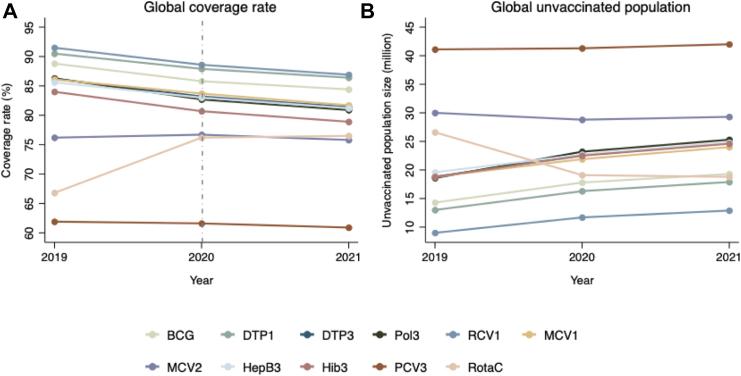
Globally between January 1, 2019 and December 31, 2021, most childhood vaccines showed a declining trend in coverage, and therefore an increasing number of unvaccinated children, especially in low-income and lower-middle-income countries. Between-country inequalities existed for all 11 routine childhood vaccine coverage indicators. The SII for the third dose of diphtheria-tetanus-pertussis-containing vaccine (DTP3) coverage was 20.1 percentage points (95% confidence interval: 13.7, 26.5) in 2019, and rose to 23.6 (17.5, 30.0) in 2020 and 26.9 (20.0, 33.8) in 2021. Similar patterns were found for RII results and in other routine vaccines. In 2021, the second dose of measles-containing vaccine (MCV2) coverage had the highest global absolute inequality (31.2, [21.5-40.8]), and completed rotavirus vaccine (RotaC) coverage had the lowest (7.8, [-3.9, 19.5]). Among six WHO regions, the European Region consistently had the lowest inequalities, and the Western Pacific Region had the largest inequalities for many indicators, although both increased from 2019 to 2021.
INTERPRETATION
Global and regional inequalities of routine childhood vaccine coverage persisted and substantially increased from 2019 to 2021. These findings reveal economic-related inequalities by vaccines, regions, and countries, and underscore the importance of reducing such inequalities. These inequalities were widened during the COVID-19 pandemic, resulting in even lower coverage and more unvaccinated children in low-income countries.
FUNDING
Bill & Melinda Gates Foundation.
背景
近年来,全球常规儿童疫苗接种覆盖率已趋于平稳,而新冠疫情进一步扰乱了免疫服务。我们估计了2019年至2021年全球和区域常规儿童疫苗接种覆盖率的不平等情况,尤其评估了新冠疫情的影响。
方法
我们使用了世界卫生组织-联合国儿童基金会国家免疫接种覆盖率估计数(WUENIC)中11种常规儿童疫苗的纵向数据,涵盖2019 - 2021年的195个国家和地区。通过线性回归计算每种疫苗的不平等斜率指数(SII)和相对不平等指数(RII),以表达全球和区域层面上排名前20%和后20%国家之间的覆盖率差异。我们还探讨了按世界卫生组织区域划分的常规儿童疫苗接种覆盖率不平等情况以及按收入群体划分的未接种疫苗儿童情况。
结果
在全球范围内,2019年1月1日至2021年12月31日期间,大多数儿童疫苗的接种覆盖率呈下降趋势,因此未接种疫苗的儿童数量不断增加,尤其是在低收入和中低收入国家。11项常规儿童疫苗接种覆盖率指标均存在国家间不平等。2019年,含白喉-破伤风-百日咳疫苗第三剂(DTP3)接种覆盖率的SII为20.1个百分点(95%置信区间:13.7, 26.5),2020年升至23.6(17.5, 30.0),2021年为26.9(20.0, 33.8)。RII结果及其他常规疫苗也呈现类似模式。2021年,含麻疹疫苗第二剂(MCV2)接种覆盖率的全球绝对不平等程度最高(31.2, [21.5 - 40.8]),轮状病毒疫苗全程接种覆盖率(RotaC)最低(7.8, [-3.9, 19.5])。在世界卫生组织的六个区域中,欧洲区域的不平等程度一直最低,西太平洋区域在许多指标上的不平等程度最大,不过两者在2019年至2021年期间均有所增加。
解读
2019年至2021年,全球和区域常规儿童疫苗接种覆盖率的不平等持续存在且大幅增加。这些发现揭示了疫苗、区域和国家层面与经济相关的不平等情况,并凸显了减少此类不平等的重要性。在新冠疫情期间,这些不平等进一步加剧,导致低收入国家的接种覆盖率更低,未接种疫苗的儿童更多。
资金来源
比尔及梅琳达·盖茨基金会



 Zotero 插件