
人脐带间充质干细胞来源的外泌体作为新型肝癌生长分子抑制剂的潜在作用。
Potential role of human umbilical cord stem cells-derived exosomes as novel molecular inhibitors of hepatocellular carcinoma growth.
机构信息
Department of Medical Biochemistry and Molecular Biology, Faculty of Medicine, Assiut University, Assiut, Egypt.
Department of Tropical Medicine and Gastroenterology, Faculty of Medicine, Assiut University, Assiut, Egypt.
出版信息
Apoptosis. 2023 Oct;28(9-10):1346-1356. doi: 10.1007/s10495-023-01863-z. Epub 2023 Jun 20.
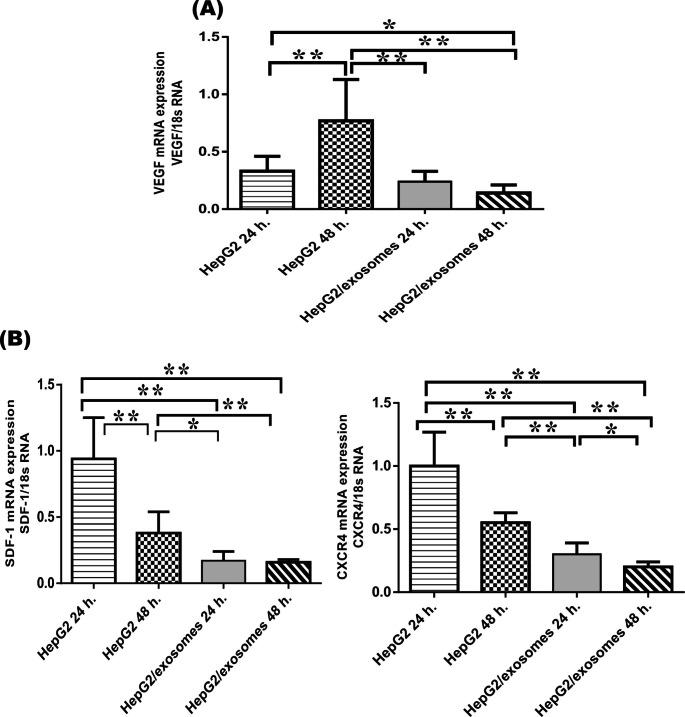
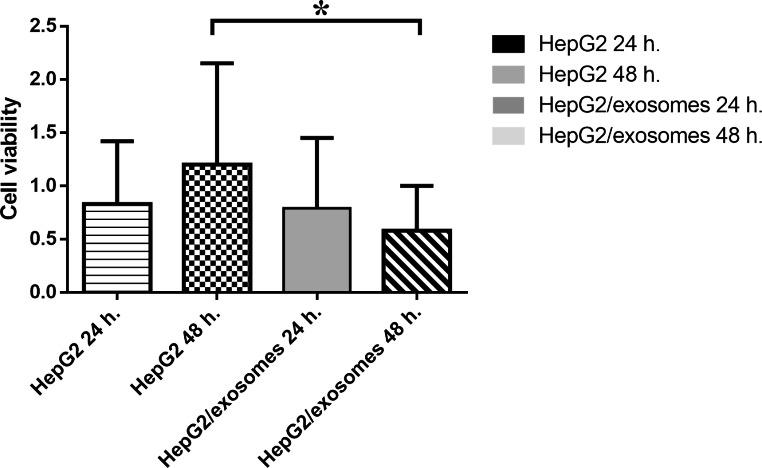
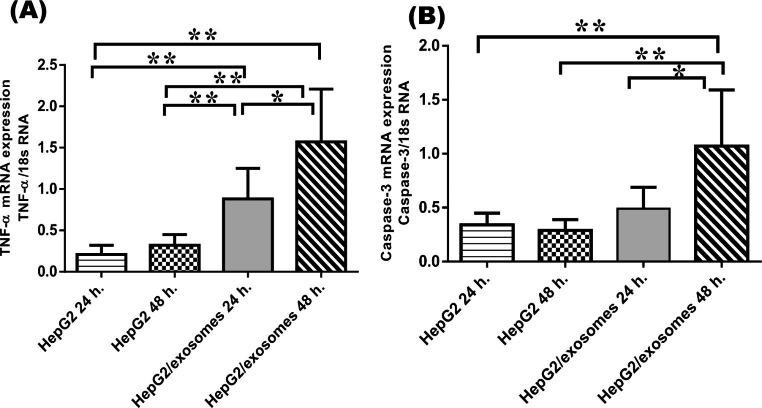
Hepatocellular carcinoma (HCC) is one of the most critical cancers; thus, novel therapeutical regimens are of great need. In this study, we investigated the effects of umbilical cord mesenchymal stem cells (UC-MSCs) derived exosomes on HepG2 cell line, and the underlying mechanism to control HCC proliferation, to identify the potential clinical role of exosomes as a novel molecular therapeutic target. Proliferation, apoptosis, and angiogenesis effects were assessed together with the cell viability evaluation by MTT assay in HepG2 cells at 24/48 h. with or without UC-MSCs-derived exosomes. Gene expressions of TNF-α, caspase-3, VEGF, stromal cell-derived factor-1 (SDF-1), and CX chemokine receptor-4 (CXCR-4) were measured by quantitative real-time PCR technique. Expression of sirtuin-1 (SIRT-1) protein was detected by western blot. Treatment of HepG2 cells with UC-MSCs-derived exosomes for 24 and 48 h. demonstrated a significant reduction of cells survival compared to the control group (p < 0.05). The SIRT-1 protein, and VEGF, SDF-1, CXCR-4 expression levels were significantly lower, TNF-α and caspase-3 expression levels were significantly higher in exosomal-treated HepG2 cells for 24 and 48 h. than those in the control group. Moreover, our findings documented that the anti-proliferative, apoptotic, and anti-angiogenic effects were achieved in a time-dependent manner in which more effects were determined after 48 h supplementation compared to 24 h (p < 0.05). UC-MSCs-derived exosomes exert anticarcinogenic molecular effects on HepG2 cells through the involvement of SIRT-1, SDF-1, and CXCR-4. Hence, exosomes would be a potential novel therapy regimen against HCC. Large-scale studies are recommended to verify this conclusion.
肝细胞癌 (HCC) 是最严重的癌症之一;因此,非常需要新的治疗方案。在这项研究中,我们研究了脐带间充质干细胞 (UC-MSCs) 衍生的外泌体对 HepG2 细胞系的影响及其控制 HCC 增殖的潜在机制,以确定外泌体作为一种新的分子治疗靶点的潜在临床作用。通过 MTT assay 评估 24/48 小时 HepG2 细胞的增殖、凋亡和血管生成作用以及细胞活力。用定量实时 PCR 技术测量 TNF-α、caspase-3、VEGF、基质细胞衍生因子-1 (SDF-1) 和 CX 趋化因子受体-4 (CXCR-4) 的基因表达。通过 Western blot 检测 SIRT-1 蛋白的表达。与对照组相比,HepG2 细胞用 UC-MSCs 衍生的外泌体处理 24 和 48 小时后,细胞存活率显著降低 (p<0.05)。与对照组相比,24 和 48 小时外泌体处理的 HepG2 细胞中的 SIRT-1 蛋白和 VEGF、SDF-1、CXCR-4 表达水平显著降低,TNF-α 和 caspase-3 表达水平显著升高。此外,我们的研究结果表明,这种抗增殖、凋亡和抗血管生成作用是在时间依赖性的方式下实现的,与 24 小时相比,48 小时补充后确定了更多的作用 (p<0.05)。UC-MSCs 衍生的外泌体通过 SIRT-1、SDF-1 和 CXCR-4 的参与对 HepG2 细胞发挥抗癌分子作用。因此,外泌体可能是一种针对 HCC 的潜在新型治疗方案。建议进行大规模研究来验证这一结论。

 Zotero 插件