
评估不同血清型和来源的表型毒力。 (你提供的原文似乎不完整,“Assessing phenotypic virulence of across serovars and sources.”这里“of”后面缺少内容。)
Assessing phenotypic virulence of across serovars and sources.
作者信息
Petrin Sara, Wijnands Lucas, Benincà Elisa, Mughini-Gras Lapo, Delfgou-van Asch Ellen H M, Villa Laura, Orsini Massimiliano, Losasso Carmen, Olsen John E, Barco Lisa
机构信息
Microbial Ecology and Microrganisms Genomics Laboratory, Istituto Zooprofilattico Sperimentale delle Venezie, Legnaro, Padova, Italy.
Department of Veterinary and Animal Sciences, Faculty of Health and Medical Sciences, University of Copenhagen, Frederiksberg C, Denmark.
出版信息
Front Microbiol. 2023 Jun 6;14:1184387. doi: 10.3389/fmicb.2023.1184387. eCollection 2023.
INTRODUCTION
Whole genome sequencing (WGS) is increasingly used for characterizing foodborne pathogens and it has become a standard typing technique for surveillance and research purposes. WGS data can help assessing microbial risks and defining risk mitigating strategies for foodborne pathogens, including .
METHODS
To test the hypothesis that (combinations of) different genes can predict the probability of infection [P(inf)] given exposure to a certain pathogen strain, we determined P(inf) based on invasion potential of 87 strains belonging to 15 serovars isolated from animals, foodstuffs and human patients, in an gastrointestinal tract (GIT) model system. These genomes were sequenced with WGS and screened for genes potentially involved in virulence. A random forest (RF) model was applied to assess whether P(inf) of a strain could be predicted based on the presence/absence of those genes. Moreover, the association between P(inf) and biofilm formation in different experimental conditions was assessed.
RESULTS AND DISCUSSION
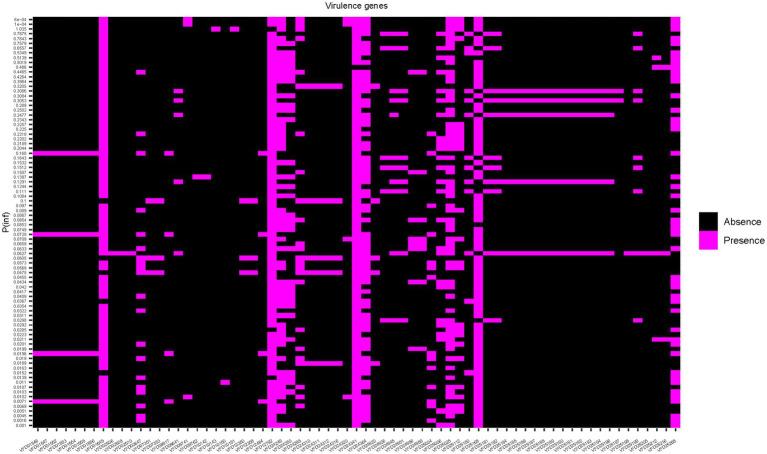
P(inf) values ranged from 6.7E-05 to 5.2E-01, showing variability both among and within serovars. P(inf) values also varied between isolation sources, but no unambiguous pattern was observed in the tested serovars. Interestingly, serovars causing the highest number of human infections did not show better ability to invade cells in the GIT model system, with strains belonging to other serovars displaying even higher infectivity. The RF model did not identify any virulence factor as significant P(inf) predictors. Significant associations of P(inf) with biofilm formation were found in all the different conditions for a limited number of serovars, indicating that the two phenotypes are governed by different mechanisms and that the ability to form biofilm does not correlate with the ability to invade epithelial cells. Other omics techniques therefore seem more promising as alternatives to identify genes associated with P(inf), and different hypotheses, such as gene expression rather than presence/absence, could be tested to explain phenotypic virulence [P(inf)].
引言
全基因组测序(WGS)越来越多地用于对食源性病原体进行特征分析,并且已成为用于监测和研究目的的标准分型技术。WGS数据有助于评估微生物风险,并为食源性病原体确定风险缓解策略,包括……
方法
为了检验不同基因(组合)能够预测接触特定病原体菌株时的感染概率[P(inf)]这一假设,我们在胃肠道(GIT)模型系统中,基于从动物、食品和人类患者中分离出的15个血清型的87株菌株的侵袭潜力,确定了P(inf)。这些基因组通过WGS进行测序,并筛选可能参与毒力的基因。应用随机森林(RF)模型来评估是否可以根据这些基因的存在与否预测菌株的P(inf)。此外,还评估了在不同实验条件下P(inf)与生物膜形成之间的关联。
结果与讨论
P(inf)值范围为6.7E-05至5.2E-01,在血清型之间和血清型内部均表现出变异性。P(inf)值在分离源之间也有所不同,但在所测试的血清型中未观察到明确的模式。有趣的是,导致人类感染数量最多的血清型在GIT模型系统中并未表现出更好的侵袭细胞能力,其他血清型的菌株表现出更高的感染性。RF模型未将任何毒力因子识别为P(inf)的显著预测因子。在有限数量的血清型的所有不同条件下,均发现P(inf)与生物膜形成存在显著关联,这表明这两种表型受不同机制控制,并且形成生物膜的能力与侵袭上皮细胞的能力不相关。因此,其他组学技术似乎作为识别与P(inf)相关基因的替代方法更具前景,可以测试不同的假设,例如基因表达而非基因存在与否,来解释表型毒力[P(inf)]。


 Zotero 插件