
透明细胞肾细胞癌中脂肪酸代谢相关基因的预后预测及免疫治疗反应分析
Prognostic prediction and immunotherapy response analysis of the fatty acid metabolism-related genes in clear cell renal cell carcinoma.
作者信息
Yao Qinfan, Zhang Xiuyuan, Wei Chunchun, Chen Hongjun, Xu Qiannan, Chen Jianghua, Chen Dajin
机构信息
Kidney Disease Center, The First Affiliated Hospital, College of Medicine, Zhejiang University, China.
Key Laboratory of Kidney Disease Prevention and Control Technology, Zhejiang Province, China.
出版信息
Heliyon. 2023 Jun 13;9(6):e17224. doi: 10.1016/j.heliyon.2023.e17224. eCollection 2023 Jun.
BACKGROUND
Clear cell renal cell carcinoma (ccRCC) is a common urinary cancer. Although diagnostic and therapeutic approaches for ccRCC have been improved, the survival outcomes of patients with advanced ccRCC remain unsatisfactory. Fatty acid metabolism (FAM) has been increasingly recognized as a critical modulator of cancer development. However, the significance of the FAM in ccRCC remains unclear. Herein, we explored the function of a FAM-related risk score in the stratification and prediction of treatment responses in patients with ccRCC.
METHODS
First, we applied an unsupervised clustering method to categorize patients from The Cancer Genome Atlas (TCGA) and International Cancer Genome Consortium (ICGC) datasets into subtypes and retrieved FAM-related genes from the MSigDB database. We discern differentially expressed genes (DEGs) among different subtypes. Then, we applied univariate Cox regression analysis followed by least absolute shrinkage and selection operator (LASSO) linear regression based on DEGs expression to establish a FAM-related risk score for ccRCC.
RESULTS
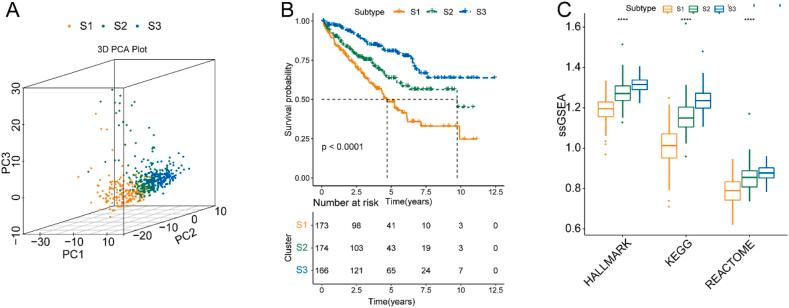
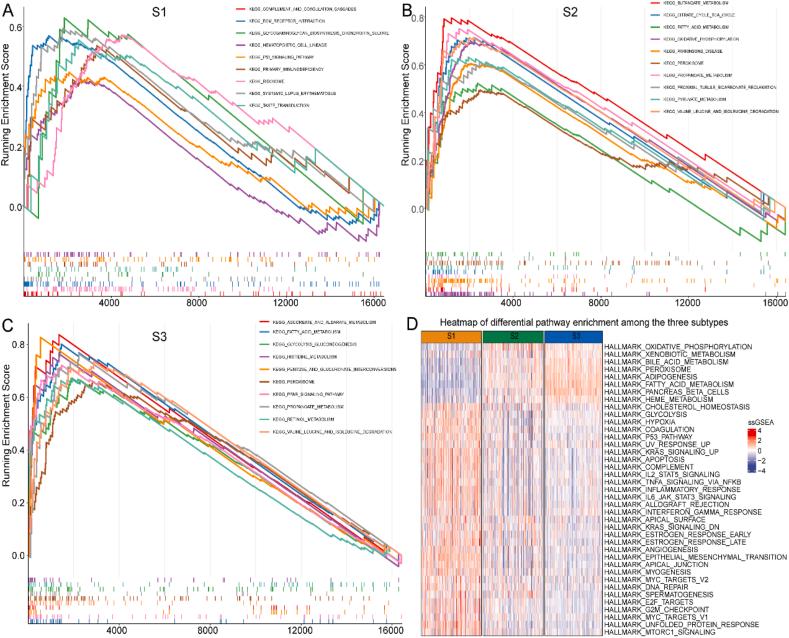
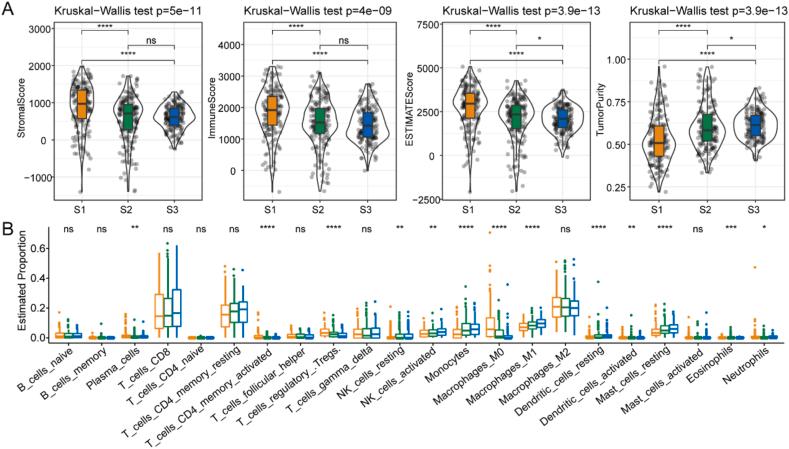
We stratified the three ccRCC subtypes based on FAM-related genes with distinct overall survival (OS), clinical features, immune infiltration patterns, and treatment sensitivities. We screened nine genes from the FAM-related DEGs in the three subtypes to establish a risk prediction model for ccRCC. Nine FAM-related genes were differentially expressed in the ccRCC cell line ACHN compared to the normal kidney cell line HK2. High-risk patients had worse OS, higher genomic heterogeneity, a more complex tumor microenvironment (TME), and elevated expression of immune checkpoints. This phenomenon was validated in the ICGC cohort.
CONCLUSION
We constructed a FAM-related risk score that predicts the prognosis and therapeutic response of ccRCC. The close association between FAM and ccRCC progression lays a foundation for further exploring FAM-related functions in ccRCC.
背景
透明细胞肾细胞癌(ccRCC)是一种常见的泌尿系统癌症。尽管ccRCC的诊断和治疗方法已有改进,但晚期ccRCC患者的生存结局仍不尽人意。脂肪酸代谢(FAM)日益被认为是癌症发展的关键调节因子。然而,FAM在ccRCC中的意义仍不清楚。在此,我们探讨了FAM相关风险评分在ccRCC患者分层及治疗反应预测中的作用。
方法
首先,我们应用无监督聚类方法将来自癌症基因组图谱(TCGA)和国际癌症基因组联盟(ICGC)数据集的患者分为不同亚型,并从MSigDB数据库中检索FAM相关基因。我们辨别不同亚型之间的差异表达基因(DEG)。然后,我们应用单变量Cox回归分析,随后基于DEG表达进行最小绝对收缩和选择算子(LASSO)线性回归,以建立ccRCC的FAM相关风险评分。
结果
我们根据FAM相关基因对三种ccRCC亚型进行分层,这些亚型具有不同的总生存期(OS)、临床特征、免疫浸润模式和治疗敏感性。我们从三种亚型中与FAM相关的DEG中筛选出9个基因,以建立ccRCC的风险预测模型。与正常肾细胞系HK2相比,9个与FAM相关的基因在ccRCC细胞系ACHN中差异表达。高危患者的OS较差、基因组异质性较高、肿瘤微环境(TME)更复杂且免疫检查点表达升高。这一现象在ICGC队列中得到验证。
结论
我们构建了一个FAM相关风险评分,可预测ccRCC的预后和治疗反应。FAM与ccRCC进展之间的密切关联为进一步探索FAM在ccRCC中的相关功能奠定了基础。



 Zotero 插件