
可控形状银纳米结构的绿色合成及其过氧化物酶活性、催化降解和抗菌活性
Green Synthesis of Controlled Shape Silver Nanostructures and Their Peroxidase, Catalytic Degradation, and Antibacterial Activity.
作者信息
Shafiq Ayesha, Deshmukh Aarti R, AbouAitah Khaled, Kim Beom-Soo
机构信息
Department of Chemical Engineering, Chungbuk National University, Cheongju 28644, Republic of Korea.
出版信息
J Funct Biomater. 2023 Jun 18;14(6):325. doi: 10.3390/jfb14060325.
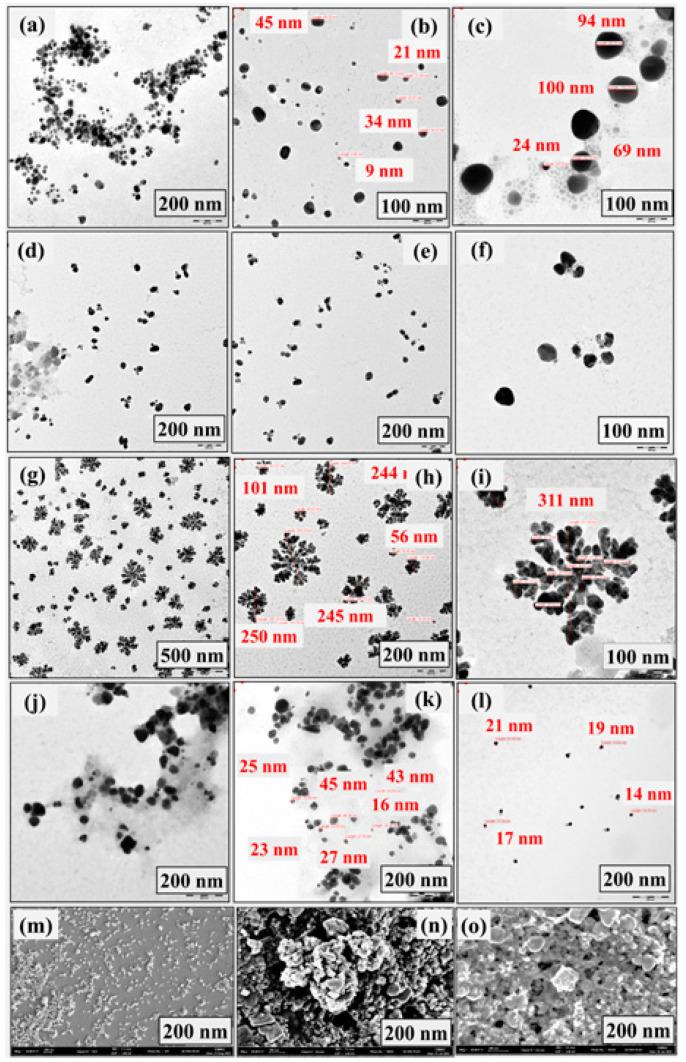
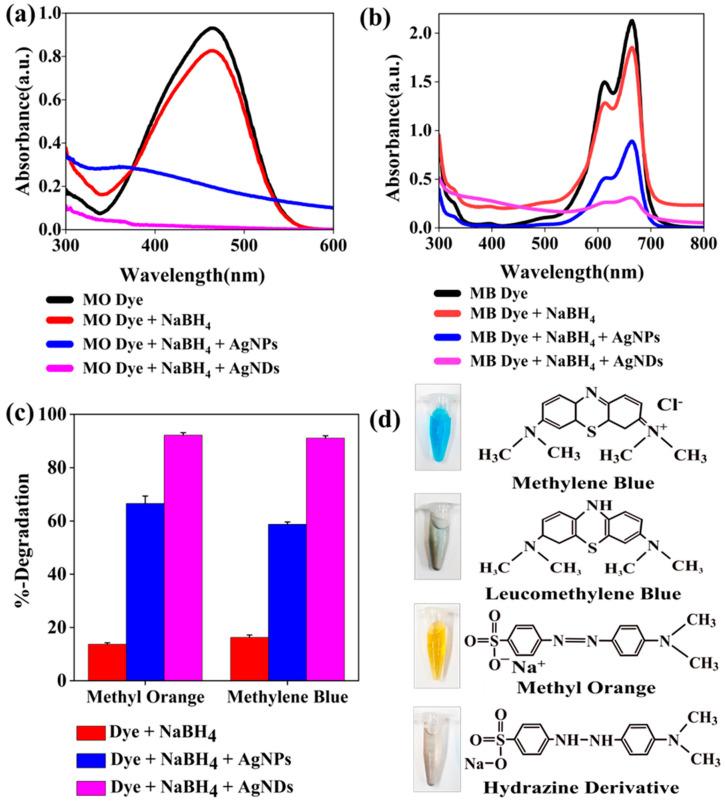
Nanoparticles with unique shapes have garnered significant interest due to their enhanced surface area-to-volume ratio, leading to improved potential compared to their spherical counterparts. The present study focuses on a biological approach to producing different silver nanostructures employing leaf extract. Phytoextract provides metabolites, serving as reducing and stabilizing agents in the reaction. Two different silver nanostructures, dendritic (AgNDs) and spherical (AgNPs), were successfully formed by adjusting the phytoextract concentration with and without copper ions in the reaction system, resulting in particle sizes of ~300 ± 30 nm (AgNDs) and ~100 ± 30 nm (AgNPs). These nanostructures were characterized by several techniques to ascertain their physicochemical properties; the surface was distinguished by functional groups related to polyphenols due to plant extract that led to critical controlling of the shape of nanoparticles. Nanostructures performance was assessed in terms of peroxidase-like activity, catalytic behavior for dye degradation, and antibacterial activity. Spectroscopic analysis revealed that AgNDs demonstrated significantly higher peroxidase activity compared to AgNPs when evaluated using chromogenic reagent 3,3',5,5'-tetramethylbenzidine. Furthermore, AgNDs exhibited enhanced catalytic degradation activities, achieving degradation percentages of 92.2% and 91.0% for methyl orange and methylene blue dyes, respectively, compared to 66.6% and 58.0% for AgNPs. Additionally, AgNDs exhibited superior antibacterial properties against Gram-negative compared to Gram-positive , as evidenced by the calculated zone of inhibition. These findings highlight the potential of the green synthesis method in generating novel nanoparticle morphologies, such as dendritic shape, compared with the traditionally synthesized spherical shape of silver nanostructures. The synthesis of such unique nanostructures holds promise for various applications and further investigations in diverse sectors, including chemical and biomedical fields.
具有独特形状的纳米颗粒因其增大的表面积与体积比而备受关注,与球形纳米颗粒相比,其具有更好的性能潜力。本研究聚焦于一种利用叶提取物制备不同银纳米结构的生物学方法。植物提取物提供代谢产物,在反应中作为还原剂和稳定剂。通过在反应体系中添加和不添加铜离子来调节植物提取物浓度,成功形成了两种不同的银纳米结构,树枝状(AgNDs)和球形(AgNPs),所得颗粒尺寸分别约为300±30nm(AgNDs)和100±30nm(AgNPs)。通过多种技术对这些纳米结构进行表征以确定其物理化学性质;由于植物提取物,其表面具有与多酚相关的官能团,这对纳米颗粒的形状起到了关键控制作用。从过氧化物酶样活性、染料降解催化行为和抗菌活性方面评估了纳米结构的性能。光谱分析表明,当使用显色剂3,3',5,5'-四甲基联苯胺进行评估时,AgNDs的过氧化物酶活性明显高于AgNPs。此外,AgNDs表现出增强的催化降解活性,对甲基橙和亚甲基蓝染料的降解率分别达到92.2%和91.0%,而AgNPs对这两种染料的降解率分别为66.6%和58.0%。此外,通过计算抑菌圈证明,与革兰氏阳性菌相比,AgNDs对革兰氏阴性菌具有更强的抗菌性能。这些发现凸显了绿色合成方法在生成新型纳米颗粒形态(如树枝状)方面的潜力,与传统合成的球形银纳米结构不同。这种独特纳米结构的合成在包括化学和生物医学领域在内的不同行业的各种应用和进一步研究中具有广阔前景。



 Zotero 插件