
不同腐殖质材料稳定的银纳米颗粒的抗氧化活性增强及细胞毒性降低
Enhanced Antioxidant Activity and Reduced Cytotoxicity of Silver Nanoparticles Stabilized by Different Humic Materials.
作者信息
Zykova Maria V, Volikov Alexander B, Buyko Evgeny E, Bratishko Kristina A, Ivanov Vladimir V, Konstantinov Andrey I, Logvinova Lyudmila A, Mihalyov Dmitrii A, Sobolev Nikita A, Zhirkova Anastasia M, Maksimov Sergey V, Perminova Irina V, Belousov Mikhail V
机构信息
Pharmaceutical Faculty, Siberian State Medical University, 634050 Tomsk, Russia.
Department of Chemistry, Lomonosov Moscow State University, Leninskiye Gory 1-3, 119991 Moscow, Russia.
出版信息
Polymers (Basel). 2023 Aug 12;15(16):3386. doi: 10.3390/polym15163386.
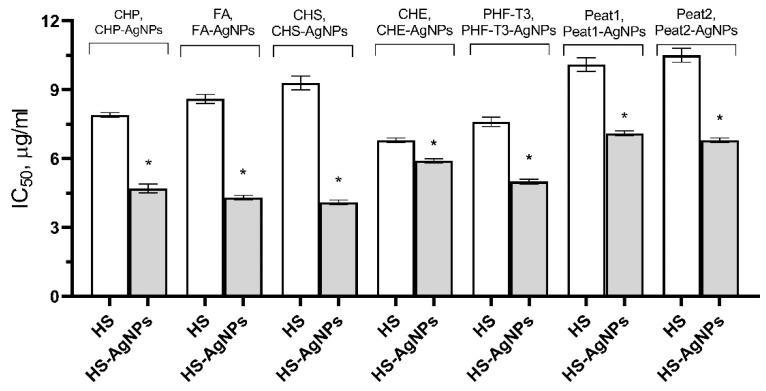
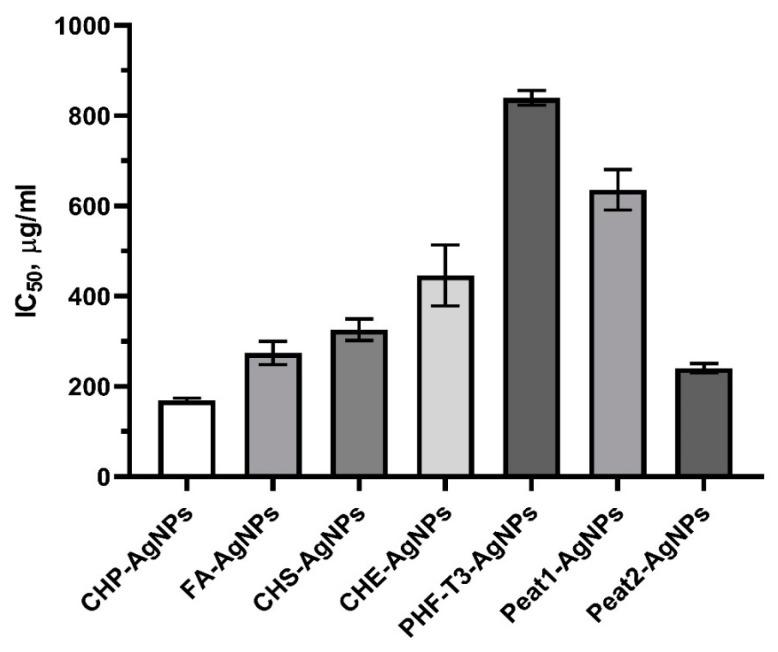
The current article describes the biological activity of new biomaterials combining the "green" properties of humic substances (HSs) and silver nanoparticles. The aim is to investigate the antioxidant activity (AOA) of HS matrices (macroligands) and AgNPs stabilized with humic macroligands (HS-AgNPs). The unique chemical feature of HSs makes them very promising ligands (matrices) for AgNP stabilization. HSs have previously been shown to exert many pharmacological effects mediated by their AOA. AgNPs stabilized with HS showed a pronounced ability to bind to reactive oxygen species (ROS) in the test with ABTS. Also, higher AOA was observed for HS-AgNPs as compared to the HS matrices. In vitro cytotoxicity studies have shown that the stabilization of AgNPs with the HS matrices reduces the cytotoxicity of AgNPs. As a result of in vitro experiments with the use of 2,7-dichlorodihydrofluorescein diacetate (DCFDA), it was found that all HS materials tested and the HS-AgNPs did not exhibit prooxidant effects. Moreover, more pronounced AOA was shown for HS-AgNP samples as compared to the original HS matrices. Two putative mechanisms of the pronounced AOA of the tested compositions are proposed: firstly, the pronounced ability of HSs to inactivate ROS and, secondly, the large surface area and surface-to-volume ratio of HS-AgNPs, which facilitate electron transfer and mitigate kinetic barriers to the reduction reaction. As a result, the antioxidant properties of the tested HS-AgNPs might be of particular interest for biomedical applications aimed at inhibiting the growth of bacteria and viruses and the healing of purulent wounds.
当前文章描述了结合腐殖质(HSs)的“绿色”特性与银纳米颗粒的新型生物材料的生物活性。目的是研究HS基质(大环配体)和用腐殖质大环配体稳定的银纳米颗粒(HS-AgNPs)的抗氧化活性(AOA)。HSs独特的化学特性使其成为用于稳定银纳米颗粒的非常有前景的配体(基质)。先前已表明HSs通过其AOA发挥许多药理作用。在用ABTS进行的测试中,用HS稳定的银纳米颗粒显示出与活性氧(ROS)结合的显著能力。此外,与HS基质相比,HS-AgNPs的AOA更高。体外细胞毒性研究表明,用HS基质稳定银纳米颗粒可降低其细胞毒性。使用2,7-二氯二氢荧光素二乙酸酯(DCFDA)进行体外实验的结果发现,所有测试的HS材料和HS-AgNPs均未表现出促氧化作用。此外,与原始HS基质相比,HS-AgNP样品的AOA更为明显。提出了所测试组合物显著AOA的两种推定机制:首先,HSs使ROS失活的显著能力;其次,HS-AgNPs的大表面积和表面体积比,这有利于电子转移并减轻还原反应的动力学障碍。因此,所测试的HS-AgNPs的抗氧化特性对于旨在抑制细菌和病毒生长以及脓性伤口愈合的生物医学应用可能特别有意义。

 Zotero 插件