
一种用于检测银的硫代乙醇酸乙酯功能化的FeO@ZnS磁性荧光纳米探针及其在实际水溶液中的应用
An Ethyl-Thioglycolate-Functionalized FeO@ZnS Magnetic Fluorescent Nanoprobe for the Detection of Ag and Its Applications in Real Water Solutions.
作者信息
Chen Xin, Chen Jie, Ma Mingshuo, Yu Shihua, Liu Zhigang, Zeng Xiaodan
机构信息
School of Chemical and Pharmaceutical Engineering, Jilin Institute of Chemical Technology, Jilin 132022, China.
Center of Characterization and Analysis, Jilin Institute of Chemical Technology, Jilin 132022, China.
出版信息
Nanomaterials (Basel). 2023 Jul 1;13(13):1992. doi: 10.3390/nano13131992.
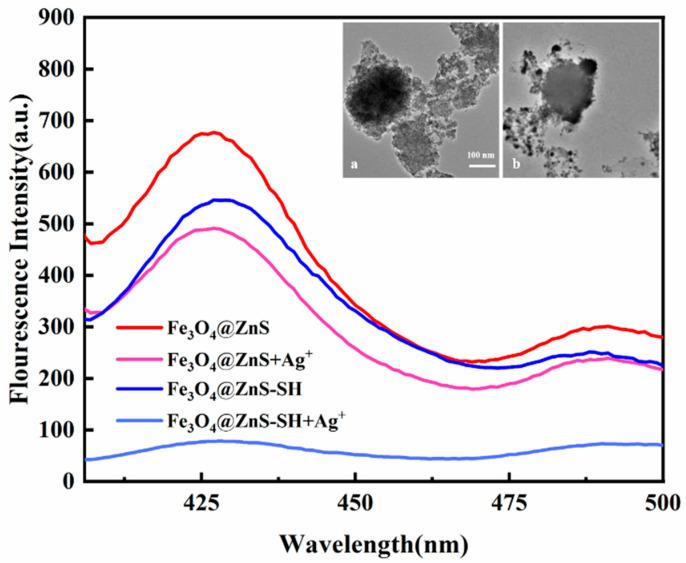
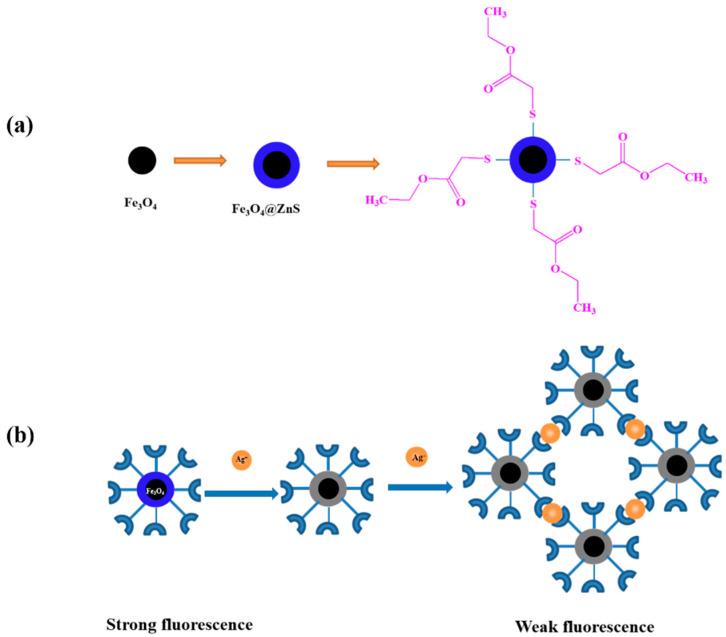
Ethyl-thioglycolate-modified FeO@ZnS nanoparticles (FeO@ZnS-SH) were successfully prepared using a simple chemical precipitation method. The introduction of ethyl thioglycolate better regulated the surface distribution of ZnS, which can act as a recognition group and can cause a considerable quenching of the fluorescence intensity of the magnetic fluorescent nanoprobe, FeO@ZnS-SH. Benefiting from stable fluorescence emission, the magnetic fluorescent nanoprobe showed a highly selective fluorescent response to Ag+ in the range of 0-400 μM, with a low detection limit of 0.20 μM. The magnetic fluorescent nanoprobe was used to determine the content of Ag in real samples. A simple and environmentally friendly approach was proposed to simultaneously achieve the enrichment, detection, and separation of Ag and the magnetic fluorescent nanoprobe from an aqueous solution. These results may lead to a wider range of application prospects of FeO nanomaterials as base materials for fluorescence detection in the environment.
采用简单的化学沉淀法成功制备了巯基乙酸乙酯修饰的FeO@ZnS纳米颗粒(FeO@ZnS-SH)。巯基乙酸乙酯的引入更好地调控了ZnS的表面分布,其可作为识别基团,并能使磁性荧光纳米探针FeO@ZnS-SH的荧光强度发生显著猝灭。得益于稳定的荧光发射,该磁性荧光纳米探针在0-400μM范围内对Ag+表现出高度选择性的荧光响应,检测限低至0.20μM。该磁性荧光纳米探针用于测定实际样品中Ag的含量。提出了一种简单且环保的方法,可同时实现从水溶液中富集、检测和分离Ag以及磁性荧光纳米探针。这些结果可能会使FeO纳米材料作为环境中荧光检测基础材料具有更广泛的应用前景。
 Zotero 插件