
HDRobust 实现高效高精度同源定向修复依赖型基因组编辑。
Efficient high-precision homology-directed repair-dependent genome editing by HDRobust.
机构信息
Department of Evolutionary Genetics, Max Planck Institute for Evolutionary Anthropology, Leipzig, Germany.
Human Evolutionary Genomics Unit, Okinawa Institute of Science and Technology, Onna-son, Japan.
出版信息
Nat Methods. 2023 Sep;20(9):1388-1399. doi: 10.1038/s41592-023-01949-1. Epub 2023 Jul 20.
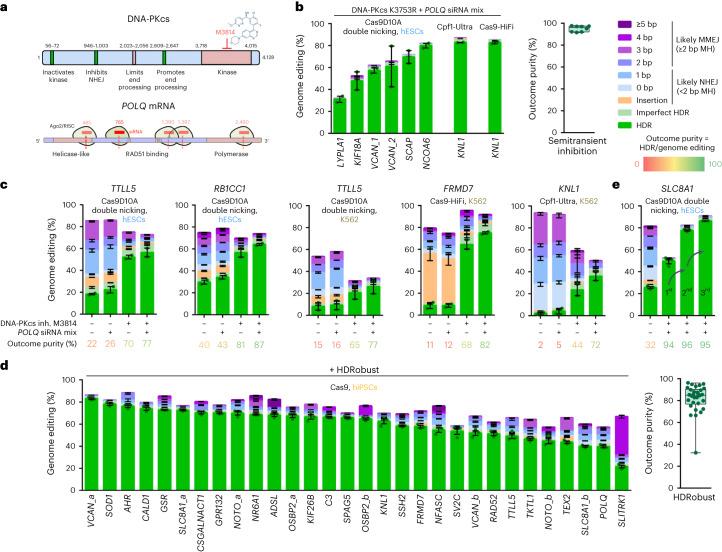
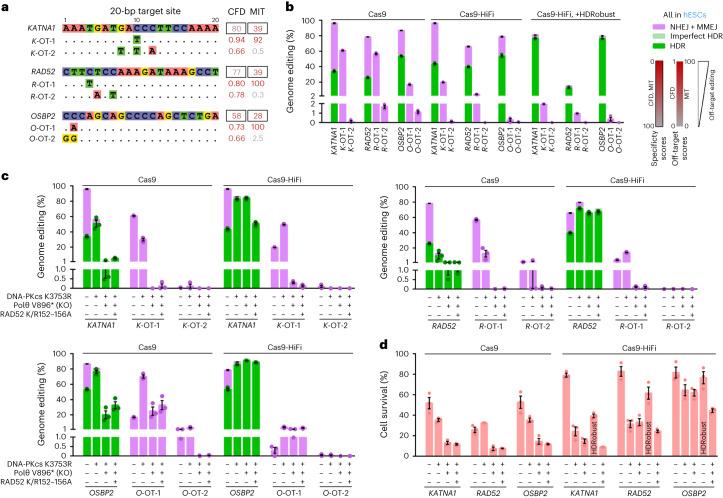
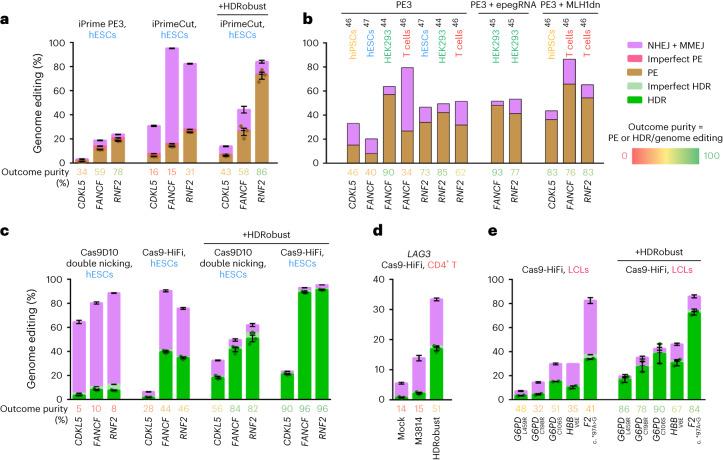
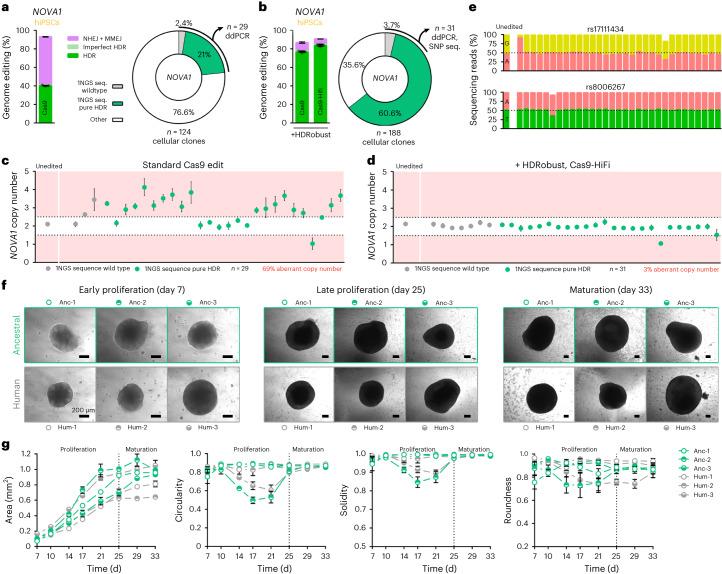
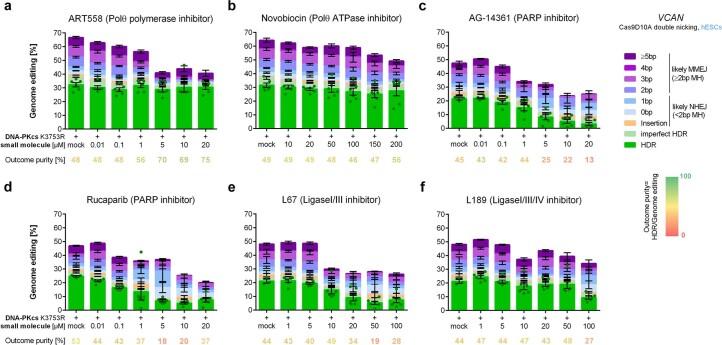
Homology-directed repair (HDR), a method for repair of DNA double-stranded breaks can be leveraged for the precise introduction of mutations supplied by synthetic DNA donors, but remains limited by low efficiency and off-target effects. In this study, we report HDRobust, a high-precision method that, via the combined transient inhibition of nonhomologous end joining and microhomology-mediated end joining, resulted in the induction of point mutations by HDR in up to 93% (median 60%, s.e.m. 3) of chromosomes in populations of cells. We found that, using this method, insertions, deletions and rearrangements at the target site, as well as unintended changes at other genomic sites, were largely abolished. We validated this approach for 58 different target sites and showed that it allows efficient correction of pathogenic mutations in cells derived from patients suffering from anemia, sickle cell disease and thrombophilia.
同源定向修复 (HDR) 是一种修复 DNA 双链断裂的方法,可以用于精确引入由合成 DNA 供体提供的突变,但仍受到效率低和脱靶效应的限制。在这项研究中,我们报告了 HDRobust,这是一种高精度的方法,通过瞬时抑制非同源末端连接和微同源介导的末端连接的联合作用,导致高达 93%(中位数 60%,标准误差 3)的细胞群体中的 HDR 诱导点突变。我们发现,使用这种方法,可以消除靶位点的插入、缺失和重排,以及其他基因组位点的意外变化。我们在 58 个不同的靶位点验证了这种方法,并表明它可以有效地纠正来自贫血、镰状细胞病和血栓形成倾向患者的细胞中的致病性突变。




 Zotero 插件