
一种源自高级别浆液性卵巢癌中促肿瘤B细胞、调节性T细胞和促炎巨噬细胞的化疗反应预测模型。
A chemotherapy response prediction model derived from tumor-promoting B and Tregs and proinflammatory macrophages in HGSOC.
作者信息
Xi Yue, Zhang Yingchun, Zheng Kun, Zou Jiawei, Gui Lv, Zou Xin, Chen Liang, Hao Jie, Zhang Yiming
机构信息
Department of Reproductive Medicine, Central Hospital Affiliated to Shandong First Medical University, Jinan, Shandong, China.
Department of Urology, Shanghai Sixth People's Hospital Affiliated to Shanghai Jiao Tong University School of Medicine, Shanghai, China.
出版信息
Front Oncol. 2023 Jul 14;13:1171582. doi: 10.3389/fonc.2023.1171582. eCollection 2023.
BACKGROUND
Most patients with high-grade serous ovarian cancer (HGSOC) experienced disease recurrence with cumulative chemoresistance, leading to treatment failure. However, few biomarkers are currently available in clinical practice that can accurately predict chemotherapy response. The tumor immune microenvironment is critical for cancer development, and its transcriptomic profile may be associated with treatment response and differential outcomes. The aim of this study was to develop a new predictive signature for chemotherapy in patients with HGSOC.
METHODS
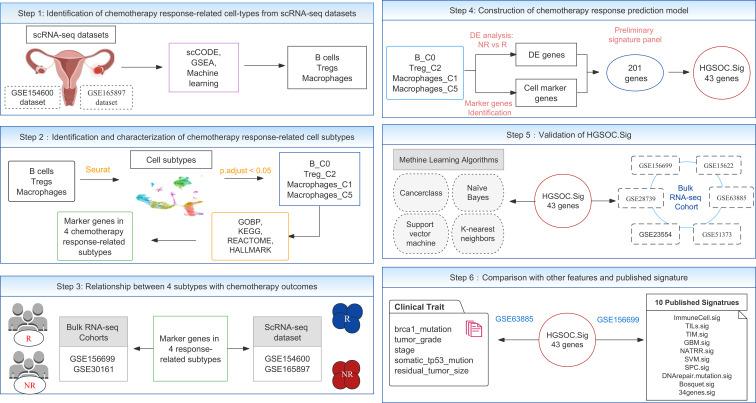
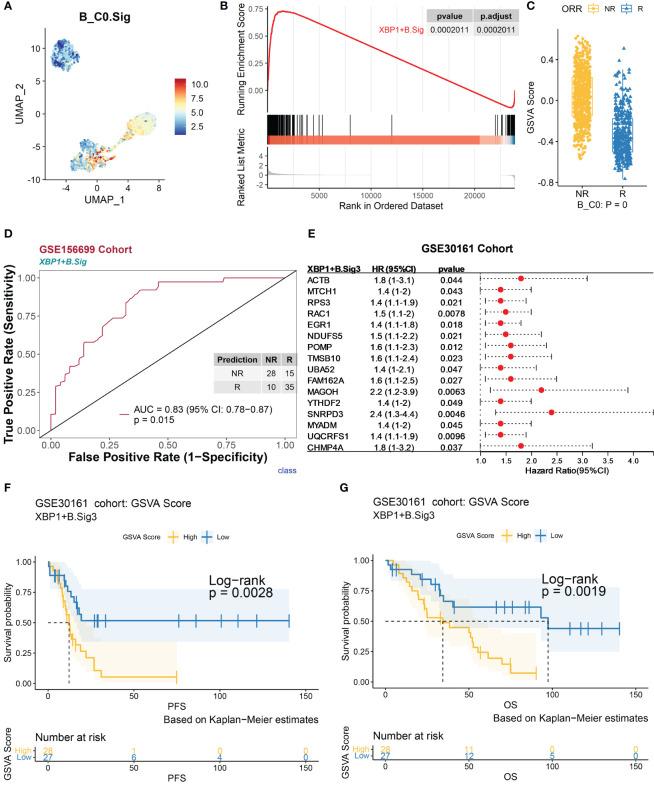
Two HGSOC single-cell RNA sequencing datasets from patients receiving chemotherapy were reinvestigated. The subtypes of endoplasmic reticulum stress-related XBP1 B cells, invasive metastasis-related ACTB Tregs, and proinflammatory-related macrophage subtypes with good predictive power and associated with chemotherapy response were identified. These results were verified in an independent HGSOC bulk RNA-seq dataset for chemotherapy. Further validation in clinical cohorts used quantitative real-time PCR (qRT-PCR).
RESULTS
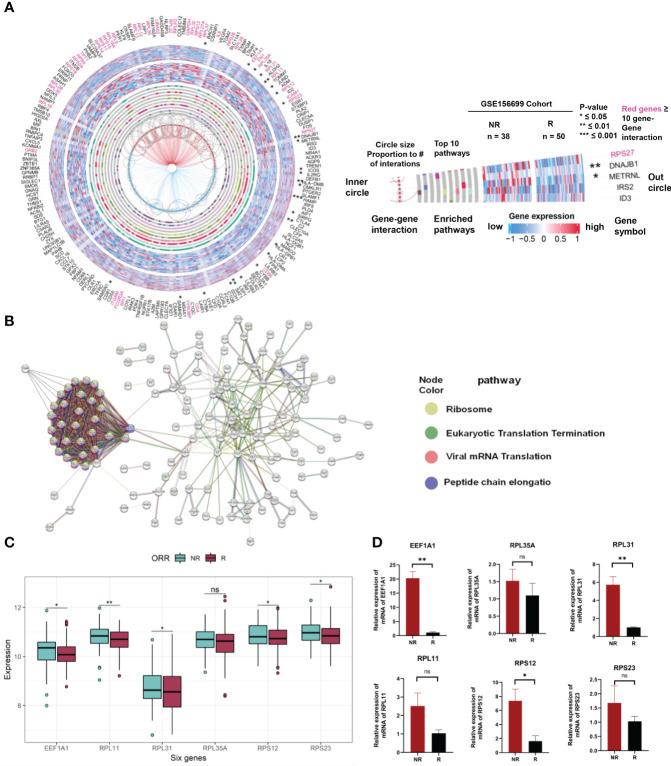
By combining cluster-specific genes for the aforementioned cell subtypes, we constructed a chemotherapy response prediction model containing 43 signature genes that achieved an area under the receiver operator curve (AUC) of 0.97 ( = 2.1e-07) for the GSE156699 cohort (88 samples). A huge improvement was achieved compared to existing prediction models with a maximum AUC of 0.74. In addition, its predictive capability was validated in multiple independent bulk RNA-seq datasets. The qRT-PCR results demonstrate that the expression of the six genes has the highest diagnostic value, consistent with the trend observed in the analysis of public data.
CONCLUSIONS
The developed chemotherapy response prediction model can be used as a valuable clinical decision tool to guide chemotherapy in HGSOC patients.
背景
大多数高级别浆液性卵巢癌(HGSOC)患者会出现疾病复发并伴有累积性化疗耐药,导致治疗失败。然而,目前临床实践中几乎没有能够准确预测化疗反应的生物标志物。肿瘤免疫微环境对癌症发展至关重要,其转录组图谱可能与治疗反应和不同结局相关。本研究的目的是为HGSOC患者开发一种新的化疗预测特征。
方法
对两个来自接受化疗患者的HGSOC单细胞RNA测序数据集进行重新研究。确定了具有良好预测能力且与化疗反应相关的内质网应激相关XBP1 B细胞亚型、侵袭转移相关ACTB Tregs以及促炎相关巨噬细胞亚型。这些结果在一个独立的用于化疗的HGSOC批量RNA测序数据集中得到验证。在临床队列中通过定量实时PCR(qRT-PCR)进行进一步验证。
结果
通过组合上述细胞亚型的簇特异性基因,我们构建了一个化疗反应预测模型,该模型包含43个特征基因,对于GSE156699队列(88个样本),其受试者操作特征曲线下面积(AUC)达到0.97( = 2.1e - 07)。与现有预测模型相比有了巨大改进,现有模型的最大AUC为0.74。此外,其预测能力在多个独立的批量RNA测序数据集中得到验证。qRT-PCR结果表明,这六个基因的表达具有最高的诊断价值,与公共数据分析中观察到的趋势一致。
结论
所开发的化疗反应预测模型可作为一种有价值的临床决策工具,用于指导HGSOC患者的化疗。



 Zotero 插件