
新冠病毒、补体系统与大脑
COVID, complement, and the brain.
机构信息
Department of Neurology, University of Maryland, School of Medicine, Baltimore, MD, United States.
Department of Medicine, Medical Clinic Nr. 1, "Iuliu Hatieganu" University of Medicine and Pharmacy, Cluj-Napoca, Romania.
出版信息
Front Immunol. 2023 Jul 18;14:1216457. doi: 10.3389/fimmu.2023.1216457. eCollection 2023.
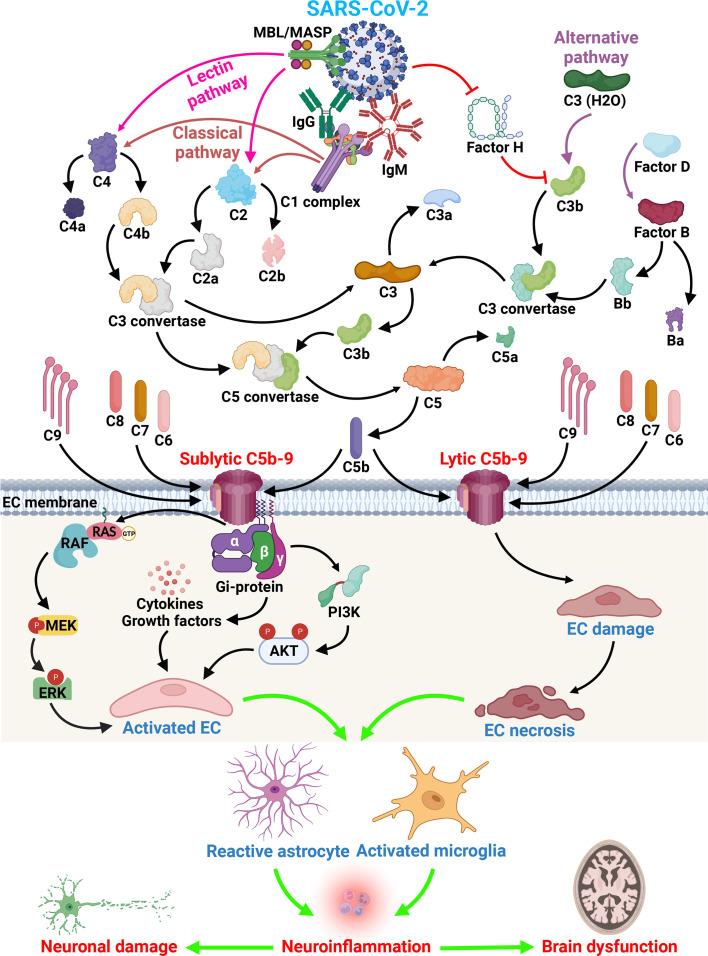
The brains of COVID-19 patients are affected by the SARS-CoV-2 virus, and these effects may contribute to several COVID-19 sequelae, including cognitive dysfunction (termed "long COVID" by some researchers). Recent advances concerning the role of neuroinflammation and the consequences for brain function are reviewed in this manuscript. Studies have shown that respiratory SARS-CoV-2 infection in mice and humans is associated with selective microglial reactivity in the white matter, persistently impaired hippocampal neurogenesis, a decrease in the number of oligodendrocytes, and myelin loss. Brain MRI studies have revealed a greater reduction in grey matter thickness in the orbitofrontal cortex and parahippocampal gyrus, associated with a greater reduction in global brain size, in those with SARS-CoV-2 and a greater cognitive decline. COVID-19 can directly infect endothelial cells of the brain, potentially promoting clot formation and stroke; complement C3 seems to play a major role in this process. As compared to controls, the brain tissue of patients who died from COVID-19 have shown a significant increase in the extravasation of fibrinogen, indicating leakage in the blood-brain barrier; furthermore, recent studies have documented the presence of IgG, IgM, C1q, C4d, and C5b-9 deposits in the brain tissue of COVID-19 patients. These data suggest an activation of the classical complement pathway and an immune-mediated injury to the endothelial cells. These findings implicate both the classical and alternative complement pathways, and they indicate that C3b and the C5b-9 terminal complement complex (membrane attack complex, MAC) are acting in concert with neuroinflammatory and immune factors to contribute to the neurological sequelae seen in patients with COVID.
新型冠状病毒肺炎(COVID-19)患者的大脑受到严重的 SARS-CoV-2 病毒影响,这可能是 COVID-19 多种后遗症的原因之一,包括认知功能障碍(一些研究人员称之为“长新冠”)。本文综述了神经炎症作用及其对大脑功能影响的最新进展。研究表明,在小鼠和人类中,呼吸道 SARS-CoV-2 感染与大脑白质中选择性小胶质细胞反应、海马神经发生持续受损、少突胶质细胞数量减少和髓鞘丢失有关。脑 MRI 研究显示,在 SARS-CoV-2 患者中,眶额皮质和海马旁回的灰质厚度减少更多,与大脑总体积减少和认知能力下降更明显相关。COVID-19 可直接感染大脑内皮细胞,可能促进血栓形成和中风;补体 C3 似乎在这一过程中起主要作用。与对照组相比,死于 COVID-19 的患者脑组织中纤维蛋白原的外渗明显增加,表明血脑屏障渗漏;此外,最近的研究还记录了 COVID-19 患者脑组织中 IgG、IgM、C1q、C4d 和 C5b-9 沉积物的存在。这些数据表明经典补体途径的激活和免疫介导的内皮细胞损伤。这些发现提示了经典和替代补体途径的参与,表明 C3b 和 C5b-9 末端补体复合物(膜攻击复合物,MAC)与神经炎症和免疫因素共同作用,导致 COVID 患者出现神经系统后遗症。
 Zotero 插件