
使用卤化铅钙钛矿量子点催化剂的可见光驱动可逆穿梭邻二卤化反应
Visible-light-driven reversible shuttle vicinal dihalogenation using lead halide perovskite quantum dot catalysts.
作者信息
Li Yonglong, Gao Yangxuan, Deng Zhijie, Cao Yutao, Wang Teng, Wang Ying, Zhang Cancan, Yuan Mingjian, Xie Wei
机构信息
State Key Laboratory of Advanced Chemical Power Sources, Key Laboratory of Advanced Energy Materials Chemistry (Ministry of Education), Haihe Laboratory of Sustainable Chemical Transformations, Renewable Energy Conversion and Storage Center, College of Chemistry, Nankai University, Tianjin, 300071, P. R. China.
State Key Laboratory of Elemento-Organic Chemistry, College of Chemistry, Nankai University, Tianjin, 300071, P. R. China.
出版信息
Nat Commun. 2023 Aug 4;14(1):4673. doi: 10.1038/s41467-023-40359-x.
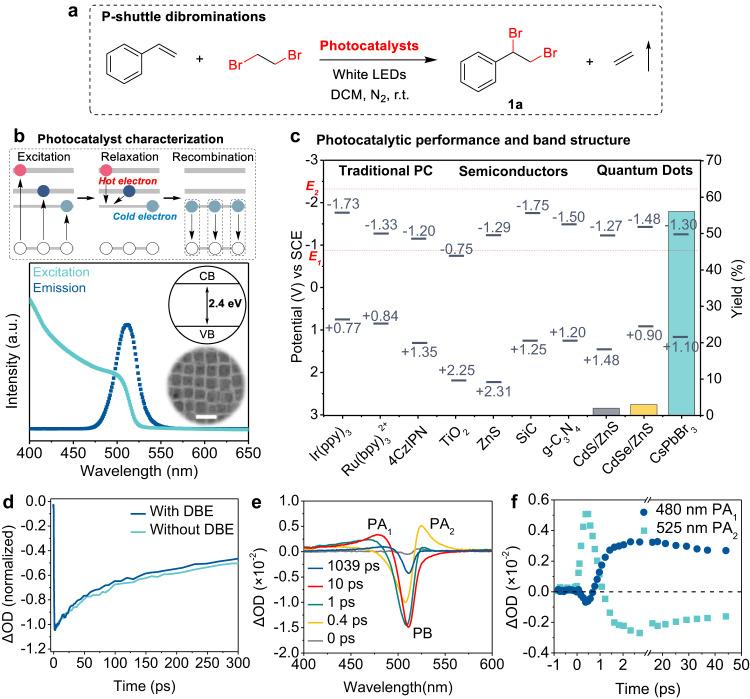
Dihalogenation of alkenes to the high-added value vicinal dihalides is a prominent process in modern synthetic chemistry. However, their effective conversion still requires the use of expensive and hazardous agents, sacrificial half-reaction coupling or primary energy input. Here, we show a photocatalytically assisted shuttle (p-shuttle) strategy for redox-neutral and reversible vicinal dihalogenation using low-cost and stable 1,2-dihaloethane under visible light illumination. Energetic hot electrons from metal-halide perovskite QDs enable the challenging photocatalytic reactions. Ultrafast laser transient absorption spectroscopy have unveiled the energy matching of the hot electrons with the high reduction potential of 1,2-dihaloethane, via two consecutive photoexcitation process. Powered by the sustainable energy as the only energy input, our new catalytic system using metal-halide perovskite QDs for dibromination, dichlorination and even unexplored hetero-dihalogenation, shows good tolerance with a wide range of alkenes at room temperature. In contrast to homogeneous photocatalysts, chalcogenide QDs and other semiconductor catalysts, perovskite QDs deliver previously unattainable performance in photoredox shuttle vicinal dihalogenation with the turnover number over 120,000. This work provides new opportunities in visible-light-driven heterogeneous catalysis for unlocking novel chemical transformations.
烯烃二卤化生成高附加值的邻二卤化物是现代合成化学中的一个重要过程。然而,其有效转化仍需要使用昂贵且危险的试剂、牺牲性半反应偶联或一次能源输入。在此,我们展示了一种光催化辅助穿梭(p-穿梭)策略,用于在可见光照射下使用低成本且稳定的1,2-二卤乙烷进行氧化还原中性和可逆的邻二卤化反应。来自金属卤化物钙钛矿量子点的高能热电子能够实现具有挑战性的光催化反应。超快激光瞬态吸收光谱通过两个连续的光激发过程揭示了热电子与1,2-二卤乙烷的高还原电位之间的能量匹配。以可持续能源作为唯一的能量输入,我们使用金属卤化物钙钛矿量子点进行二溴化、二氯化甚至未探索的杂二卤化反应的新催化体系,在室温下对多种烯烃表现出良好的耐受性。与均相光催化剂、硫族化物量子点和其他半导体催化剂相比,钙钛矿量子点在光氧化还原穿梭邻二卤化反应中展现出了前所未有的性能,其周转数超过120,000。这项工作为可见光驱动的多相催化开辟新型化学转化提供了新的机遇。




 Zotero 插件