
意大利家禽群体的基因组学与抗菌监测
Genomic and Antimicrobial Surveillance of Population in Italian Poultry.
作者信息
Marotta Francesca, Janowicz Anna, Romantini Romina, Di Marcantonio Lisa, Di Timoteo Federica, Romualdi Teresa, Zilli Katiuscia, Barco Lisa, D'Incau Mario, Mangone Iolanda, Cito Francesca, Di Domenico Marco, Pomilio Francesco, Ricci Lucilla, Garofolo Giuliano
机构信息
National Reference Laboratory for Campylobacter, Istituto Zooprofilattico Sperimentale Teramo, Via Campo Boario 1, 64100 Teramo, Italy.
Italian National Reference Laboratory for Salmonellosis, Istituto Zooprofilattico Sperimentale delle Venezie, Legnaro, 35020 Padua, Italy.
出版信息
Foods. 2023 Jul 31;12(15):2919. doi: 10.3390/foods12152919.
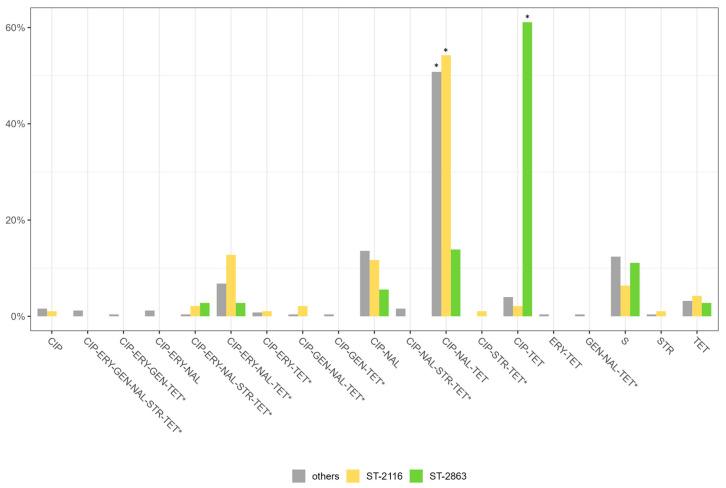
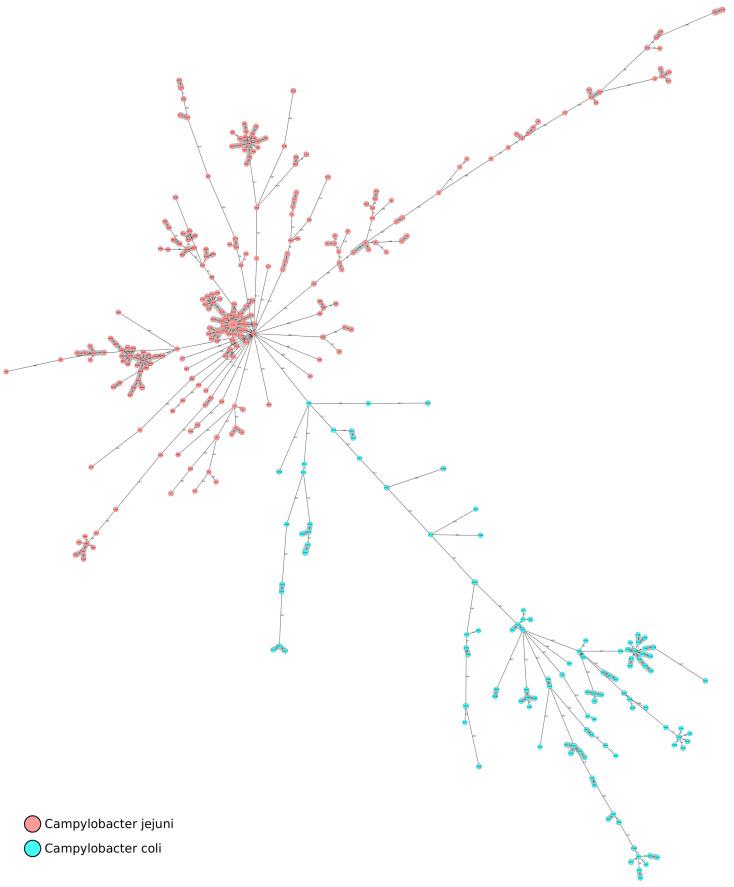
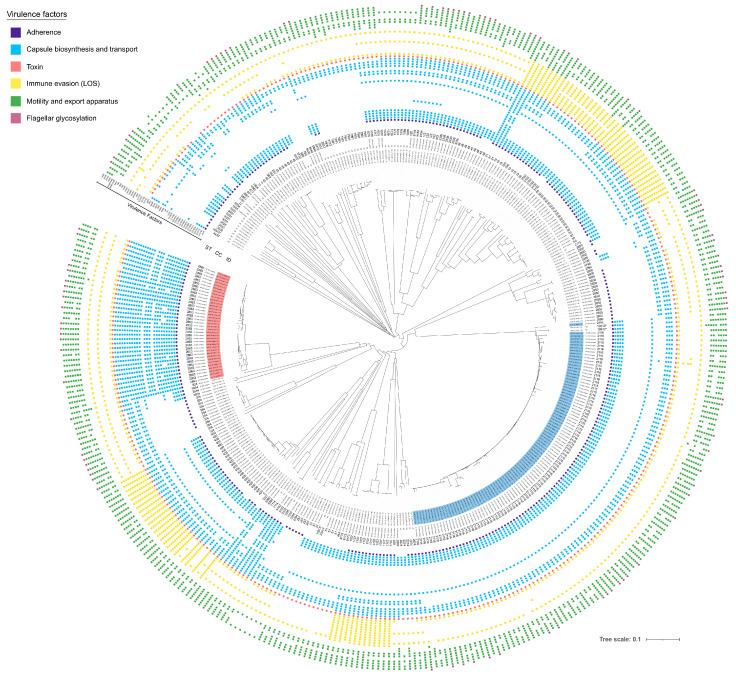
is one of the most common foodborne diseases worldwide with increasing rates of antibiotic resistance. Most cases of campylobacteriosis can be traced back to the consumption of poultry meat. Despite many efforts to reduce contamination in farms and in slaughterhouses, the persistence of this pathogen in poultry products remains a problem. This study aimed to evaluate the genetic diversity and antibiotic resistance of 542 and in Italian poultry, in the framework of two National Monitoring Programs. Genomes were screened for antibiotic resistance, virulence determinants and contextualized within a global collection of . ST2116, ST2863 and ST 832 were the most prevalent and significantly associated with Italian poultry. A worrying increase in resistance to quinolones, fluoroquinolones and tetracycline was observed in , while an increased occurrence of multidrug resistant (MDR) strains and strains resistant to macrolides was detected in . Low resistance rates were found for aminoglycosides. Molecular resistance determinants were consistent with the phenotypic resistance for tetracycline and quinolones. In silico analysis revealed 119 genes associated with virulence factors, with a notably higher prevalence of some genes in ST2863 genomes. This study highlights the increased resistance to macrolides and the emergence of MDR strains for , the genetic basis of AMR and the predominance of two genotypes among strains isolated from the Italian poultry farms.
是全球最常见的食源性疾病之一,抗生素耐药率不断上升。大多数弯曲杆菌病病例可追溯到食用禽肉。尽管在农场和屠宰场采取了许多减少污染的措施,但这种病原体在禽肉产品中的持续存在仍然是一个问题。本研究旨在在两项国家监测计划的框架内,评估意大利家禽中542株弯曲杆菌的遗传多样性和抗生素耐药性。对基因组进行了抗生素耐药性、毒力决定因素筛查,并在全球弯曲杆菌菌株集合中进行了背景分析。ST2116、ST2863和ST832最为普遍,且与意大利家禽显著相关。在弯曲杆菌中观察到对喹诺酮类、氟喹诺酮类和四环素的耐药性令人担忧地增加,而在弯曲杆菌中检测到多重耐药(MDR)菌株和对大环内酯类耐药的菌株发生率增加。氨基糖苷类的耐药率较低。四环素和喹诺酮类的分子耐药决定因素与表型耐药一致。计算机分析揭示了119个与毒力因子相关的基因,其中一些基因在ST2863基因组中的发生率明显更高。本研究强调了弯曲杆菌对大环内酯类耐药性的增加和MDR菌株的出现、抗生素耐药性的遗传基础以及从意大利家禽农场分离的弯曲杆菌菌株中两种基因型的优势。




 Zotero 插件