
索拉非尼联合强化化疗治疗新诊断的 FLT3-ITD AML:ALLG 开展的一项随机、安慰剂对照研究。
Sorafenib plus intensive chemotherapy in newly diagnosed FLT3-ITD AML: a randomized, placebo-controlled study by the ALLG.
机构信息
Department of Haematology, Peter MacCallum Cancer Centre and Royal Melbourne Hospital, Melbourne, VIC, Australia.
Walter and Eliza Hall Institute of Medical Research, Parkville, VIC, Australia.
出版信息
Blood. 2023 Dec 7;142(23):1960-1971. doi: 10.1182/blood.2023020301.
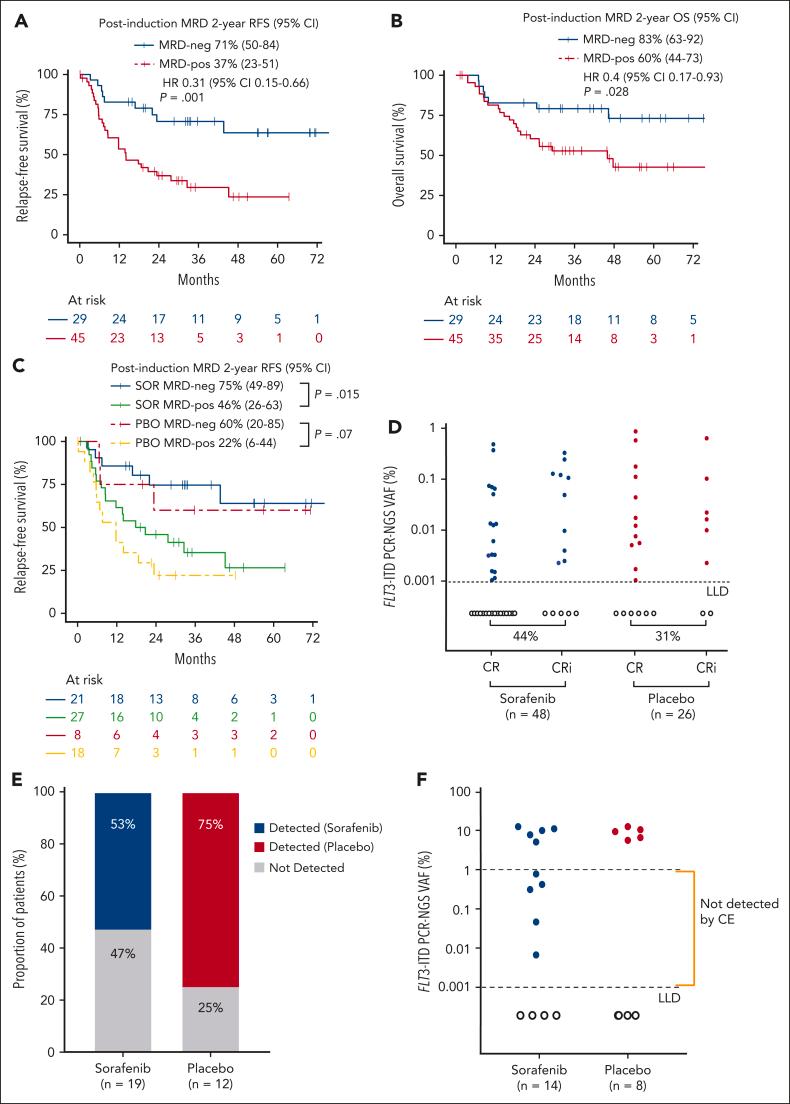
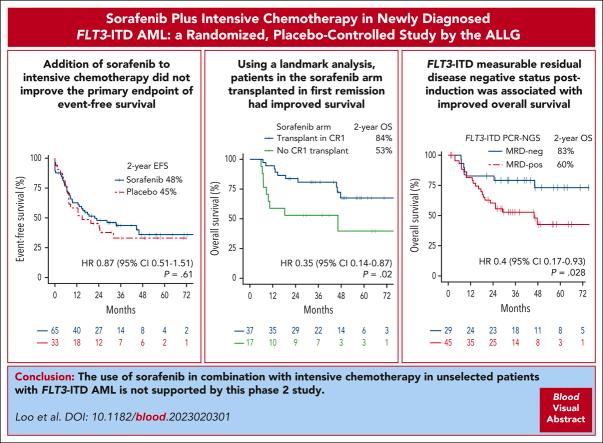
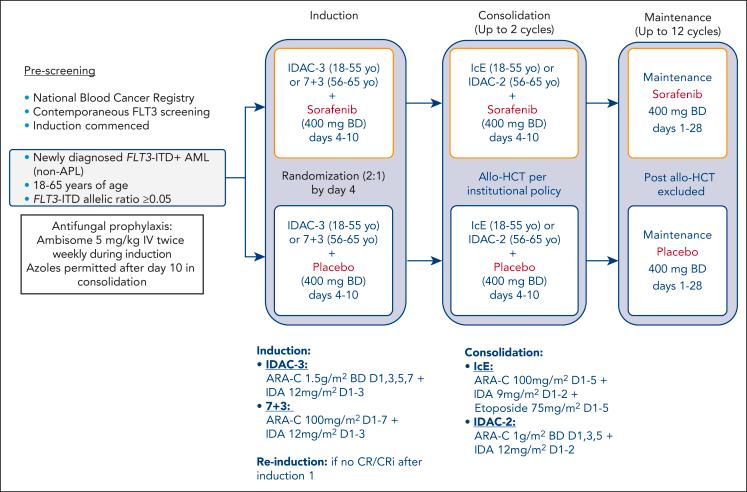
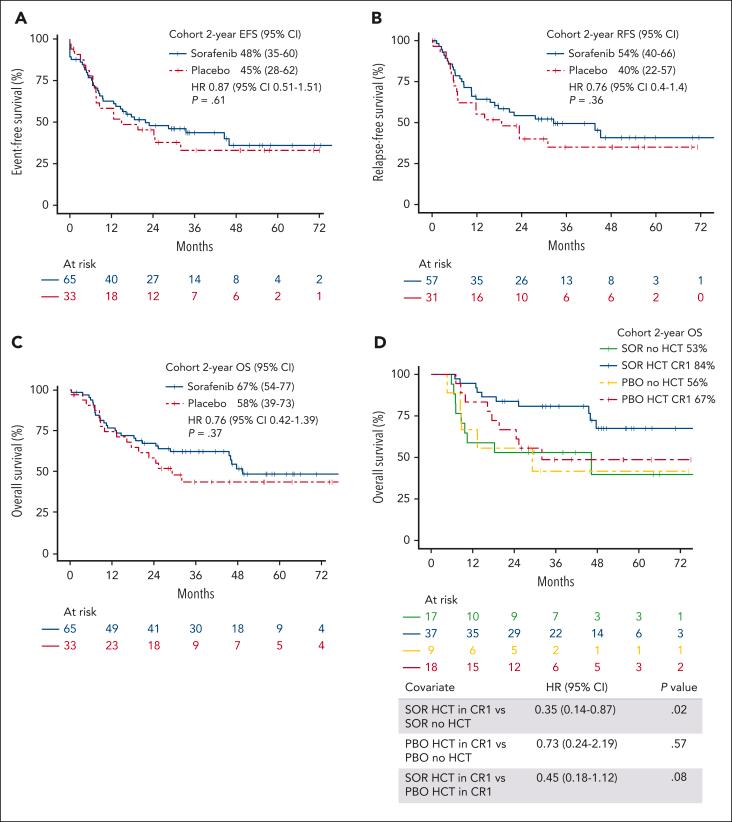
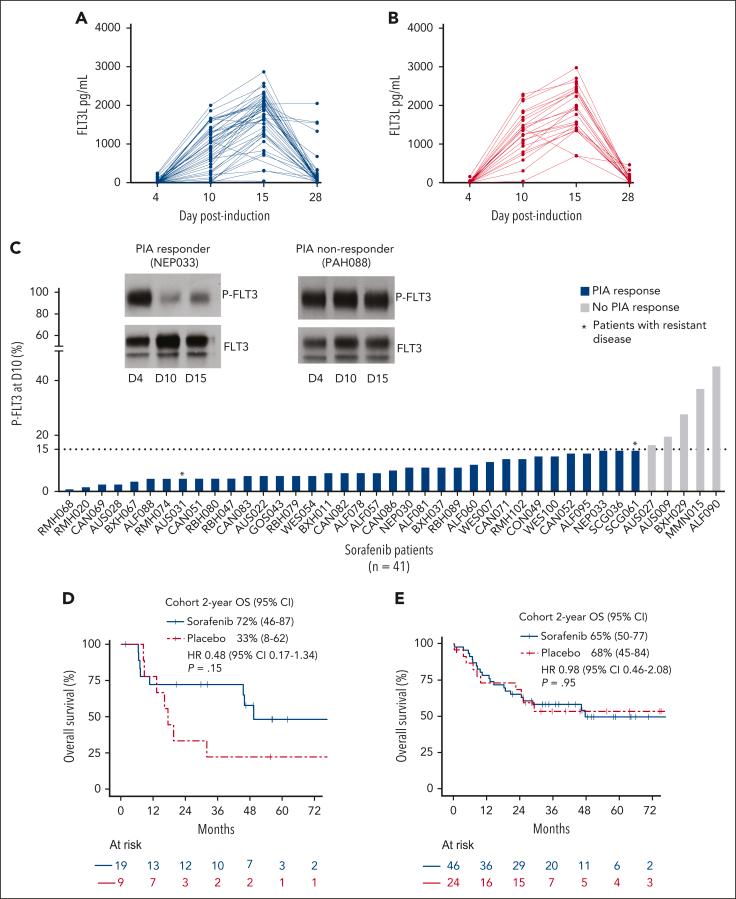
Sorafenib maintenance improves outcomes after hematopoietic cell transplant (HCT) for patients with FMS-like tyrosine kinase 3-internal tandem duplication (FLT3-ITD) acute myeloid leukemia (AML). Although promising outcomes have been reported for sorafenib plus intensive chemotherapy, randomized data are limited. This placebo-controlled, phase 2 study (ACTRN12611001112954) randomized 102 patients (aged 18-65 years) 2:1 to sorafenib vs placebo (days 4-10) combined with intensive induction: idarubicin 12 mg/m2 on days 1 to 3 plus either cytarabine 1.5 g/m2 twice daily on days 1, 3, 5, and 7 (18-55 years) or 100 mg/m2 on days 1 to 7 (56-65 years), followed by consolidation and maintenance therapy for 12 months (post-HCT excluded) in newly diagnosed patients with FLT3-ITD AML. Four patients were excluded in a modified intention-to-treat final analysis (3 not commencing therapy and 1 was FLT3-ITD negative). Rates of complete remission (CR)/CR with incomplete hematologic recovery were high in both arms (sorafenib, 78%/9%; placebo, 70%/24%). With 49.1-months median follow-up, the primary end point of event-free survival (EFS) was not improved by sorafenib (2-year EFS 47.9% vs 45.4%; hazard ratio [HR], 0.87; 95% confidence interval [CI], 0.51-1.51; P = .61). Two-year overall survival (OS) was 67% in the sorafenib arm and 58% in the placebo arm (HR, 0.76; 95% CI, 0.42-1.39). For patients who received HCT in first remission, the 2-year OS rates were 84% and 67% in the sorafenib and placebo arms, respectively (HR, 0.45; 95% CI, 0.18-1.12; P = .08). In exploratory analyses, FLT3-ITD measurable residual disease (MRD) negative status (<0.001%) after induction was associated with improved 2-year OS (83% vs 60%; HR, 0.4; 95% CI, 0.17-0.93; P = .028). In conclusion, routine use of pretransplant sorafenib plus chemotherapy in unselected patients with FLT3-ITD AML is not supported by this study.
索拉非尼维持治疗可改善 FMS 样酪氨酸激酶 3 内部串联重复(FLT3-ITD)急性髓系白血病(AML)患者造血细胞移植(HCT)后的疗效。尽管索拉非尼联合强化化疗的疗效令人鼓舞,但随机数据有限。这项安慰剂对照、2 期研究(ACTRN12611001112954)将 102 例年龄在 18-65 岁之间的患者以 2:1 的比例随机分为索拉非尼组和安慰剂组(第 4-10 天),联合强化诱导治疗:第 1-3 天给予伊达比星 12mg/m2,第 1、3、5 和 7 天给予阿糖胞苷 1.5g/m2 每日两次(18-55 岁)或第 1-7 天给予 100mg/m2(56-65 岁),随后进行 12 个月的巩固和维持治疗(HCT 后除外),用于新诊断的 FLT3-ITD AML 患者。在改良意向治疗的最终分析中,有 4 例患者被排除(3 例未开始治疗,1 例 FLT3-ITD 阴性)。两组完全缓解(CR)/不完全血液学恢复的完全缓解率均较高(索拉非尼组为 78%/9%,安慰剂组为 70%/24%)。中位随访 49.1 个月时,无事件生存(EFS)的主要终点未得到索拉非尼的改善(2 年 EFS 分别为 47.9%和 45.4%;风险比[HR],0.87;95%置信区间[CI],0.51-1.51;P=0.61)。索拉非尼组和安慰剂组的 2 年总生存率(OS)分别为 67%和 58%(HR,0.76;95%CI,0.42-1.39)。对于在首次缓解期接受 HCT 的患者,索拉非尼组和安慰剂组的 2 年 OS 率分别为 84%和 67%(HR,0.45;95%CI,0.18-1.12;P=0.08)。在探索性分析中,诱导后 FLT3-ITD 可测量残留疾病(MRD)阴性(<0.001%)与改善 2 年 OS 相关(83% vs 60%;HR,0.4;95%CI,0.17-0.93;P=0.028)。总之,这项研究不支持在未选择的 FLT3-ITD AML 患者中常规使用移植前索拉非尼联合化疗。
 Zotero 插件