
5-ALA 通过激素转导途径和叶绿素代谢的组合提高菜豆幼苗的低温耐受性。
5-ALA Improves the Low Temperature Tolerance of Common Bean Seedlings through a Combination of Hormone Transduction Pathways and Chlorophyll Metabolism.
机构信息
College of Horticulture, Sichuan Agricultural University, Chengdu 611130, China.
出版信息
Int J Mol Sci. 2023 Aug 25;24(17):13189. doi: 10.3390/ijms241713189.
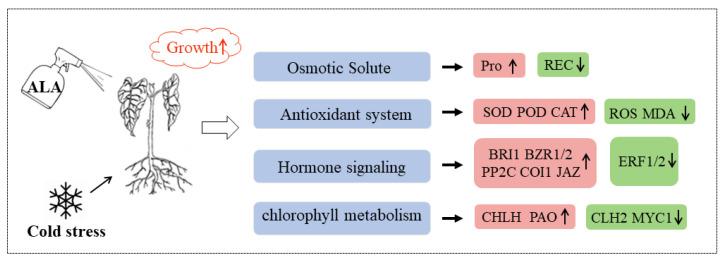
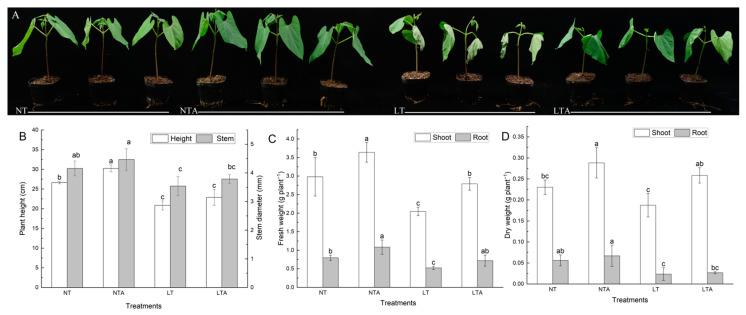
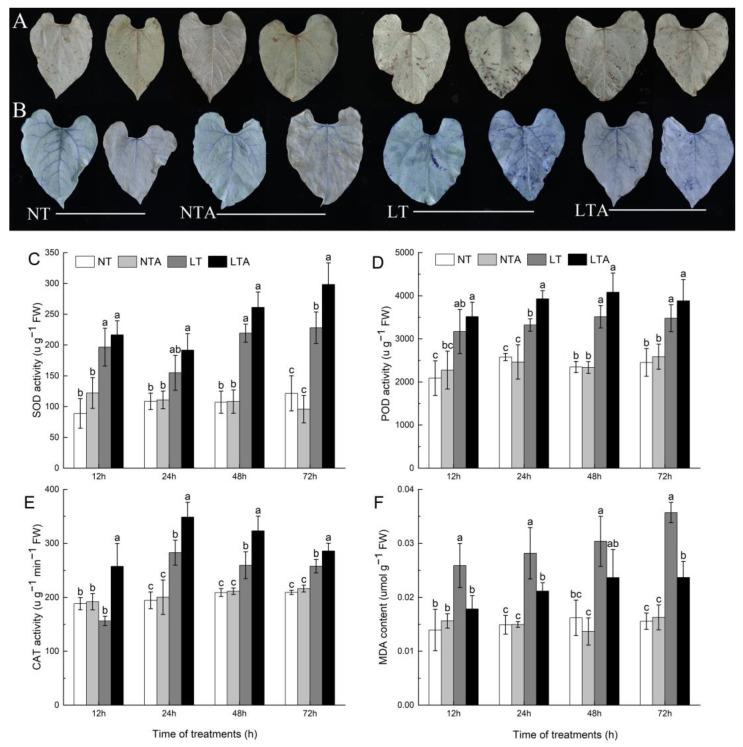
Low-temperature stress is a key factor limiting the yield and quality of the common bean. 5-aminolevulinic acid (5-ALA), an antioxidant in plants, has been shown to modulate plant cold stress responses. However, the molecular mechanisms of 5-ALA-induced physiological and chemical changes in common bean seedlings under cold stress remains unknown. This study explored the physiological and transcriptome changes of common bean seedlings in response to cold stress after 5-ALA pretreatment. Physiological results showed that exogenous 5-ALA promotes the growth of common bean plants under cold stress, increases the activity of antioxidant enzymes (superoxide dismutase: 23.8%; peroxidase: 10.71%; catalase: 9.09%) and proline content (24.24%), decreases the relative conductivity (23.83%), malondialdehyde (33.65%), and active oxygen content, and alleviates the damage caused by cold to common bean seedlings. Transcriptome analysis revealed that 214 differentially expressed genes (DEGs) participate in response to cold stress. The DEGs are mainly concentrated in indole alkaloid biosynthesis, carotenoid biosynthesis, porphyrin, and chlorophyll metabolism. It is evident that exogenous 5-ALA alters the expression of genes associated with porphyrin and chlorophyll metabolism, as well as the plant hormone signal transduction pathway, which helps to maintain the energy supply and metabolic homeostasis under low-temperature stress. The results reveal the effect that applying exogenous 5-ALA has on the cold tolerance of the common bean and the molecular mechanism of its response to cold tolerance, which provides a theoretical basis for exploring and improving plant tolerance to low temperatures.
低温胁迫是限制普通豆产量和品质的关键因素。5-氨基乙酰丙酸(5-ALA)是植物中的一种抗氧化剂,已被证明可以调节植物的冷胁迫反应。然而,5-ALA 诱导普通豆幼苗在冷胁迫下的生理和化学变化的分子机制尚不清楚。本研究探讨了外源 5-ALA 预处理后普通豆幼苗对冷胁迫的生理和转录组变化。生理结果表明,外源 5-ALA 促进了冷胁迫下普通豆植株的生长,提高了抗氧化酶(超氧化物歧化酶:23.8%;过氧化物酶:10.71%;过氧化氢酶:9.09%)和脯氨酸含量(24.24%),降低了相对电导率(23.83%)、丙二醛(33.65%)和活性氧含量,减轻了冷胁迫对普通豆幼苗的伤害。转录组分析表明,214 个差异表达基因(DEGs)参与了对冷胁迫的响应。这些 DEGs 主要集中在吲哚生物碱生物合成、类胡萝卜素生物合成、卟啉和叶绿素代谢。显然,外源 5-ALA 改变了与卟啉和叶绿素代谢以及植物激素信号转导途径相关的基因的表达,有助于在低温胁迫下维持能量供应和代谢平衡。研究结果揭示了外源 5-ALA 对普通豆耐寒性的影响及其对耐寒性的响应分子机制,为探索和提高植物对低温的耐受性提供了理论依据。



 Zotero 插件