
琥珀酸脱氢酶(FH)与癌症:一种癌代谢的范例。
Fumarate hydratase (FH) and cancer: a paradigm of oncometabolism.
机构信息
Department of Biochemistry and Molecular Biology, Faculty of Science and Technology, UPV/EHU, University of the Basque Country (UPV/EHU), Leioa, Bizkaia, Spain.
University of Cologne, Faculty of Mathematics and Natural Sciences, Institute of Genetics, Cluster of Excellence Cellular Stress Responses in Aging-associated Diseases (CECAD), Cologne, Germany.
出版信息
Br J Cancer. 2023 Nov;129(10):1546-1557. doi: 10.1038/s41416-023-02412-w. Epub 2023 Sep 9.
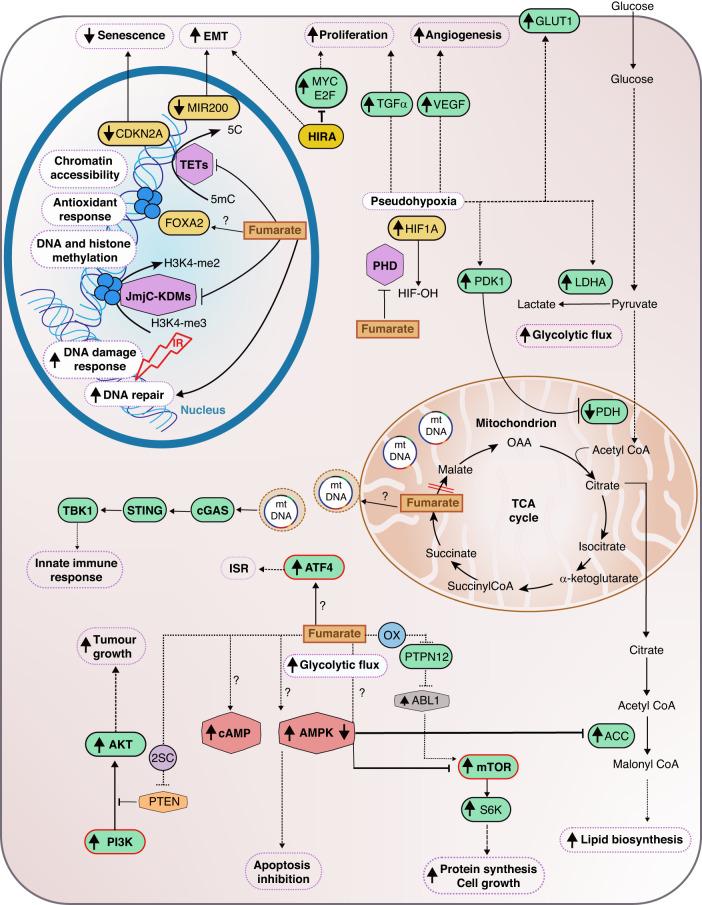
Fumarate hydratase (FH) is an enzyme of the Tricarboxylic Acid (TCA) cycle whose mutations lead to hereditary and sporadic forms of cancer. Although more than twenty years have passed since its discovery as the leading cause of the cancer syndrome Hereditary leiomyomatosis and Renal Cell Carcinoma (HLRCC), it is still unclear how the loss of FH causes cancer in a tissue-specific manner and with such aggressive behaviour. It has been shown that FH loss, via the accumulation of FH substrate fumarate, activates a series of oncogenic cascades whose contribution to transformation is still under investigation. In this review, we will summarise these recent findings in an integrated fashion and put forward the case that understanding the biology of FH and how its mutations promote transformation will be vital to establish novel paradigms of oncometabolism.
延胡索酸水合酶(FH)是三羧酸(TCA)循环中的一种酶,其突变导致遗传性和散发性癌症。尽管自发现其是遗传性平滑肌瘤病和肾细胞癌(HLRCC)癌症综合征的主要原因以来已经过去了二十多年,但 FH 缺失如何以组织特异性和如此侵袭性行为导致癌症仍然不清楚。已经表明,FH 缺失会导致 FH 底物延胡索酸的积累,从而激活一系列致癌级联反应,其对转化的贡献仍在研究中。在这篇综述中,我们将以综合的方式总结这些最新发现,并提出这样的观点,即理解 FH 的生物学及其突变如何促进转化对于建立新的癌代谢范例至关重要。


 Zotero 插件