
严重免疫抑制需机械通气患者 COVID-19 相关侵袭性肺曲霉病负担高。
High Burden of COVID-19-Associated Pulmonary Aspergillosis in Severely Immunocompromised Patients Requiring Mechanical Ventilation.
机构信息
Medical Intensive Care Unit, University Hospitals Leuven, Leuven, Belgium.
Department of Microbiology, Immunology and Transplantation, KU Leuven, Leuven, Belgium.
出版信息
Clin Infect Dis. 2024 Feb 17;78(2):361-370. doi: 10.1093/cid/ciad546.
BACKGROUND
Coronavirus disease 2019 (COVID-19)-associated pulmonary aspergillosis (CAPA) is a frequent superinfection in critically ill patients with COVID-19 and is associated with increased mortality rates. The increasing proportion of severely immunocompromised patients with COVID-19 who require mechanical ventilation warrants research into the incidence and impact of CAPA during the vaccination era.
METHODS
We performed a retrospective, monocentric, observational study. We collected data from adult patients with severe COVID-19 requiring mechanical ventilation who were admitted to the intensive care unit (ICU) of University Hospitals Leuven, a tertiary referral center, between 1 March 2020 and 14 November 2022. Probable or proven CAPA was diagnosed according to the 2020 European Confederation for Medical Mycology/International Society for Human and Animal Mycology (ECMM/ISHAM) criteria.
RESULTS
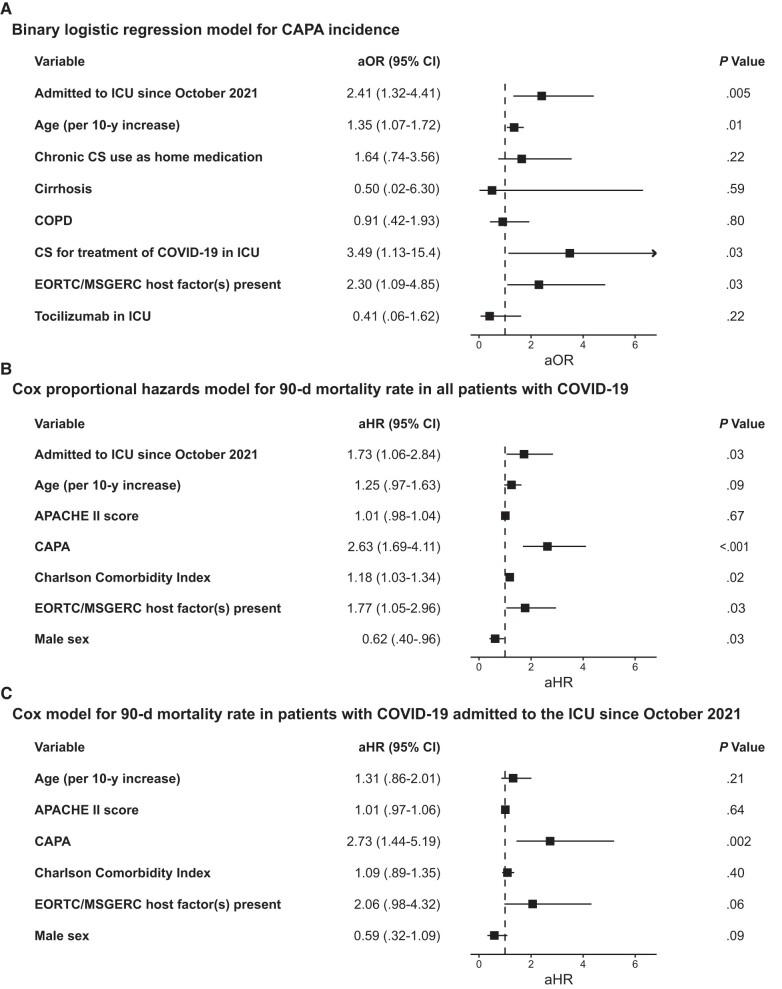
We included 335 patients. Bronchoalveolar lavage sampling was performed in 300 (90%), and CAPA was diagnosed in 112 (33%). The incidence of CAPA was 62% (50 of 81 patients) in European Organisation for Research and Treatment of Cancer (EORTC)/Mycosis Study Group Education and Research Consortium (MSGERC) host factor-positive patients, compared with 24% (62 of 254) in host factor-negative patients. The incidence of CAPA was significantly higher in the vaccination era, increasing from 24% (57 of 241) in patients admitted to the ICU before October 2021 to 59% (55 of 94) in those admitted since then. Both EORTC/MSGERC host factors and ICU admission in the vaccination era were independently associated with CAPA development. CAPA remained an independent risk factor associated with mortality risk during the vaccination era.
CONCLUSIONS
The presence of EORTC/MSGERC host factors for invasive mold disease is associated with increased CAPA incidence and worse outcome parameters, and it is the main driver for the significantly higher incidence of CAPA in the vaccination era. Our findings warrant investigation of antifungal prophylaxis in critically ill patients with COVID-19.
背景
2019 年冠状病毒病(COVID-19)相关的肺曲霉病(CAPA)是 COVID-19 重症患者中常见的继发感染,与死亡率升高相关。COVID-19 患者中需要机械通气的严重免疫功能低下患者比例不断增加,这就需要研究疫苗接种时代 CAPA 的发病率和影响。
方法
我们进行了一项回顾性、单中心、观察性研究。我们收集了 2020 年 3 月 1 日至 2022 年 11 月 14 日期间入住鲁汶大学医院重症监护病房(ICU)的需要机械通气的严重 COVID-19 成年患者的数据。根据 2020 年欧洲医学真菌学联合会/国际人类与动物真菌学会(ECMM/ISHAM)标准诊断可能或确诊的 CAPA。
结果
我们纳入了 335 例患者。对 300 例(90%)患者进行了支气管肺泡灌洗采样,诊断出 112 例(33%)CAPA。在欧洲癌症研究与治疗组织(EORTC)/霉菌研究组教育与研究联盟(MSGERC)宿主因素阳性患者中,CAPA 的发病率为 62%(50/81 例),而在宿主因素阴性患者中为 24%(62/254 例)。在疫苗接种时代,CAPA 的发病率显著更高,从 2021 年 10 月前入住 ICU 的患者的 24%(57/241 例)增加到此后入住的患者的 59%(55/94 例)。EORTC/MSGERC 宿主因素和疫苗接种时代入住 ICU 均与 CAPA 发展独立相关。CAPA 仍然是疫苗接种时代与死亡率风险相关的独立危险因素。
结论
侵袭性霉菌病 EORTC/MSGERC 宿主因素的存在与 CAPA 发病率增加和更差的结局参数相关,是疫苗接种时代 CAPA 发病率显著升高的主要驱动因素。我们的研究结果需要进一步研究 COVID-19 重症患者中抗真菌预防治疗。


 Zotero 插件