
马德里地区(西班牙)家养犬猫肠道寄生虫的流行情况及其公共卫生意义,重点关注十二指肠贾第虫和隐孢子虫。
Prevalence and public health relevance of enteric parasites in domestic dogs and cats in the region of Madrid (Spain) with an emphasis on Giardia duodenalis and Cryptosporidium sp.
机构信息
Department of Microbiology and Parasitology, Faculty of Pharmacy, Complutense University of Madrid, Madrid, Spain.
Department of Animal Health, Faculty of Veterinary, Complutense University of Madrid, Madrid, Spain.
出版信息
Vet Med Sci. 2023 Nov;9(6):2542-2558. doi: 10.1002/vms3.1270. Epub 2023 Sep 19.
BACKGROUND
Pet dogs and cats exert an unquestionable beneficial effect in the well-being of their owners, but can also act as a source of zoonotic infections if improperly cared.
OBJECTIVES
We investigated the occurrence, risk factors, genetic variability and zoonotic potential of intestinal parasites in dogs and cats attended in a clinical veterinary setting in Spain.
METHODS
Canine (n = 252) and feline (n = 35) faecal samples were collected during 2017-2019 and analysed by coproparasitological methods. A rapid lateral immunochromatographic test (ICT) was used for detecting Giardia duodenalis and Cryptosporidium sp. Samples positive at microscopy examination and/or ICT were reassessed by molecular methods.
RESULTS
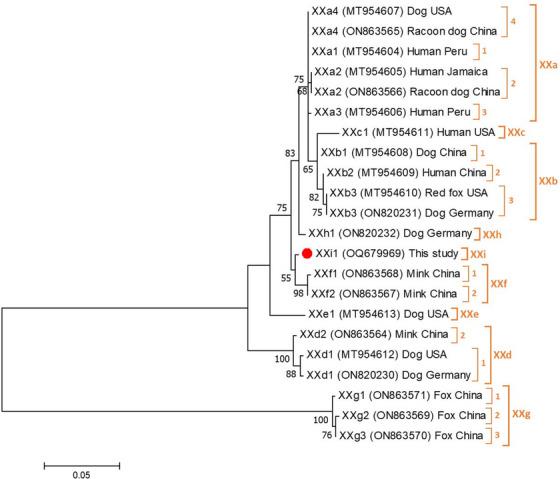
Overall, 48.8% (123/252) of dogs and 48.6% (17/35) of cats were infected by enteric parasites. In dogs, G. duodenalis was the most prevalent species (40.9%), followed by Cystoisospora sp. (7.1%), and Toxocara canis (5.2%). In cats, Joyeuxiella sp. and Toxocara cati were the dominant species (20.0% each), followed by G. duodenalis (14.3%), D. caninum (5.7%) and Cystoisospora felis and Toxascaris leonina (2.9% each). Pups and kittens were more likely to harbour intestinal parasites and develop clinical signs. Sequence analyses of dog isolates revealed the presence of assemblages A (n = 1), C (n = 4), D (n = 4) and C+D (n = 1) within G. duodenalis; C. parvum (n = 1) and C. canis (n = 4) within Cryptosporidium and PtEb IX (n = 1) in Enterocytozoon bieneusi. A novel C. canis subtype family, named XXi, is reported.
CONCLUSIONS
Our results highlight that (i) well-cared dogs carry zoonotic enteric protozoan parasites of public health relevance, (ii) proper hygiene practices and routine veterinary treatment are essential to prevent zoonotic infections, (iii) vulnerable populations should avoid contact with pups/kittens with diarrhoea and (iv) infected dogs might be major contributors to the environmental contamination with soil-transmitted helminths (STHs) eggs.
背景
宠物狗和猫对其主人的健康无疑有有益影响,但如果照顾不当,它们也可能成为人畜共患病感染源。
目的
我们调查了在西班牙临床兽医环境中就诊的犬和猫的肠道寄生虫的发生、危险因素、遗传变异性和人畜共患潜力。
方法
在 2017 年至 2019 年期间收集了 252 只犬和 35 只猫的粪便样本,并通过粪便寄生虫学方法进行分析。使用快速侧向免疫层析试验(ICT)检测犬贾第虫和隐孢子虫。显微镜检查和/或 ICT 阳性的样本通过分子方法重新评估。
结果
总体而言,252 只犬中有 48.8%(123/252)和 35 只猫中有 48.6%(17/35)受到肠道寄生虫感染。在犬中,最常见的物种是犬贾第虫(40.9%),其次是等孢球虫(7.1%)和犬弓首蛔虫(5.2%)。在猫中,优势物种是 Joyeuxiella 属和猫弓首蛔虫(各占 20.0%),其次是犬贾第虫(14.3%)、犬复孔绦虫(5.7%)、猫等孢球虫和猫弓首蛔虫(各占 2.9%)。幼犬和幼猫更有可能携带肠道寄生虫并出现临床症状。对犬分离株的序列分析显示,犬贾第虫中存在 A 群(n=1)、C 群(n=4)、D 群(n=4)和 C+D 群(n=1);隐孢子虫中有 C. parvum(n=1)和 C. canis(n=4);贝氏等孢球虫中有 PtEbIX(n=1)。报告了一种新的犬弓首蛔虫亚型家族,命名为 XXi。
结论
我们的结果表明:(i)照顾良好的犬携带与人畜共患相关的肠道原生动物寄生虫;(ii)适当的卫生措施和常规兽医治疗对于预防人畜共患病感染至关重要;(iii)弱势群体应避免接触有腹泻症状的幼犬/幼猫;(iv)感染犬可能是土壤传播性蠕虫(STHs)卵环境污染的主要贡献者。
 Zotero 插件