
埃及家犬和家猫肠道原生生物的分子特征及人畜共患病潜力
Molecular characteristics and zoonotic potential of enteric protists in domestic dogs and cats in Egypt.
作者信息
Elmahallawy Ehab Kotb, Gareh Ahmed, Abu-Okail Akram, Köster Pamela C, Dashti Alejandro, Asseri Jamal, Gouda Asmaa Aboelabbas, Mubaraki Murad A, Mohamed Sara Abdel-Aal, Mohamed Yasser M, Hassan Ehssan Ahmed, Elgendy Mohamed, Hernández-Castro Carolina, Bailo Begoña, González-Barrio David, Xiao Lihua, Carmena David
机构信息
Departamento de Sanidad Animal, Grupo de Investigación en Sanidad Animal y Zoonosis (GISAZ), Facultad de Veterinaria, Universidad de Córdoba, Córdoba, Spain.
Department of Zoonoses, Faculty of Veterinary Medicine, Sohag University, Sohag, Egypt.
出版信息
Front Vet Sci. 2023 Jul 6;10:1229151. doi: 10.3389/fvets.2023.1229151. eCollection 2023.
INTRODUCTION
Domestic dogs and cats can be a source of human infection by a wide diversity of zoonotic pathogens including parasites. Genotyping and subtyping tools are useful in assessing the true public health relevance of canine and feline infections by these pathogens. This study investigated the occurrence, genetic diversity, and zoonotic potential of common diarrhea-causing enteric protist parasites in household dogs and cats in Egypt, a country where this information is particularly scarce.
METHODS
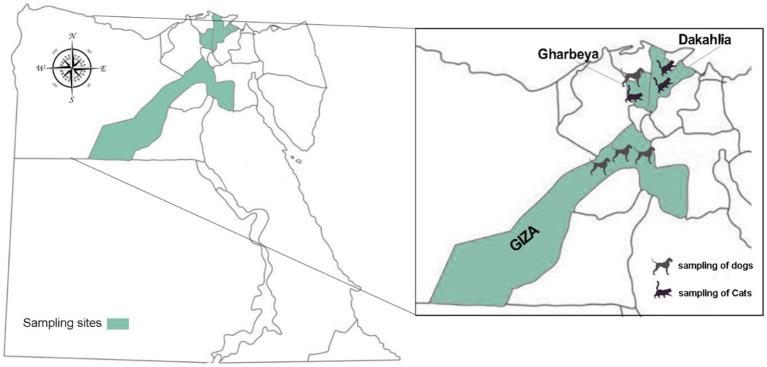
In this prospective, cross-sectional study a total of 352 individual fecal samples were collected from dogs ( = 218) and cats ( = 134) in three Egyptian governorates (Dakahlia, Gharbeya, and Giza) during July-December 2021. Detection and identification of spp., , , and sp. were carried out by PCR and Sanger sequencing. Basic epidemiological variables (geographical origin, sex, age, and breed) were examined for association with occurrence of infection by enteric protists.
RESULTS AND DISCUSSION
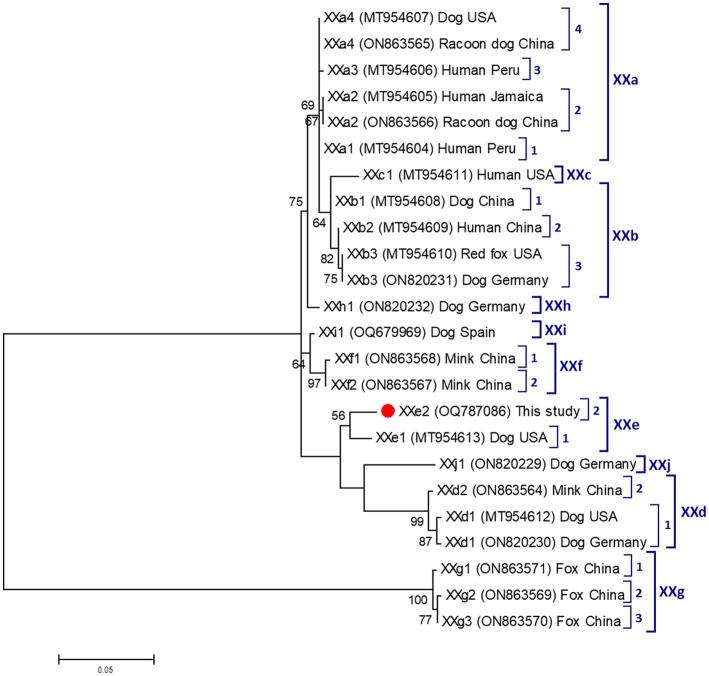
The overall prevalence rates of spp. and were 1.8% (95% CI: 0.5-4.6) and 38.5% (95% CI: 32.0-45.3), respectively, in dogs, and 6.0% (95% CI: 2.6-11.4) and 32.1% (95% CI: 24.3-40.7), respectively, in cats. All canine and feline fecal samples analyzed tested negative for and sp. Dogs from Giza governorate and cats from Dakahlia governorate were at higher risk of infection by spp. ( = 0.0006) and ( = 0.00001), respectively. Sequence analyses identified host-adapted ( = 4, one of them belonging to novel subtype XXe2) and assemblages C ( = 1) and D ( = 3) in dogs. In cats the zoonotic ( = 5) was more prevalent than host-adapted ( = 1). Household dogs had a limited (but not negligible) role as source of human giardiasis and cryptosporidiosis, but the unexpected high frequency of zoonotic in domestic cats might be a public health concern. This is the first molecular-based description of spp. infections in cats in the African continent to date. Molecular epidemiological data provided here can assist health authorities and policy makers in designing and implementing effective campaigns to minimize the transmission of enteric protists in Egypt.
引言
家犬和家猫可能是包括寄生虫在内的多种人畜共患病原体的人类感染源。基因分型和亚型分型工具有助于评估这些病原体引起的犬类和猫类感染对公共卫生的实际影响。本研究调查了埃及家犬和家猫中常见的引起腹泻的肠道原生动物寄生虫的发生情况、遗传多样性和人畜共患病潜力,而该国在这方面的信息尤为匮乏。
方法
在这项前瞻性横断面研究中,2021年7月至12月期间,从埃及三个省份(达卡利亚、加比亚和吉萨)的犬(n = 218)和猫(n = 134)中总共采集了352份个体粪便样本。通过聚合酶链反应(PCR)和桑格测序对贾第虫属、隐孢子虫属、结肠小袋纤毛虫属和爱美虫属进行检测和鉴定。检查基本流行病学变量(地理来源、性别、年龄和品种)与肠道原生动物感染发生之间的关联。
结果与讨论
犬中贾第虫属和隐孢子虫属的总体患病率分别为1.8%(95%置信区间:0.5 - 4.6)和38.5%(95%置信区间:32.0 - 45.3),猫中分别为6.0%(95%置信区间:2.6 - 11.4)和32.1%(95%置信区间:24.3 - 40.7)。所有分析的犬类和猫类粪便样本对结肠小袋纤毛虫属和爱美虫属检测均为阴性。来自吉萨省的犬和来自达卡利亚省的猫感染贾第虫属(P = 0.0006)和隐孢子虫属(P = 0.00001)的风险更高。序列分析在犬中鉴定出宿主适应性贾第虫(n = 4,其中之一属于新型XXe2亚型)以及隐孢子虫C群(n = 1)和D群(n = 3)。在猫中,人畜共患的隐孢子虫(n = 5)比宿主适应性隐孢子虫(n = 1)更普遍。家犬作为人类贾第虫病和隐孢子虫病来源的作用有限(但并非可以忽略不计),但家猫中意外出现的高人畜共患爱美虫感染频率可能是一个公共卫生问题。这是迄今为止非洲大陆首次基于分子的猫爱美虫属感染描述。此处提供的分子流行病学数据可协助卫生当局和政策制定者设计和实施有效活动,以尽量减少埃及肠道原生动物的传播。
 Zotero 插件