
免疫治疗时代复发性/难治性经典型霍奇金淋巴瘤的治疗优化
Optimizing Treatment for Relapsed/Refractory Classic Hodgkin Lymphoma in the Era of Immunotherapy.
作者信息
Randall Michael P, Spinner Michael A
机构信息
Division of Hematology/Oncology, Department of Medicine, University of California San Francisco, San Francisco, CA 94143, USA.
出版信息
Cancers (Basel). 2023 Sep 11;15(18):4509. doi: 10.3390/cancers15184509.
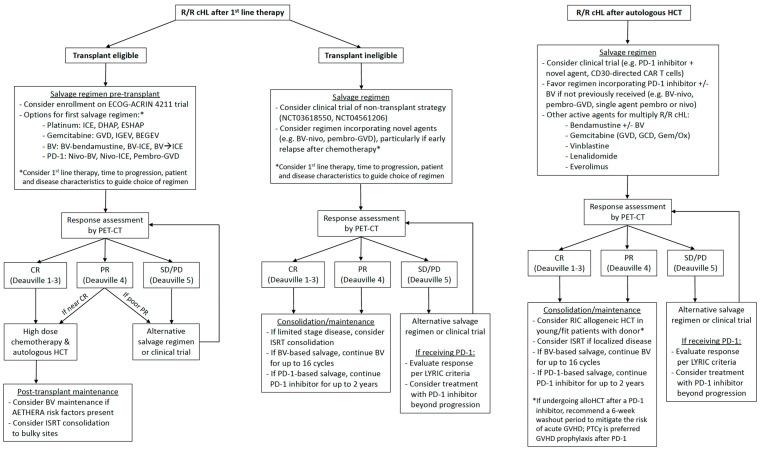
Most patients with classic Hodgkin lymphoma (cHL) are cured with combination chemotherapy, but approximately 10-20% will relapse, and another 5-10% will have primary refractory disease. The treatment landscape of relapsed/refractory (R/R) cHL has evolved significantly over the past decade following the approval of brentuximab vedotin (BV), an anti-CD30 antibody-drug conjugate, and the PD-1 inhibitors nivolumab and pembrolizumab. These agents have significantly expanded options for salvage therapy prior to autologous hematopoietic cell transplantation (AHCT), post-transplant maintenance, and treatment of relapse after AHCT, which have led to improved survival in the modern era. In this review, we highlight our approach to the management of R/R cHL in 2023 with a focus on choosing first salvage therapy, post-transplant maintenance, and treatment of relapse after AHCT. We also discuss the management of older adults and transplant-ineligible patients, who require a separate approach. Finally, we review novel immunotherapy approaches in clinical trials, including combinations of PD-1 inhibitors with other immune-activating agents as well as novel antibody-drug conjugates, bispecific antibodies, and cellular immunotherapies. Ongoing studies assessing biomarkers of response to immunotherapy and dynamic biomarkers such as circulating tumor DNA may further inform treatment decisions and enable a more personalized approach in the future.
大多数经典型霍奇金淋巴瘤(cHL)患者通过联合化疗可治愈,但约10%-20%的患者会复发,另有5%-10%的患者会出现原发性难治性疾病。在抗CD30抗体药物偶联物brentuximab vedotin(BV)以及PD-1抑制剂纳武单抗和派姆单抗获批后,过去十年中复发/难治性(R/R)cHL的治疗格局发生了显著变化。这些药物显著扩大了自体造血细胞移植(AHCT)前挽救治疗、移植后维持治疗以及AHCT后复发治疗的选择,从而提高了现代患者的生存率。在本综述中,我们重点介绍2023年R/R cHL的管理方法,重点关注首次挽救治疗的选择、移植后维持治疗以及AHCT后复发的治疗。我们还将讨论老年患者和不符合移植条件患者的管理,他们需要采用不同的方法。最后,我们回顾了临床试验中的新型免疫治疗方法,包括PD-1抑制剂与其他免疫激活剂的联合应用以及新型抗体药物偶联物、双特异性抗体和细胞免疫疗法。正在进行的评估免疫治疗反应生物标志物和动态生物标志物(如循环肿瘤DNA)的研究可能会进一步为治疗决策提供信息,并在未来实现更个性化的治疗方法。

 Zotero 插件