
评价 Qvella FAST 系统和 FAST-PBC 试剂盒,用于从阳性血培养物中快速进行种属鉴定和抗菌药物耐药性检测。
Evaluation of the Qvella FAST System and the FAST-PBC cartridge for rapid species identification and antimicrobial resistance testing directly from positive blood cultures.
机构信息
Institute of Medical Microbiology and Hygiene, Saarland University , Homburg, Germany.
Swiss Tropical and Public Health Institute , Allschwil, Switzerland.
出版信息
J Clin Microbiol. 2023 Oct 24;61(10):e0056923. doi: 10.1128/jcm.00569-23. Epub 2023 Sep 28.
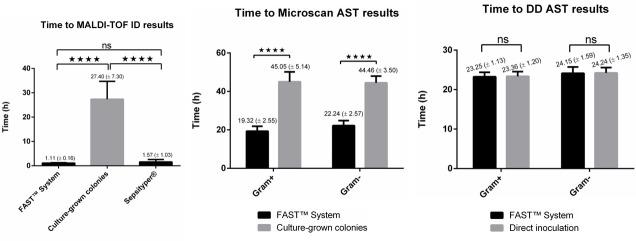
Blood culture diagnostics require rapid and accurate identification (ID) of pathogens and antimicrobial susceptibility testing (AST). Standard procedures, involving conventional cultivation on agar plates, may take up to 48 hours or more until AST completion. Recent approaches aim to shorten the processing time of positive blood cultures (PBC). The FAST System is a new technology, capable of purifying and concentrating bacterial/fungal pathogens from positive blood culture media and producing a bacterial suspension called "liquid colony" (LC), which can be further used in downstream analyses (e.g., ID and AST). Here, we evaluated the performance of the FAST System LC generated from PBC in comparison to our routine workflow including ID by matrix-assisted laser desorption/ionization time-of-flight mass spectrometry using Sepsityper, AST by automatized MicroScan WalkAway and directly inoculated disk diffusion (DD), and MICRONAUT-AM for yeast/fungi. A total of 261 samples were analyzed, of which 86.6% (226/261) were eligible for the comparative ID and AST analyses. In comparison to the reference technique (culture-grown colonies), ID concordance of the FAST System LC and Sepsityper was 150/154 (97.4%) and 123/154 (79.9%), respectively, for Gram positive; 67/70 (95.7%) and 64/70 (91.4%), respectively, for Gram negative. For AST, categorical agreement (CA) of the FAST System LC in comparison to the routine workflow for Gram-positive bacteria was 96.1% and 98.7% for MicroScan and DD, respectively. Similar results were obtained for Gram-negative bacteria with 96.6% and 97.5% of CA for MicroScan and DD, respectively. Taken together, the FAST System LC allowed the laboratory to significantly reduce the time to obtain correct ID and AST (automated MicroScan) results 1 day earlier and represents a promising tool to expedite the processing of PBC.
血培养诊断需要快速准确地鉴定病原体和抗菌药物敏感性测试(AST)。标准程序,包括在琼脂平板上的常规培养,可能需要长达 48 小时或更长时间才能完成 AST。最近的方法旨在缩短阳性血培养物(PBC)的处理时间。FAST 系统是一种新技术,能够从阳性血培养介质中纯化和浓缩细菌/真菌病原体,并产生称为“液体菌落”(LC)的细菌悬浮液,可进一步用于下游分析(例如,ID 和 AST)。在这里,我们评估了 FAST 系统 LC 从 PBC 中产生的性能,与我们的常规工作流程进行了比较,包括使用 Sepsityper 的基质辅助激光解吸/电离飞行时间质谱进行 ID、使用 automatized MicroScan WalkAway 进行 AST 以及直接接种的圆盘扩散(DD)和用于酵母/真菌的 MICRONAUT-AM。共分析了 261 个样本,其中 86.6%(226/261)适合进行比较 ID 和 AST 分析。与参考技术(培养生长的菌落)相比,FAST 系统 LC 和 Sepsityper 的 ID 一致性分别为 150/154(97.4%)和 123/154(79.9%),用于革兰氏阳性菌;分别为 67/70(95.7%)和 64/70(91.4%),用于革兰氏阴性菌。对于 AST,FAST 系统 LC 与常规工作流程相比的分类一致性(CA)对于革兰氏阳性菌分别为 MicroScan 和 DD 的 96.1%和 98.7%。对于革兰氏阴性菌,也获得了类似的结果,MicroScan 和 DD 的 CA 分别为 96.6%和 97.5%。总的来说,FAST 系统 LC 使实验室能够显著缩短获得正确 ID 和 AST(自动 MicroScan)结果的时间,提前 1 天,并代表了一种有前途的工具,可以加快 PBC 的处理。
 Zotero 插件