
P2Y2 受体在 HDM 驱动的变应性气道炎症模型中的细胞类型特异性作用。
Cell-type-specific role of P2Y2 receptor in HDM-driven model of allergic airway inflammation.
机构信息
Department of Pneumology, Medical Center - University of Freiburg, Freiburg, Germany.
Department of Pulmonology, Medical University of Vienna, Vienna, Austria.
出版信息
Front Immunol. 2023 Sep 14;14:1209097. doi: 10.3389/fimmu.2023.1209097. eCollection 2023.
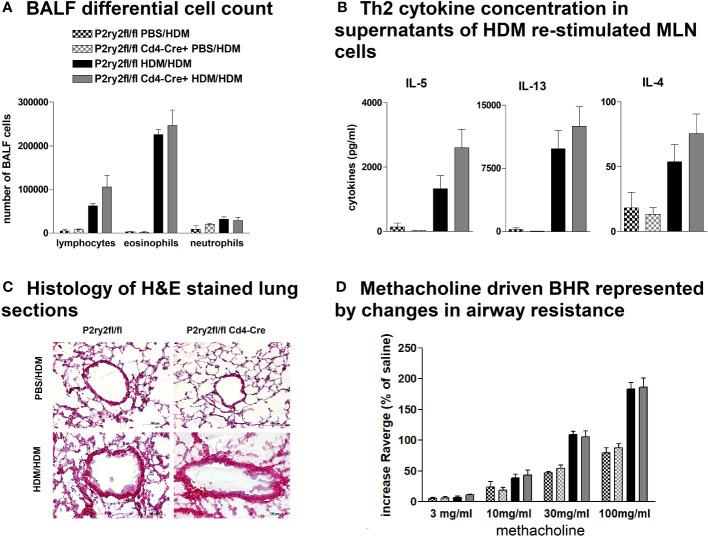
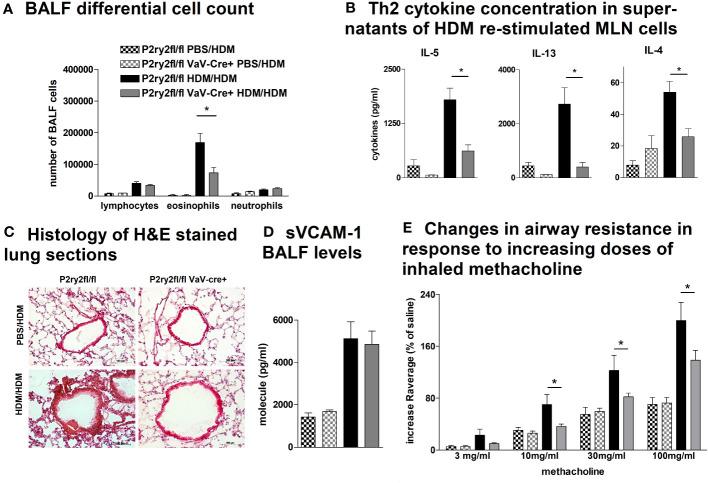
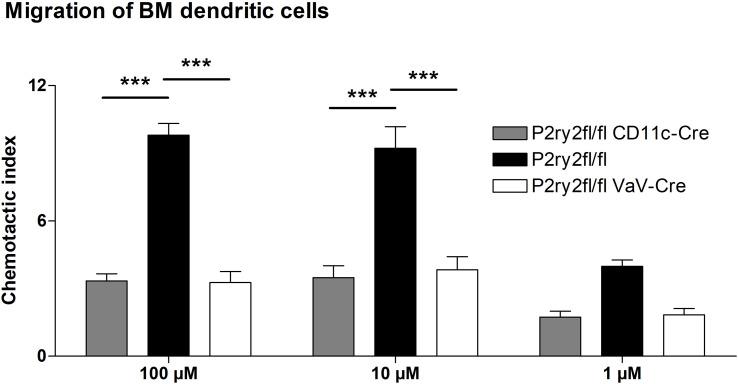
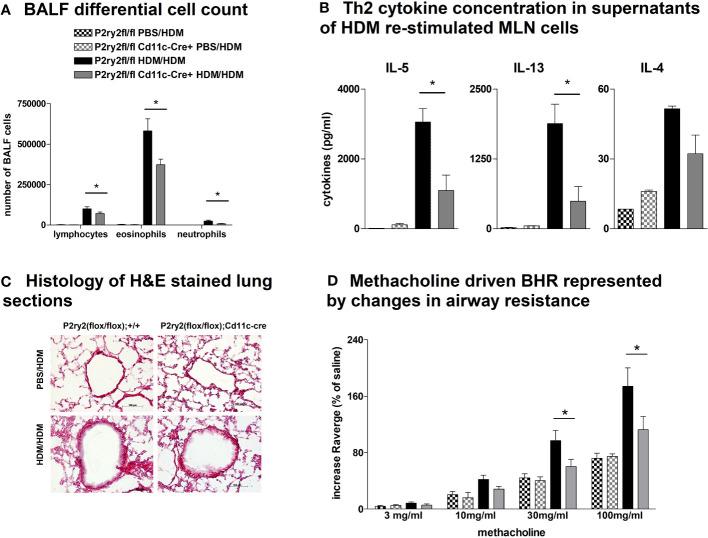
Allergic airway inflammation (AAI) is a chronic respiratory disease that is considered a severe restriction in daily life and is accompanied by a constant risk of acute aggravation. It is characterized by IgE-dependent activation of mast cells, infiltration of eosinophils, and activated T-helper cell type 2 (Th2) lymphocytes into airway mucosa. Purinergic receptor signaling is known to play a crucial role in inducing and maintaining allergic airway inflammation. Previous studies in an ovalbumin (OVA)-alum mouse model demonstrated a contribution of the P2Y2 purinergic receptor subtype (P2RY2) in allergic airway inflammation. However, conflicting data concerning the mechanism by which P2RY2 triggers AAI has been reported. Thus, we aimed at elucidating the cell-type-specific role of P2RY2 signaling in house dust mite (HDM)-driven model of allergic airway inflammation. Thereupon, HDM-driven AAI was induced in conditional knockout mice, deficient or intact for in either alveolar epithelial cells, hematopoietic cells, myeloid cells, helper T cells, or dendritic cells. To analyze the functional role of P2RY2 in these mice models, flow cytometry of bronchoalveolar lavage fluid (BALF), cytokine measurement of BALF, invasive lung function measurement, HDM re-stimulation of mediastinal lymph node (MLN) cells, and lung histology were performed. Mice that were subjected to an HDM-based model of allergic airway inflammation resulted in reduced signs of acute airway inflammation including eosinophilia in BALF, peribronchial inflammation, Th2 cytokine production, and bronchial hyperresponsiveness in mice deficient for in alveolar epithelial cells, hematopoietic cells, myeloid cells, or dendritic cells. Furthermore, the migration of bone-marrow-derived dendritic cells and bone-marrow-derived monocytes, both deficient in , towards ATP was impaired. Additionally, we found reduced levels of MCP-1/CCL2 and IL-8 homologues in the BALF of mice deficient in in myeloid cells and lower concentrations of IL-33 in the lung tissue of mice deficient in in alveolar epithelial cells. In summary, our results show that P2RY2 contributes to HDM-induced airway inflammation by mediating proinflammatory cytokine production in airway epithelial cells, monocytes, and dendritic cells and drives the recruitment of lung dendritic cells and monocytes.
变应性气道炎症(AAI)是一种慢性呼吸道疾病,被认为严重限制了日常生活,并且伴随着持续的急性加重风险。它的特征是 IgE 依赖性的肥大细胞激活、嗜酸性粒细胞浸润和辅助性 T 细胞 2(Th2)淋巴细胞浸润到气道黏膜。嘌呤能受体信号被认为在诱导和维持变应性气道炎症中发挥关键作用。先前在卵清蛋白(OVA)-明矾小鼠模型中的研究表明,P2Y2 嘌呤能受体亚型(P2RY2)在变应性气道炎症中发挥作用。然而,关于 P2RY2 触发 AAI 的机制的研究结果存在矛盾。因此,我们旨在阐明 P2RY2 信号在屋尘螨(HDM)驱动的变应性气道炎症模型中的细胞类型特异性作用。因此,在条件性敲除小鼠中诱导 HDM 驱动的 AAI,这些小鼠缺乏或完整地表达肺泡上皮细胞、造血细胞、髓样细胞、辅助性 T 细胞或树突状细胞中的 。为了分析 P2RY2 在这些小鼠模型中的功能作用,我们进行了支气管肺泡灌洗液(BALF)的流式细胞术、BALF 中细胞因子的测量、肺功能的侵入性测量、HDM 重新刺激纵隔淋巴结(MLN)细胞以及肺组织学分析。在缺乏肺泡上皮细胞、造血细胞、髓样细胞或树突状细胞中的 时,接受基于 HDM 的变应性气道炎症模型的小鼠表现出急性气道炎症的迹象减轻,包括 BALF 中的嗜酸性粒细胞增多、支气管周围炎症、Th2 细胞因子产生和支气管高反应性。此外,骨髓来源的树突状细胞和骨髓来源的单核细胞向 ATP 的迁移受损,这两种细胞都缺乏 。此外,我们发现缺乏髓样细胞中的 时,BALF 中的 MCP-1/CCL2 和 IL-8 同系物水平降低,肺泡上皮细胞中缺乏 时肺组织中的 IL-33 浓度降低。总之,我们的结果表明,P2RY2 通过介导气道上皮细胞、单核细胞和树突状细胞中促炎细胞因子的产生,以及驱动肺树突状细胞和单核细胞的募集,促进 HDM 诱导的气道炎症。


 Zotero 插件