
JNKs通过调节Apelin信号通路来保护机体免受胆汁淤积性肝病进展的影响。
JNKs protect from cholestatic liver disease progression by modulating Apelin signalling.
作者信息
Mohamed Mohamed Ramadan, Haybaeck Johannes, Wu Hanghang, Su Huan, Bartneck Matthias, Lin Cheng, Boekschoten Mark V, Boor Peter, Goeppert Benjamin, Rupp Christian, Strnad Pavel, Davis Roger J, Cubero Francisco Javier, Trautwein Christian
机构信息
Department of Internal Medicine III, University Hospital, RWTH Aachen, Aachen, Germany.
Institute of Pathology, Neuropathology and Molecular Pathology, Medical University of Innsbruck, Innsbruck, Austria.
出版信息
JHEP Rep. 2023 Jul 18;5(11):100854. doi: 10.1016/j.jhepr.2023.100854. eCollection 2023 Nov.
BACKGROUND & AIMS: Cholestatic liver injury is associated with c-Jun N-terminal kinases (JNK) activation in distinct cell types. Its hepatocyte-specific function during cholestasis, however, has not yet been established. Therefore, in our present study, we investigated the role of JNK1/2 during cholestasis and dissected its hepatocyte-specific function.
METHODS
A cohort of patients with primary biliary cholangitis (n = 29) and primary sclerosing cholangitis (n = 37) was examined. Wild-type, hepatocyte-specific knockout mice for () or and () were generated. Mice were subjected to bile duct ligation (BDL) or carbon tetrachloride (CCl) treatment. Finally, Apelin signalling was blocked using a specific inhibitor. As an interventional approach, were silenced in wild-type mice using lipid nanoparticles for small interfering RNA delivery.
RESULTS
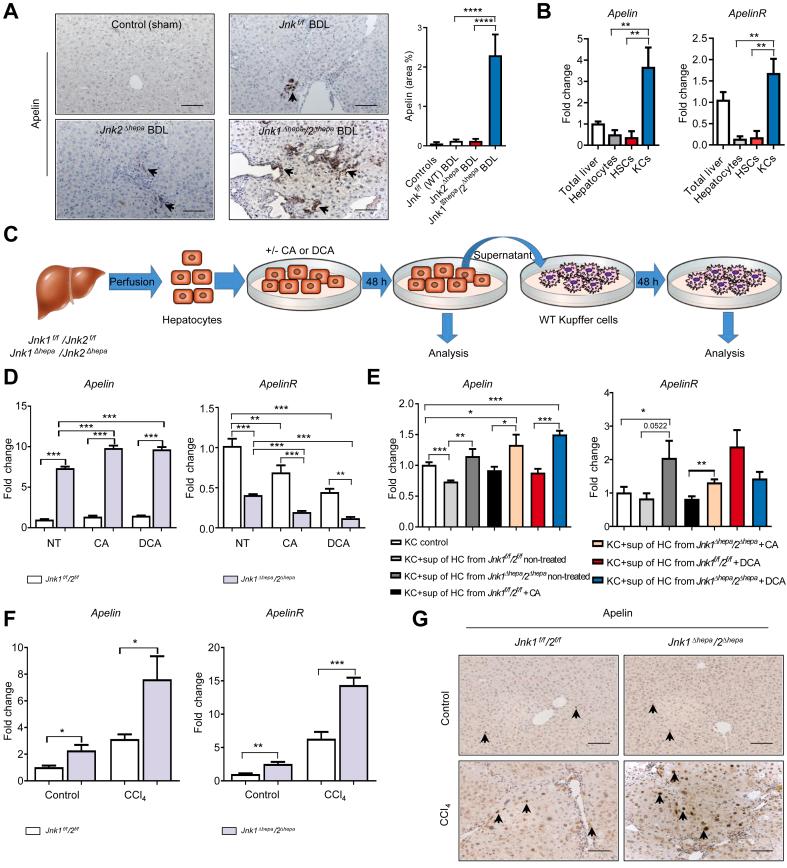
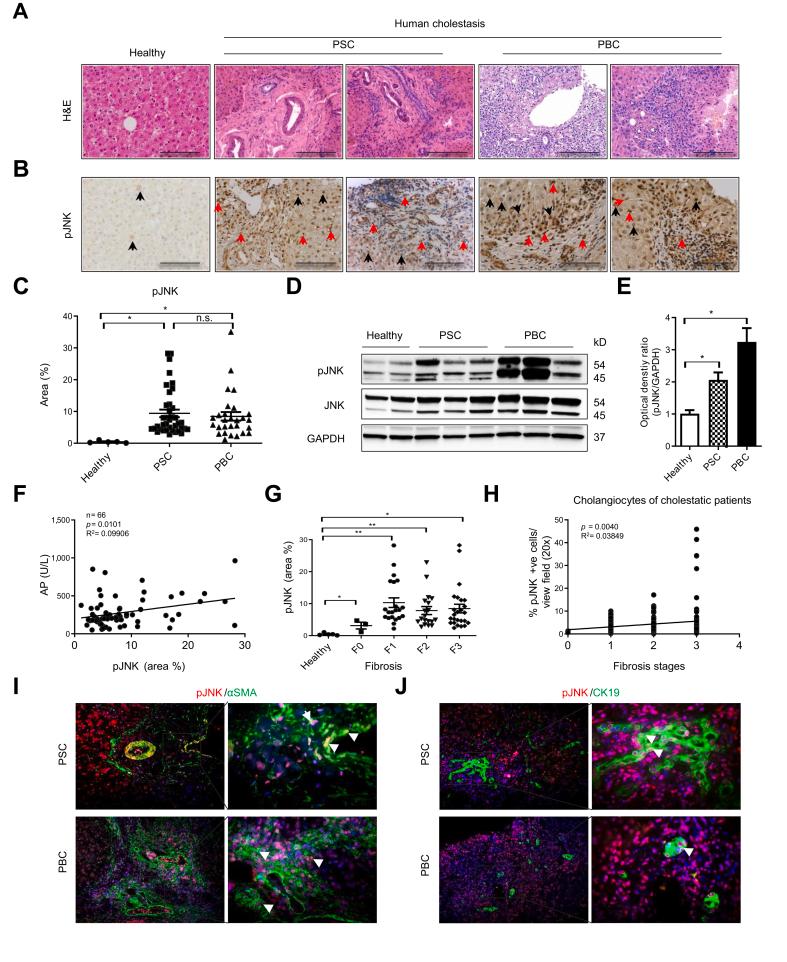
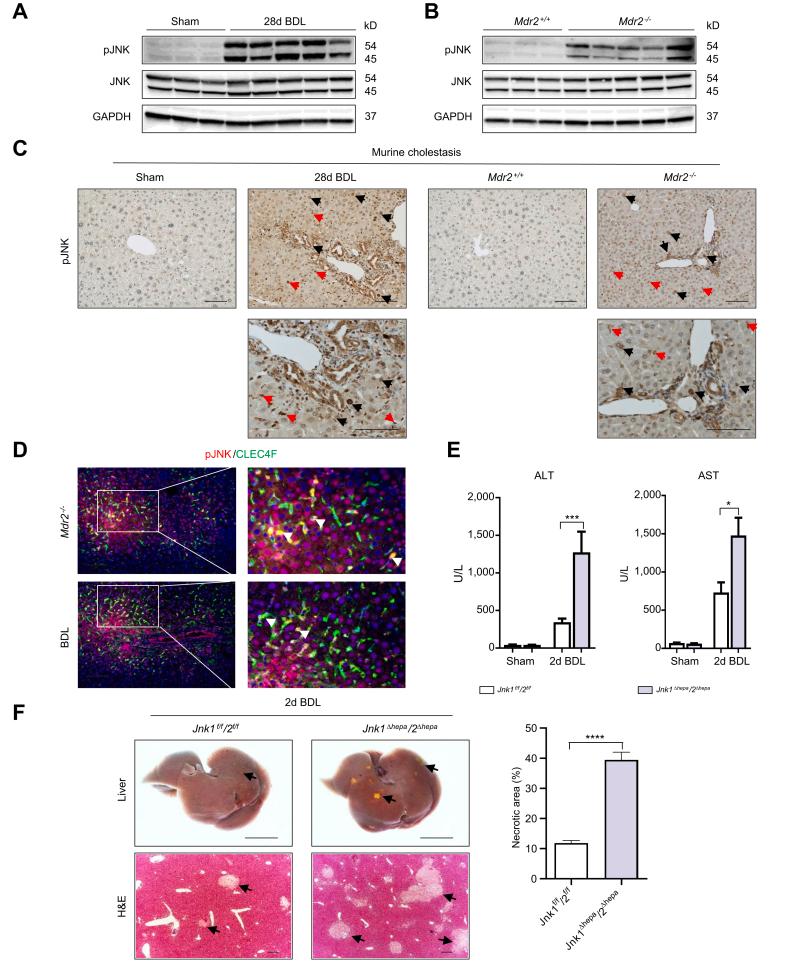
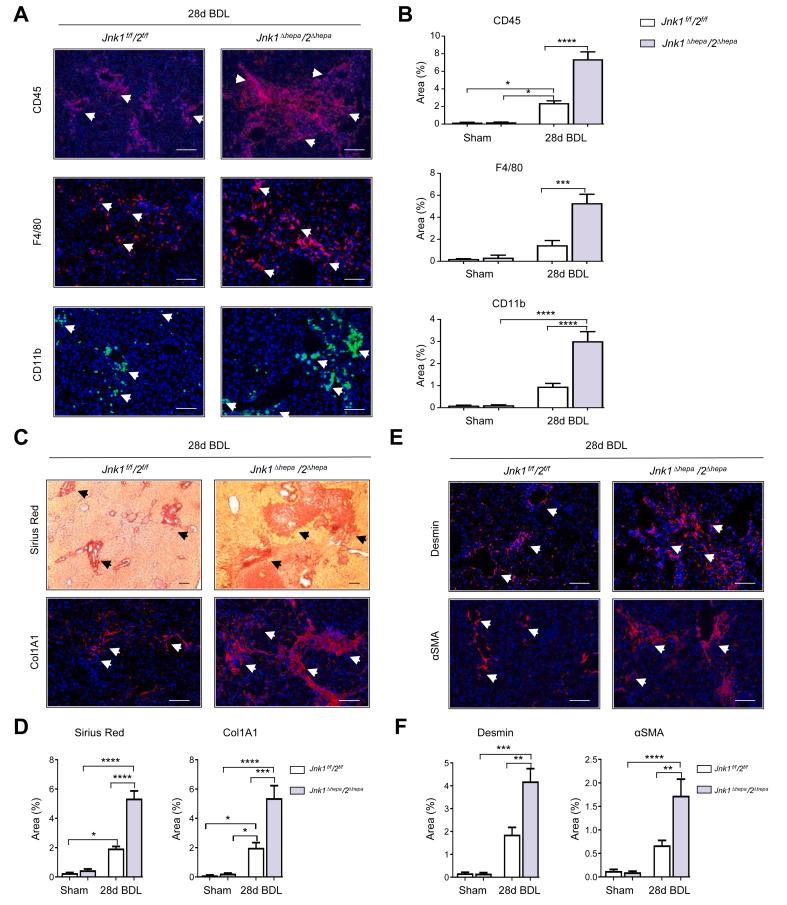
JNK activation was increased in liver specimens from patients with chronic cholestasis (primary biliary cholangitis and primary sclerosing cholangitis) and in livers of and BDL-treated animals. In animals, serum transaminases increased after BDL, and liver histology demonstrated enhanced cell death, compensatory proliferation, hepatic fibrogenesis, and inflammation. Furthermore, microarray analysis revealed that hepatocytic ablation induces JNK-target genes involved in oxidative stress and Apelin signalling after BDL. Consequently, blocking Apelin signalling attenuated BDL-induced liver injury and fibrosis in mice. Finally, we established an interventional small interfering RNA approach of selective targeting in hepatocytes , further demonstrating the essential protective role of during cholestasis.
CONCLUSIONS
and work together to protect hepatocytes from cholestatic liver disease by controlling Apelin signalling. Dual modification of JNK signalling in hepatocytes is feasible, and enhancing its expression might be an attractive therapeutic approach for cholestatic liver disease.
IMPACT AND IMPLICATIONS
The cell-specific function of genes during cholestasis has not been explicitly explored. In this study, we showed that combined , but not deficiency, in hepatocytes exacerbates liver damage and fibrosis by enhancing Apelin signalling, which contributes to cholestasis progression. Combined cell-specific Jnk targeting may be a new molecular strategy for treating cholestatic liver disease.
背景与目的
胆汁淤积性肝损伤与不同细胞类型中的c-Jun氨基末端激酶(JNK)激活有关。然而,其在胆汁淤积期间的肝细胞特异性功能尚未明确。因此,在本研究中,我们研究了JNK1/2在胆汁淤积中的作用,并剖析了其肝细胞特异性功能。
方法
对一组原发性胆汁性胆管炎患者(n = 29)和原发性硬化性胆管炎患者(n = 37)进行检查。构建野生型、肝细胞特异性敲除( )或 与 双敲除( )小鼠。对小鼠进行胆管结扎(BDL)或四氯化碳(CCl)处理。最后,使用特异性抑制剂阻断Apelin信号通路。作为一种干预方法,使用脂质纳米颗粒将 沉默于野生型小鼠中以递送小干扰RNA。
结果
慢性胆汁淤积患者(原发性胆汁性胆管炎和原发性硬化性胆管炎)肝脏标本以及 小鼠和BDL处理动物肝脏中的JNK激活增加。在 小鼠中,BDL后血清转氨酶升高,肝脏组织学显示细胞死亡增加、代偿性增殖、肝纤维化和炎症增强。此外,微阵列分析显示,肝细胞特异性敲除 会诱导BDL后参与氧化应激和Apelin信号通路的JNK靶基因表达。因此,阻断Apelin信号通路可减轻BDL诱导的 小鼠肝损伤和纤维化。最后,我们建立了一种在肝细胞中选择性靶向 的干预性小干扰RNA方法,进一步证明了 在胆汁淤积期间的重要保护作用。
结论
和 共同作用,通过控制Apelin信号通路保护肝细胞免受胆汁淤积性肝病的侵害。肝细胞中JNK信号通路的双重修饰是可行的,增强其表达可能是胆汁淤积性肝病一种有吸引力的治疗方法。
影响与意义
尚未明确探索 基因在胆汁淤积期间的细胞特异性功能。在本研究中,我们表明肝细胞中 联合缺失(而非单一缺失)会通过增强Apelin信号通路加重肝损伤和纤维化,这促进了胆汁淤积的进展。联合细胞特异性Jnk靶向可能是治疗胆汁淤积性肝病的一种新分子策略。



 Zotero 插件