
印度头颈癌负担:基于37个基于人群的癌症登记处已发表数据的分析
Head and neck cancer burden in India: an analysis from published data of 37 population-based cancer registries.
作者信息
Bagal Sonali, Budukh Atul, Thakur Jarnail Singh, Dora Tapas, Qayyumi Burhanuddin, Khanna Divya, Fernandes Dolorosa, Chakravarti Priyal, Singh Ravikant, Patil Suvarna, Dikshit Rajesh, Chaturvedi Pankaj
机构信息
Centre for Cancer Epidemiology (CCE), Advance Centre for Treatment, Research and Education in Cancer (ACTREC), Tata Memorial Centre (TMC), Navi Mumbai 410210, India.
https://orcid.org/0000-0002-2510-1751.
出版信息
Ecancermedicalscience. 2023 Sep 21;17:1603. doi: 10.3332/ecancer.2023.1603. eCollection 2023.
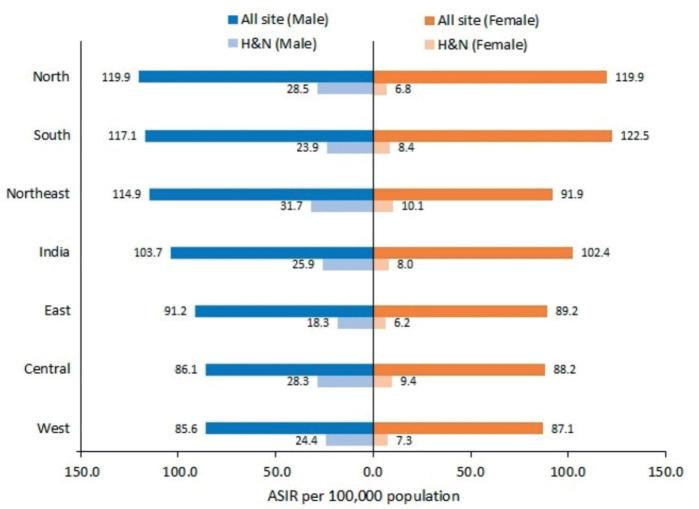
Head and neck cancer (HNC) is a major public health problem in India. This article presents the HNC burden in different regions of India. The published population-based cancer registries (PBCRs) data from the National Cancer Registry Programme, Bengaluru, and the Tata Memorial Centre, Mumbai, India, were utilised. The 37 PBCRs were divided into six regions including central, east, north, northeast, west and south. The age-standardised incidence rate of HNC was 25.9 (95% CI 25.7-26.1) and 8.0 (95% CI 7.9-8.1) per 100,000 population, respectively, in males and females. HNC accounted for about 26% of all cancer cases in males and 8% in females. The risk of developing HNC was 1 in 33 for males and 1 in 107 for females. The northeastern registries reported the highest incidence rate 31.7 per 100,000 population in males followed by northern (28.5), central (28.3), western (24.4), southern (23.9) and eastern (18.3). In females, the incidence was in the range of 6.2-10.1 per 100,000 population. For all PBCRs together, the HNC burden was two to three times higher in the age group 60+ as compared to 20-39 years. The HNC burden in India is higher than in the USA, UK, Australia, Africa and Brazil. The PBCRs from the south-east Asia region such as the Colombo district, Sri Lanka, as well as Siraha, Saptari, Dhanusha and Mohattari - Nepal have also reported a high burden of HNC. All regions reported mouth as a leading cancer site followed by tongue, larynx, hypopharynx and tonsil except the northeastern region registries where hypopharynx was the top leading cancer. The burden of other sites of HNC is low. Raising awareness of the disease and associated risk factors, providing early detection services, as well as easy access to diagnosis and treatment are required. The government should focus on building the infrastructure and capacity building to control this disease.
头颈癌(HNC)是印度一个主要的公共卫生问题。本文介绍了印度不同地区的头颈癌负担情况。利用了来自印度班加罗尔国家癌症登记计划以及孟买塔塔纪念中心已发表的基于人群的癌症登记处(PBCRs)数据。37个PBCRs被划分为六个地区,包括中部、东部、北部、东北部、西部和南部。头颈癌的年龄标准化发病率在男性中为每10万人口25.9(95%可信区间25.7 - 26.1),在女性中为每10万人口8.0(95%可信区间7.9 - 8.1)。头颈癌分别占男性所有癌症病例的约26%和女性的8%。男性患头颈癌的风险为1/33,女性为1/107。东北部登记处报告的发病率最高,男性为每10万人口31.7,其次是北部(28.5)、中部(28.3)、西部(24.4)、南部(23.9)和东部(18.3)。在女性中,发病率为每10万人口6.2 - 10.1。对于所有PBCRs而言,60岁及以上年龄组的头颈癌负担比20 - 39岁年龄组高两到三倍。印度的头颈癌负担高于美国、英国、澳大利亚、非洲和巴西。来自东南亚地区如斯里兰卡科伦坡区以及尼泊尔的锡拉哈、萨普塔里、达努沙和莫哈塔里的PBCRs也报告了较高的头颈癌负担。除了东北部地区登记处下咽癌是首要的主要癌症外,所有地区均报告口腔是主要的癌症部位,其次是舌、喉、下咽和扁桃体。头颈癌其他部位的负担较低。需要提高对该疾病及其相关风险因素 的认识,提供早期检测服务,以及方便的诊断和治疗途径。政府应专注于基础设施建设和能力建设以控制这种疾病。


 Zotero 插件