
马尔堡病毒在非洲的兴起:呼吁全球做好准备。
Rise of Marburg virus in Africa: a call for global preparedness.
作者信息
Okesanya Olalekan J, Manirambona Emery, Olaleke Noah O, Osumanu Hisham A, Faniyi Ayodeji A, Bouaddi Oumnia, Gbolahan Olatunji, Lasala Jose J, Lucero-Prisno Don E
机构信息
Department of Medical Laboratory Science, Neuropsychiatric Hospital, Aro, Abeokuta.
College of Medicine and Health Sciences, University of Rwanda, Kigali, Rwanda.
出版信息
Ann Med Surg (Lond). 2023 Sep 1;85(10):5285-5290. doi: 10.1097/MS9.0000000000001257. eCollection 2023 Oct.
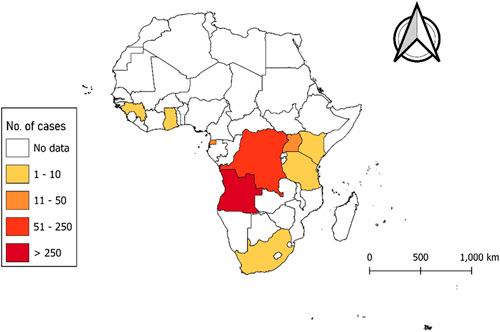
The Marburg virus disease (MVD) is caused by a rare RNA virus that can result in severe hemorrhagic fever in humans and other primates. The disease was first discovered in 1967 in Marburg Frankfurt in Germany and since then, sporadic cases have been reported in southeastern Africa. The Egyptian fruit bat is considered a reservoir for the virus, which can be transmitted through direct contact with infected bat or monkey tissue, bodily fluids, or contaminated objects. The Marburg virus disease shares clinical features with the Ebola virus disease, and there are no widely accepted vaccines or antiviral medications to treat it. The article provides an overview of Marburg virus (MARV) outbreaks in Africa, including the most recent outbreaks in Guinea, Ghana, Equatorial Guinea, and Tanzania. The authors discuss the recent outbreaks and the implications of the spread of MARV to Africa's healthcare systems. The authors also present key recommendations for both multicountry and global preparedness efforts in order to better prevent and respond to future MARV outbreaks and other viruses with an epidemic potential.
马尔堡病毒病(MVD)由一种罕见的RNA病毒引起,可导致人类和其他灵长类动物患上严重出血热。该疾病于1967年在德国法兰克福的马尔堡首次发现,自那时起,非洲东南部陆续报告了散发病例。埃及果蝠被认为是该病毒的宿主,该病毒可通过直接接触受感染的蝙蝠或猴子组织、体液或受污染的物体进行传播。马尔堡病毒病与埃博拉病毒病具有相同的临床特征,目前尚无广泛认可的疫苗或抗病毒药物可用于治疗。本文概述了非洲的马尔堡病毒(MARV)疫情,包括几内亚、加纳、赤道几内亚和坦桑尼亚最近的疫情。作者讨论了近期疫情以及MARV传播对非洲医疗系统的影响。作者还提出了针对多国和全球防范工作的关键建议,以便更好地预防和应对未来的MARV疫情以及其他具有流行潜力的病毒。


 Zotero 插件